Click for more.
A Brief Overview of Porsche Endurance Racing
• For 75 years, Porsche says with justification that it has been writing motorsport history. The first chapter is considered to be the 24 Hours of Le Mans in 1951, where a factory-prepared Porsche 356 SL achieved a class victory in the hands of a customer team. Porsche’s triumphs at Daytona begins a few years later, on 5 April 1959. A couple of months after the official opening Daytona International Speedway, the United States Auto Club (USAC) staged its first sports car race. Ture to its origins, the race course was a combination of the NASCAR oval and the infield road course. The championship race, originally scheduled to run over 1000 kilometers, is stopped after six hours due to nightfall. The winners come from Argentina – and they are driving a Porsche: Roberto Mieres and Antonio von Döry take victory in a 718 RSK ahead of the Porsche driven by Americans Bob Said and Art Bunker. Because of the sanctioning body, this race does not appear in the official IMSA statistics Porsche notes.
• IMSA’s official Daytona history begins in 1962 – although the championship round was not a 24-hour race. In that year and the following season, the race ran over three hours, before being extended to a distance of 2000 kilometers in 1964 and 1965. Porsche on 4 February 1968 took its first overall victory: Entered by the Porsche System Engineering works team, a 907 LH crosses the finish line, followed by two identical sister cars. A curious detail: On the instructions of then Porsche race director Huschke von Hanstein, works drivers Jo Siffert, Rolf Stommelen and Hans Herrmann also take turns driving the leading No. 54 car of Vic Elford and Jochen Neerpasch for five laps each in the closing stages – meaning that the trio are also officially classified as winners of the race. Siffert and Herrmann also step onto the podium a second time as runners-up.
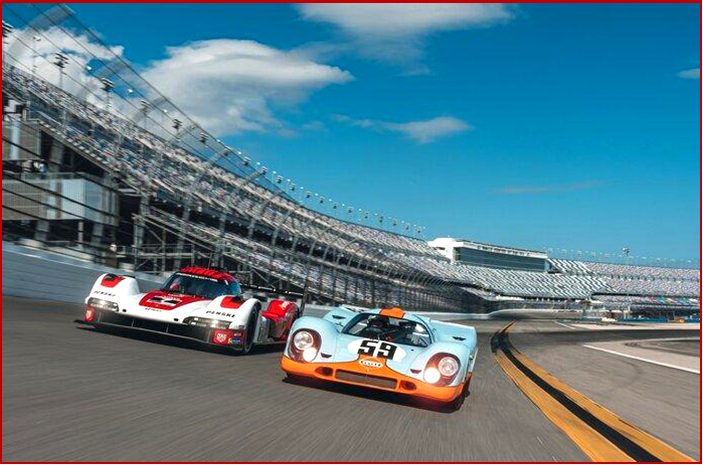
• At the start of the 1970s, the Porsche 917 KH entered by John Wyer Engineering became legendary, winning the 24 Hours of Daytona in 1970 and 1971 in what is still fondly remember Gulf livery, battling Ferrari. After a six-hour race in 1972, Porsche celebrates another triumph the following year: In 1973, the Porsche 911 Carrera RSR of Daytona record winner Hurley Haywood and his partner and Brumos boss Peter Gregg defeats strong opposition. “It is the first victory for the legendary Brumos Porsche team, which shapes the history of Daytona like no other. Further 911 Carrera RSR victories follow in 1975 and 1977. An unparalleled winning streak then begins, lasting until 1987: initially with derivatives of the 935, followed by the 962 – interrupted only by a March victory in 1984, albeit powered by a Porsche engine,” Porsche said.
“The Porsche engineers always had an innovative answer to every challenge back then,” recalls Hurley Haywood, five-time overall winner of the 24 Hours of Daytona. He cites the 962 as an example: “The car was the response to the fact that IMSA did not allow the Porsche 956 in North America because the driver’s feet were located ahead of the front axle. Porsche simply moved the seating position further back and extended the wheelbase – and with the 962, one of the most successful race cars of all time was born.”