
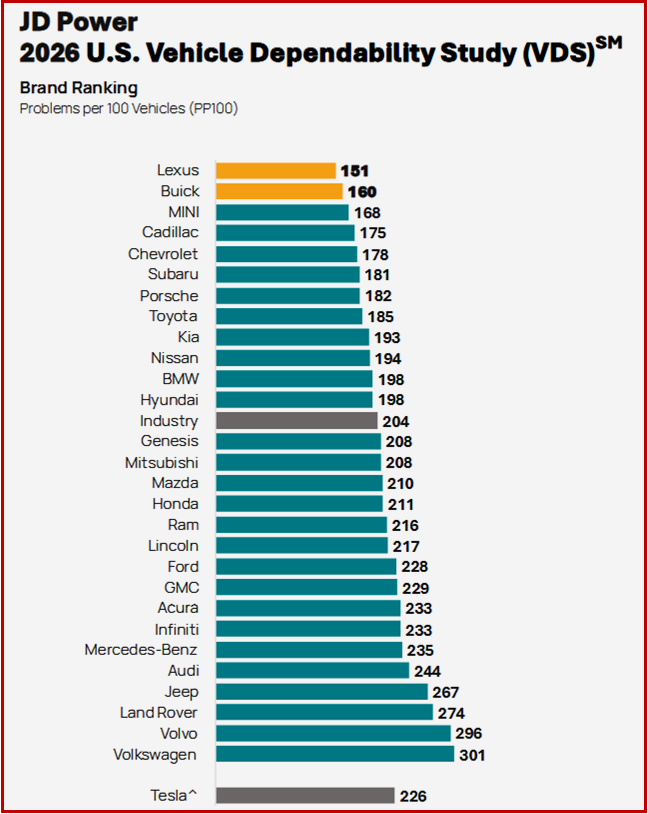
Click for more.
“As owners hold onto their vehicles longer, the long-term ownership experience matters more than ever,” said Jason Norton, director of auto benchmarking at J.D. Power. “Software updates and new technologies should enhance the ownership experience over time, yet many vehicle owners cite ongoing mobile phone integration problems and little to no benefit after an update is performed. Much of this comes down to owner education and ongoing communication. Automakers should focus on delivering meaningful improvements and clearly communicating the intended benefits of software updates so owners understand how they are designed to enhance their vehicle and ownership experience.”
Key Findings of the 2026 U.S. Vehicle Dependability StudySM
• Premium segment sees rising issues: After 2 years of stability, problems among premium vehicles have jumped 8 PP100 year over year to 217 PP100—the highest since the study’s 2022 redesign. The gap between premium and mass market vehicles has widened to 17 PP100, with premium underperforming mass market in seven of the nine study categories, notably in features/controls/displays (FCD) (5.8 PP100 delta) and driving experience (3.4 PP100 delta). Only the powertrain and seats categories show better performance among premium makes.
• OTA software updates deliver mixed results: As vehicles become more software-driven, receiving updates is now a routine experience for many owners, with 40% saying they received a software update in the past 12 months. Of those owners, only 27% say the update improved their vehicle, while 58% say they perceived no noticeable difference. More than half (63%) of the software updates were performed OTA and resulted in a nearly 14% increase in problems this year (2.5 PP100).
• Mobile phone integration drives top industry problems: Of the top five industry problems, four are directly related to owner integration of mobile phones to their vehicles, including the top issue in the industry for a third consecutive year—Android Auto and Apple CarPlay connectivity (8.9 PP100). Coupled with built-in Bluetooth systems (5.5 PP100), wireless charging pads (5.1 PP100), and OEM app connectivity (4.7 PP100), these issues account for 24.2 PP100, nearly half of the infotainment category problems in total. Issues with the vehicle exterior, such as abnormal noises, also contribute to the overall increase in reported problems.
• Problems increase across all electrified powertrain types: Plug-in hybrid electric vehicles (PHEVs) remain the most problematic of any powertrain type in the study, increasing 39 PP100 year over year to 281 PP100. Problems among battery electric vehicles (BEVs) and hybrids also increase by 14 PP100 each to 237 PP100 and 213 PP100, respectively. By contrast, the long-term dependability of gas-powered vehicles improves slightly by 2 PP100 to 198 PP100—the least problematic among all powertrains.







