
Click for more.
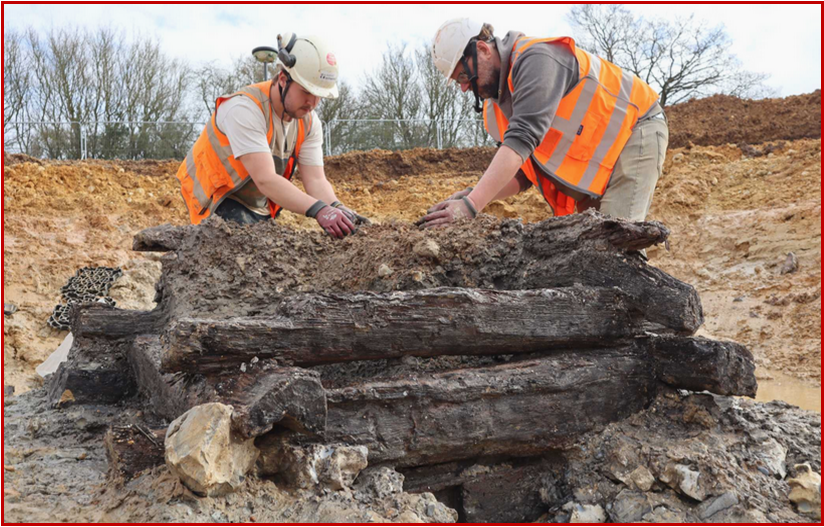
The timbers found at the Home of Rolls-Royce extension site originated from the base of the well and would have been permanently waterlogged; the timber bracing would have extended to ground level. The timbers are now being sampled for dendrochronological dating, which involves counting the rings to help determine the year in which the trees were felled. Further analysis should reveal the kinds of tools used to work the timbers; it may even be possible to reconstruct the forms of the trees from which the timbers were cut, providing insight into how woodlands were being managed and felled in the locality.
The Home of Rolls-Royce lies on the outskirts of Chichester. The area was occupied sometime from the mid-1st century when the Romans established the settlement that was known as Noviomagus Reginorum until the end of their rule in Britain in the early 5th century. “Noviomagus” is thought to mean New Market in Latin and Reginorum refers to the Regni, the local Celtic tribe allied with Rome. In addition to the well, the dig has revealed evidence of human activity dating back to the Neolithic period (4000-2200 BCE), including tools and pottery.
The artefacts are currently undergoing further study and cataloguing to develop a more detailed understanding of life in the local area over the past six millennia. One early hypothesis is that the site was once used for metal-working activities. If confirmed, this would suggest that Rolls-Royce is continuing a long, but overlooked, tradition in this part of southern England.