Click for more.
How Road Hazard Warnings Work
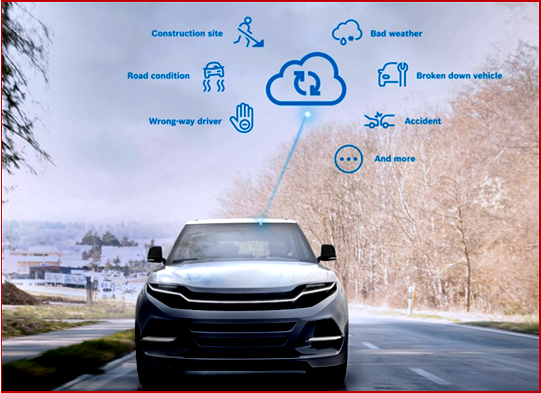
Bosch says it combines anonymized real-time data from a worldwide fleet of millions of connected vehicles with information from third-party providers such as weather services and road operators. “These sources together provide a highly precise, current overview of the road conditions, which forms the basis for reliable warnings. Driver assistance systems such as adaptive cruise control (ACC) and emergency braking assist can also use the predictive warnings to respond even more safely and precisely.”
In practice, an algorithm continuously analyzes and combines the incoming vehicle data, such as control interventions by the electronic stability program (DSC) and the activity of the windshield wipers. If the system determines, for example, that many vehicles in one region are using the windshield wipers on the highest setting and weather data is reporting heavy rain, the system concludes that there is a risk of hydroplaning. Affected drivers then receive an early warning and can adjust their speed in time. The quality of the predictions is continuously validated by Bosch’s own test fleet, which is equipped with special sensors. In addition, external sources such as webcams along the roads verify the emitted warnings.







