Click for more.
“The fuel cell is the perfect complement to battery-electric powertrains – even in bus operations,” said Thomas Pauer, member of the Bosch Mobility sector board and president of Bosch Power Solutions.*
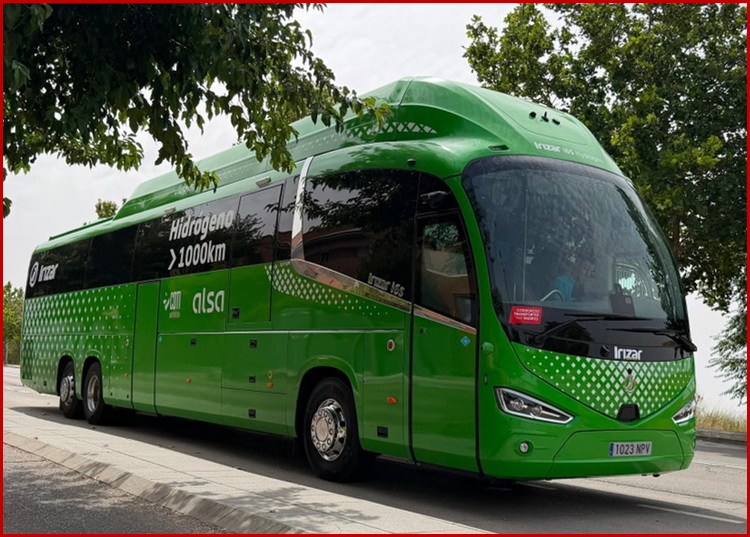
In Europe, demands on urban public transit is growing because of mandatory EU requirements to reduce carbon emissions from city buses by 90% by 2030. The test bus is equipped with the FCPM C190 fuel-cell system from Bosch. This compact system is based on a horizontal double stack and delivers a continuous output of 190 kilowatts. With the available hydrogen tank capacity, ranges of more than 1000 kilometers are possible, with refueling times of just 10 to 15 minutes. Therefore, the bus can also be used for intercity service including ultimately moving people away from out of control wildfires.
In addition to the FCPM C190, Bosch also offers the FCPM C300, a system designed for heavy-duty tour buses and trucks. The portfolio is rounded off by the FCPM C100, which, with a continuous power output of 100 kilowatts and a flat design, is the ideal solution for city buses.
“Bosch is strongly committed to building an H2 economy, and is developing technical solutions for the production, infrastructure, and use of hydrogen. In 2025, the company announced the launch of its Hybrion PEM electrolysis stack for hydrogen production. Bosch is also working on technology for hydrogen engines and offers corresponding components for port and direct injection,” Bosch said.







