
The original 1965 Shelby GT350 established Mustang’s performance rep. Early in the development of this GT350, engineers decided a high-revving, naturally-aspirated V8 engine was best. This runs contrary to Ford’s EcoBoost strategy that uses turbocharging to increase the output of small displacement engines.
An all-new Ford V8 for Shelby GT350 and GT350R pony cars is the most power-dense as well as the highest output naturally aspirated road-legal engine in Ford history. With 526 horsepower and 429 lb.-ft. of torque made possible by a redline of 8,250 rpm, the result of a so-called flat-plane crankshaft that is lighter than a traditional cross plane one.
Unknown at this time is whether the notorious weaknesses of a flat plane crankshaft engine – vibration and an odd exhaust sound – are acceptable to street drivers as opposed racing applications where they are common.
The usual cross-plane crankshaft, such as the ones used in Ford’s original flathead V8 engine starting in 1932 or the Chevy small-block V8 that debuted in 1955, attach the piston connecting rods to the crankshaft at 90-degree intervals, creating a “cross” of counterweights when viewed down the axis of the crankshaft.
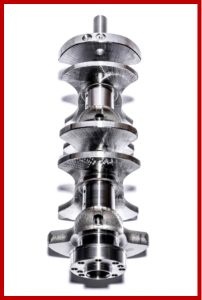
The new 5.2-liter engine is the first-ever production V8 from Ford with a flat-plane crankshaft, an architecture typically found only in racing applications.
In the new 5.2-liter Ford V8, the connecting rods attach to the flat-plane crankshaft at aligned 180-degree intervals – creating what looks like a flat line of counterweights when viewed down the axis of the crankshaft.
This flat-plane crankshaft also helps improve cylinder exhaust-pulse separation by allowing a firing order that alternates ignition between the V8’s two cylinder banks. This can improve engine breathing, and subsequently allow the engine to produce more power. However, the design does change the beloved loping exhaust rumble of a high performance American V8 as noted.
Other aspects of the new 5.2-liter V8 (displacement is 5,163 cubic centimeters) include a slightly oversquare bore and stroke of 94×93 millimeters, and a 12:1 compression ratio. Camshafts develop a massive 14 millimeters of lift for both the hollow-stem intake valves and sodium-filled exhaust valves. A single 87-millimeter throttle body – the largest ever used for a Ford engine – feeds air to the engine, allowing for a simpler, lighter intake.
In both Shelby GT350 and Shelby GT350R, the 5.2-liter will be paired with a six-speed manual transmission as its only gearbox option. The Tremec TR-3160 six-speed is engineered for less mass and high-rpm application in the new Shelby Mustangs. The six-speed features a lightweight, die-cast aluminum case and clutch housing for increased overall powertrain stiffness. Gear cross-sections, the dual-mass flywheel and dual-disc clutch are all optimized for an overall reduction in inertia and weight.