Click for more information.
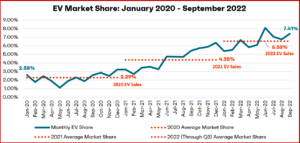
During the third quarter of 2022, more than 232,000 electric vehicles were sold in the United States, representing 7.1% of overall light-duty vehicle sales. EVs include battery, plug-in hybrid, and fuel-cell electric vehicles. This is a 2.14 percentage point (pp) increase compared to Q3 of 2021, and a 0.42 pp increase from the Q2 of 2022, according to data released today by the Alliance for Automotive Innovation, an industry trade group in Washington, DC.*
The cost of the average EV in the third quarter of 2022 was about $66,100 while the average cost of all new light-duty vehicles in that time period was about $48,000. Year-over-year, EV prices rose more than $12,500 from the Q3 of 2021, while the average cost of all new light vehicles rose just over $3,700.
AutoInformed thinks two factors are in play here: First demand for EVs is strong, particularly among affluent buyers. Second, EVs are more costly to develop, batteries are still expensive and the covid pandemic supply chain interruptions are making them scarce. One click bait headline had it that “EVs are Bringing Out the Worst in Us” because, among other things, a Hummer EV battery pack weighs as much as a Honda Civic. It consumes minerals that could otherwise be used to build several electric-sedan batteries or hundreds upon hundreds of e-bike batteries.
Perhaps such thinkers are unaware of the ongoing mood amongst that tawdry cast of Capital characters along the banks of the Potomac who will not legislate SUVs and Pickup trucks out of existence. Yes, Virginia there is a Santos clause and his party wants to legislate the government out of business.
More than 652,000 EVs were sold in the first three quarters of 2022, totaling 6.53% of all light vehicle sales and an increased market share of 3.0 pp compared to the first three quarters of 2021. The total volume of all light-duty sales for the first three quarters of the year is down 17% from the same period a year ago, while the volume for EVs increased 40% (an increase of 184,884 vehicles), admittedly from a small base, but healthy growth all things considered.
Significantly, this trend is a subject of much concern among environmentalists. Passenger cars once dominated the EV market, but makers continue to introduce new models in higher volume segments. Duh. Utility vehicle (UV) offerings are growing rapidly. Moreover, electric pickup trucks are a relatively new entry to the market (their commercial debut was September 2021), with many more models and deliveries now expected in the short-term.
The upshot: non-car segments are continuing to make gains, and in the third quarter of 2022, light truck (UVs, minivans, and pickups) sales comprised more than 68% of the EV market. Quarterly sales of BEV and PHEV UVs have grown from about 19% of EVs at the start of 2020 to 61% in the third quarter of 2022 (averaging 55% of EV sales for all of 2021). The faux argument is, based partly on wishful thinking in our view, that moving EV production in to larger vehicle segments is self-defeating because they are inherently less efficient. AutoInformed disagrees. EVs are and will come. Let’s concentrate on improving EVs. Let’s not get the imperfectly wished for great get in the way of the good – ultimately for all. You cannot dissolve the people and elect new ones. You can improve their choices.
* Figures compiled by Alliance for Automotive Innovation with new registrations for retail and fleet data provided by S&P Global Mobility.

About Ken Zino
Ken Zino, editor and publisher of AutoInformed, is a versatile auto industry participant with global experience spanning decades in print and broadcast journalism, as well as social media. He has automobile testing, marketing, public relations and communications experience. He is past president of The International Motor Press Assn, the Detroit Press Club, founding member and first President of the Automotive Press Assn. He is a member of APA, IMPA and the Midwest Automotive Press Assn.
He also brings an historical perspective while citing their contemporary relevance of the work of legendary auto writers such as Ken Purdy, Jim Dunne or Jerry Flint, or writers such as Red Smith, Mark Twain, Thomas Jefferson – all to bring perspective to a chaotic automotive universe.
Above all, decades after he first drove a car, Zino still revels in the sound of the exhaust as the throttle is blipped during a downshift and the driver’s rush that occurs when the entry, apex and exit points of a turn are smoothly and swiftly crossed. It’s the beginning of a perfect lap.
AutoInformed has an editorial philosophy that loves transportation machines of all kinds while promoting critical thinking about the future use of cars and trucks.
Zino builds AutoInformed from his background in automotive journalism starting at Hearst Publishing in New York City on Motor and MotorTech Magazines and car testing where he reviewed hundreds of vehicles in his decade-long stint as the Detroit Bureau Chief of Road & Track magazine. Zino has also worked in Europe, and Asia – now the largest automotive market in the world with China at its center.








Automakers Rapidly Increasing EV Prices
Click for more information.
During the third quarter of 2022, more than 232,000 electric vehicles were sold in the United States, representing 7.1% of overall light-duty vehicle sales. EVs include battery, plug-in hybrid, and fuel-cell electric vehicles. This is a 2.14 percentage point (pp) increase compared to Q3 of 2021, and a 0.42 pp increase from the Q2 of 2022, according to data released today by the Alliance for Automotive Innovation, an industry trade group in Washington, DC.*
The cost of the average EV in the third quarter of 2022 was about $66,100 while the average cost of all new light-duty vehicles in that time period was about $48,000. Year-over-year, EV prices rose more than $12,500 from the Q3 of 2021, while the average cost of all new light vehicles rose just over $3,700.
AutoInformed thinks two factors are in play here: First demand for EVs is strong, particularly among affluent buyers. Second, EVs are more costly to develop, batteries are still expensive and the covid pandemic supply chain interruptions are making them scarce. One click bait headline had it that “EVs are Bringing Out the Worst in Us” because, among other things, a Hummer EV battery pack weighs as much as a Honda Civic. It consumes minerals that could otherwise be used to build several electric-sedan batteries or hundreds upon hundreds of e-bike batteries.
Perhaps such thinkers are unaware of the ongoing mood amongst that tawdry cast of Capital characters along the banks of the Potomac who will not legislate SUVs and Pickup trucks out of existence. Yes, Virginia there is a Santos clause and his party wants to legislate the government out of business.
More than 652,000 EVs were sold in the first three quarters of 2022, totaling 6.53% of all light vehicle sales and an increased market share of 3.0 pp compared to the first three quarters of 2021. The total volume of all light-duty sales for the first three quarters of the year is down 17% from the same period a year ago, while the volume for EVs increased 40% (an increase of 184,884 vehicles), admittedly from a small base, but healthy growth all things considered.
Significantly, this trend is a subject of much concern among environmentalists. Passenger cars once dominated the EV market, but makers continue to introduce new models in higher volume segments. Duh. Utility vehicle (UV) offerings are growing rapidly. Moreover, electric pickup trucks are a relatively new entry to the market (their commercial debut was September 2021), with many more models and deliveries now expected in the short-term.
The upshot: non-car segments are continuing to make gains, and in the third quarter of 2022, light truck (UVs, minivans, and pickups) sales comprised more than 68% of the EV market. Quarterly sales of BEV and PHEV UVs have grown from about 19% of EVs at the start of 2020 to 61% in the third quarter of 2022 (averaging 55% of EV sales for all of 2021). The faux argument is, based partly on wishful thinking in our view, that moving EV production in to larger vehicle segments is self-defeating because they are inherently less efficient. AutoInformed disagrees. EVs are and will come. Let’s concentrate on improving EVs. Let’s not get the imperfectly wished for great get in the way of the good – ultimately for all. You cannot dissolve the people and elect new ones. You can improve their choices.
* Figures compiled by Alliance for Automotive Innovation with new registrations for retail and fleet data provided by S&P Global Mobility.
About Ken Zino
Ken Zino, editor and publisher of AutoInformed, is a versatile auto industry participant with global experience spanning decades in print and broadcast journalism, as well as social media. He has automobile testing, marketing, public relations and communications experience. He is past president of The International Motor Press Assn, the Detroit Press Club, founding member and first President of the Automotive Press Assn. He is a member of APA, IMPA and the Midwest Automotive Press Assn. He also brings an historical perspective while citing their contemporary relevance of the work of legendary auto writers such as Ken Purdy, Jim Dunne or Jerry Flint, or writers such as Red Smith, Mark Twain, Thomas Jefferson – all to bring perspective to a chaotic automotive universe. Above all, decades after he first drove a car, Zino still revels in the sound of the exhaust as the throttle is blipped during a downshift and the driver’s rush that occurs when the entry, apex and exit points of a turn are smoothly and swiftly crossed. It’s the beginning of a perfect lap. AutoInformed has an editorial philosophy that loves transportation machines of all kinds while promoting critical thinking about the future use of cars and trucks. Zino builds AutoInformed from his background in automotive journalism starting at Hearst Publishing in New York City on Motor and MotorTech Magazines and car testing where he reviewed hundreds of vehicles in his decade-long stint as the Detroit Bureau Chief of Road & Track magazine. Zino has also worked in Europe, and Asia – now the largest automotive market in the world with China at its center.