Click to enlarge.
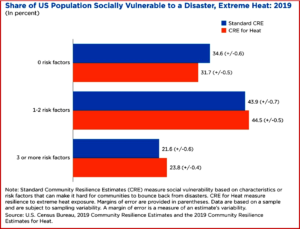
About 1 in 4 people in the United States are socially vulnerable and have low resilience to extreme heat exposure, according to new US Census Bureau data released today. The so-called “Community Resilience Estimates” (CRE)* for Heat, an awakened experimental data model released in April, measures the capacity of individuals and households in a community to withstand the stress of exposure to extreme heat based on their social characteristics.
The experimental climate-focused data product was developed with Arizona State University’s Knowledge Exchange for Resilience (KER). The product was released at a joint Census Bureau-KER climate resilience symposium in Washington, DC. The first CRE was published as an experimental data product in June 2020 to provide information about the COVID-19 pandemic. It was also published to garner feedback from data users and stakeholders on the quality and usefulness of such a product.
Click to enlarge.
“This collaboration is an example of how we can leverage data and innovation to identify and address social inequalities and improve the resilience of communities in the face of climate change,” said Patricia Solís, KER’s executive director.
Be aware that CRE for Heat does not measure which areas are warmer than others or which areas are more likely to experience future heat waves. Instead, it identifies which areas exhibit low resilience if faced with extreme heat.
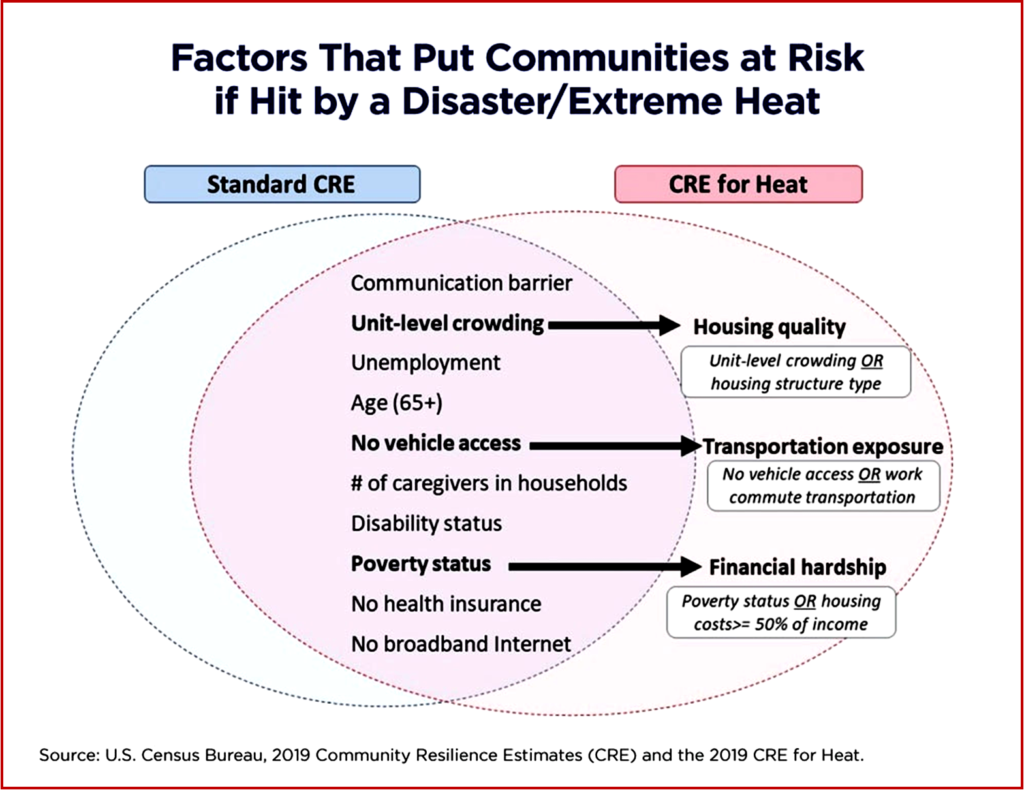
*The standard CRE measures social vulnerability that inhibits community resilience while the Community Resilience Estimates (CRE) for Heat adjusts risk factors such as quality of housing, transportation modes and financial hardship to gauge social vulnerability specifically to extreme heat exposure.”
The tool produces national, state, county and census tract (neighborhood equivalent) estimates using individual and household data from the 2019 American Community Survey (ACS) restricted microdata and the Census Bureau’s Population Estimates Program (PEP),” the Census Bureau said.
AutoInformed on

About Ken Zino
Ken Zino, editor and publisher of AutoInformed, is a versatile auto industry participant with global experience spanning decades in print and broadcast journalism, as well as social media. He has automobile testing, marketing, public relations and communications experience. He is past president of The International Motor Press Assn, the Detroit Press Club, founding member and first President of the Automotive Press Assn. He is a member of APA, IMPA and the Midwest Automotive Press Assn.
He also brings an historical perspective while citing their contemporary relevance of the work of legendary auto writers such as Ken Purdy, Jim Dunne or Jerry Flint, or writers such as Red Smith, Mark Twain, Thomas Jefferson – all to bring perspective to a chaotic automotive universe.
Above all, decades after he first drove a car, Zino still revels in the sound of the exhaust as the throttle is blipped during a downshift and the driver’s rush that occurs when the entry, apex and exit points of a turn are smoothly and swiftly crossed. It’s the beginning of a perfect lap.
AutoInformed has an editorial philosophy that loves transportation machines of all kinds while promoting critical thinking about the future use of cars and trucks.
Zino builds AutoInformed from his background in automotive journalism starting at Hearst Publishing in New York City on Motor and MotorTech Magazines and car testing where he reviewed hundreds of vehicles in his decade-long stint as the Detroit Bureau Chief of Road & Track magazine. Zino has also worked in Europe, and Asia – now the largest automotive market in the world with China at its center.








Census Bureau – 1 in 4 People Vulnerable to Extreme Heat
Click to enlarge.
About 1 in 4 people in the United States are socially vulnerable and have low resilience to extreme heat exposure, according to new US Census Bureau data released today. The so-called “Community Resilience Estimates” (CRE)* for Heat, an awakened experimental data model released in April, measures the capacity of individuals and households in a community to withstand the stress of exposure to extreme heat based on their social characteristics.
The experimental climate-focused data product was developed with Arizona State University’s Knowledge Exchange for Resilience (KER). The product was released at a joint Census Bureau-KER climate resilience symposium in Washington, DC. The first CRE was published as an experimental data product in June 2020 to provide information about the COVID-19 pandemic. It was also published to garner feedback from data users and stakeholders on the quality and usefulness of such a product.
Click to enlarge.
“This collaboration is an example of how we can leverage data and innovation to identify and address social inequalities and improve the resilience of communities in the face of climate change,” said Patricia Solís, KER’s executive director.
Be aware that CRE for Heat does not measure which areas are warmer than others or which areas are more likely to experience future heat waves. Instead, it identifies which areas exhibit low resilience if faced with extreme heat.
*The standard CRE measures social vulnerability that inhibits community resilience while the Community Resilience Estimates (CRE) for Heat adjusts risk factors such as quality of housing, transportation modes and financial hardship to gauge social vulnerability specifically to extreme heat exposure.”
The tool produces national, state, county and census tract (neighborhood equivalent) estimates using individual and household data from the 2019 American Community Survey (ACS) restricted microdata and the Census Bureau’s Population Estimates Program (PEP),” the Census Bureau said.
AutoInformed on
About Ken Zino
Ken Zino, editor and publisher of AutoInformed, is a versatile auto industry participant with global experience spanning decades in print and broadcast journalism, as well as social media. He has automobile testing, marketing, public relations and communications experience. He is past president of The International Motor Press Assn, the Detroit Press Club, founding member and first President of the Automotive Press Assn. He is a member of APA, IMPA and the Midwest Automotive Press Assn. He also brings an historical perspective while citing their contemporary relevance of the work of legendary auto writers such as Ken Purdy, Jim Dunne or Jerry Flint, or writers such as Red Smith, Mark Twain, Thomas Jefferson – all to bring perspective to a chaotic automotive universe. Above all, decades after he first drove a car, Zino still revels in the sound of the exhaust as the throttle is blipped during a downshift and the driver’s rush that occurs when the entry, apex and exit points of a turn are smoothly and swiftly crossed. It’s the beginning of a perfect lap. AutoInformed has an editorial philosophy that loves transportation machines of all kinds while promoting critical thinking about the future use of cars and trucks. Zino builds AutoInformed from his background in automotive journalism starting at Hearst Publishing in New York City on Motor and MotorTech Magazines and car testing where he reviewed hundreds of vehicles in his decade-long stint as the Detroit Bureau Chief of Road & Track magazine. Zino has also worked in Europe, and Asia – now the largest automotive market in the world with China at its center.