Click for more on Veterans and the Census.
Vespa’s Observations:
The main reason for classifying veterans in the United States was for determining pension eligibility. As veterans benefits expanded in the early 1900s, the importance of including veterans data in the decennial census also increased, particularly to track whether veterans were engaged in military operations or were killed in action and left surviving widows and children.
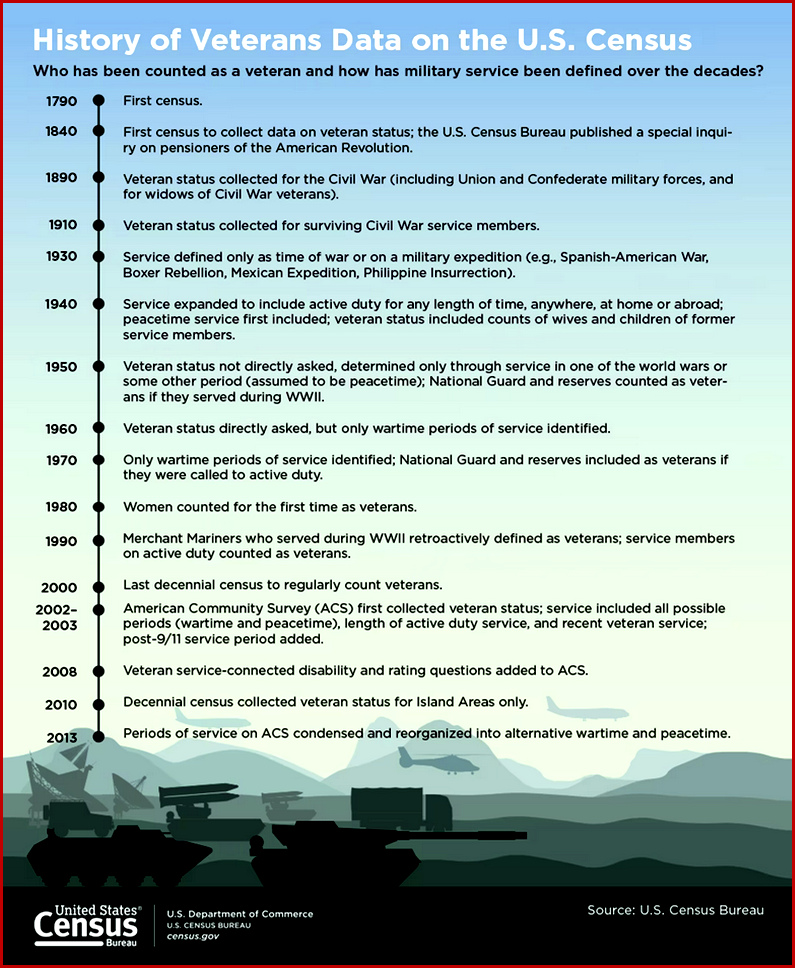
For decades, the decennial census only classified as veterans the men who served during wartime or went abroad as part of a military operation. By 1930, the definition of a veteran expanded to include men who served on military expeditions, which included the Spanish-American War (1898), Philippine Insurrection (1899–1902), Boxer Rebellion (1900–1901), and Mexican Expedition (1916–1917).
Men who served in peacetime, or who did not experience combat or service overseas, were not counted as veterans.
Turning Points in How We Classified Veterans
Starting in 1930, veteran questions appeared on every decennial census to varying degrees until the 2000 Census. With the end of World War II in 1945, the nation faced a burgeoning veteran population as most of the 16.1 million men who served during the war returned to civilian life. The influx of veterans further fueled the need for data on military service and experiences.
1940
The 1940 Census marked a significant turning point in how the Census Bureau defined and collected data on veterans. For the first time, the census included peacetime service, specified whether a veteran had served on active duty, and in which branch, for any length of time regardless of duty location (United States or abroad). This was the broadest definition of a veteran and military service to date. Since military pensions were still a focus, the 1940 Census included dependents of ex-service members in the count of veterans and determined the mortality status of veteran husbands and fathers. Before 1940, the decennial census had been primarily concerned with identifying how and where veterans served, and consequently counted men as veterans only if they met certain conditions (i.e., service in a specific war, branch, or military expedition). The 1940 Census shifted the focus to who served and when they did so, including both wartime and peacetime service.
1980
The “who” of military service changed again in 1980, when the census counted women as veterans for the first time. Women had long been connected to the U.S. military, even before they could formally serve or were recognized as veterans for their service.
A report on the history of women veterans from the Department of Veterans Affairs (VA) writes that although not recognized as veterans until 1980, women served on the battlefield alongside men during the American Revolution, some even masquerading as men. Some women served as spies during the Civil War but their main contributions were in the field of medicine.
“The nurses who served during the Spanish-American War paved the way for the creation of a permanent corps of nurses in the Army and Navy. In 1901, the Army Nurse Corps (ANC) was established,” according to the VA. Counting women as veterans marked a major shift in the way the Census Bureau measured the veteran population. Until that point, only men were considered to be veterans regardless of the military service or experiences of women.