
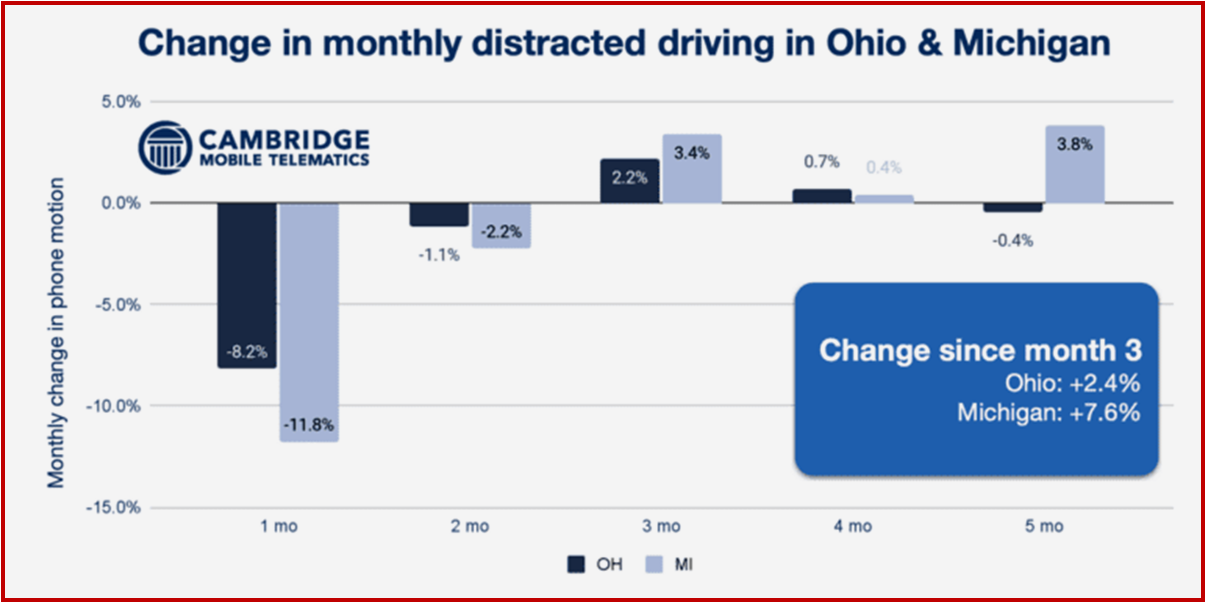
Click to Enlarge.
A New Way To Think Of Grace Periods?
“As we’ve seen from the results in Ohio, grace periods don’t seem to have the same impact on reducing distracted driving as the initial launch of the law. Launching the law without a grace period may have a stronger initial effect, like we saw with Michigan. However, as states evaluate their launch strategy for hands-free laws, they should consider the grace period in two ways.
• First, the grace period is a great opportunity to increase awareness of the law by having officers actively educate drivers about it.
• Second, it creates a media touchpoint in the hands-free campaign where politicians can generate attention for the law, highlighting its successes and mapping the next phase.
• Ohio has run this playbook well. As a result, the law has high awareness levels among Ohio drivers. And, as we’ve argued, awareness of hands-free laws leads to lower levels of distracted driving” said CMT.
*Cambridge Mobile Telematics (CMT) is the world’s largest telematics service provider. Its mission is to make the world’s roads and drivers safer. The company’s AI-driven platform, DriveWell®, gathers sensor data from millions of IoT devices, including smartphones, proprietary Tags, connected vehicles, dashcams, and third-party devices , and fuses them with contextual data to create a unified view of vehicle and driver behavior. Companies from personal and commercial auto insurance, automotive, rideshare, smart cities, wireless, financial services, and family safety industries use insights from CMT’s platform to power their risk assessment, safety, claims, and driver improvement programs. Headquartered in Cambridge, MA, with offices in Budapest, Chennai, Seattle, Tokyo, and Zagreb, CMT serves millions of people through over 95 programs in 25 countries, including 21 of the top 25 US auto insurers.