
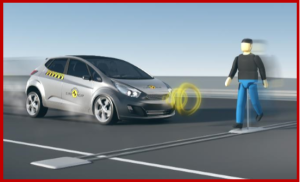
The number of pedestrians, cyclists and motorcyclists killed or injured on EU roads annually is 47% of the 26,000 deaths.
The European safety organization, aka Euro NCAP, is introducing a new test in 2016 that checks how well vehicles autonomously detect and prevent pedestrian collisions. With new vehicles offering more autonomous driver assist systems, Euro NCAP’s Autonomous Emergency Braking (AEB) pedestrian collision tests – in theory – will make it simpler for consumers and manufacturers to find out which systems work best.
Autonomous Emergency Braking (AEB)systems use lasers, radar and/or cameras to detect an imminent collision, enact an emergency stop or reduce the impact speed significantly. It’s a sure bet that the Insurance Institute for Highway Safety and NHTSA will ultimately develop pedestrian collision tests in the U.S.
While protection for drivers and passengers has helped lower Europe’s road death toll significantly during the past 20 years, the number of pedestrians, cyclists and motorcyclists killed and injured on its roads every year accounted for almost half (47%) of Europe’s 26,000 road deaths. For every death, there are estimated four permanently disabling injuries, such as damage to the brain or spinal cord, and eight serious injuries.
The safety agency said today in Brussels that independent analysis of crash data in the UK and Germany indicates that effective autonomous emergency braking systems on passenger cars could prevent one in five fatal pedestrian collisions. Most collisions occur when drivers fail to brake, brake too late or brake too gently – often because the driver is distracted or because the pedestrian crosses unexpectedly.
Euro NCAP will test system response to pedestrians in simulations of the three most common urban scenarios – adults walking and running into the vehicle’s path and a child stepping out from behind a parked car. To Score well in the test, vehicles should be able to prevent collisions with specially developed pedestrian dummies at speeds of up to 40 kmh (25 mph). At more challenging speeds of 40-60 kmh (25-37 mph), the tests aim to reduce the collision speed to less than 40 kmh, making the impact more survivable.