Click for more.
Blind Zones and Turning Crashes
An analysis of ~4500 police-reported pedestrian crashes in seven states showed that large driver-side blind zones were associated with a 70% increase in the risk of left-turn crashes with pedestrians, compared with small ones. Medium driver-side blind zones were associated with a 59% increase in left-turn crash risk.
To reach this estimate, the researchers counted how many times a vehicle in each of the three blind zone categories (small, medium and large) hit a pedestrian while turning left and how many times a vehicle in the same group hit a pedestrian while going straight. They then compared the ratios of left-turn to straight-moving crashes for each group.
“Straight-moving crashes were included to help account for how often vehicles encounter and hit pedestrians, independent of driver-side blind zones. A similar analysis of 3500 crashes showed that passenger-side blind zones had no significant impact on the risk of right-turn crashes.
Location of Driver-Side Blind Zones Also Important
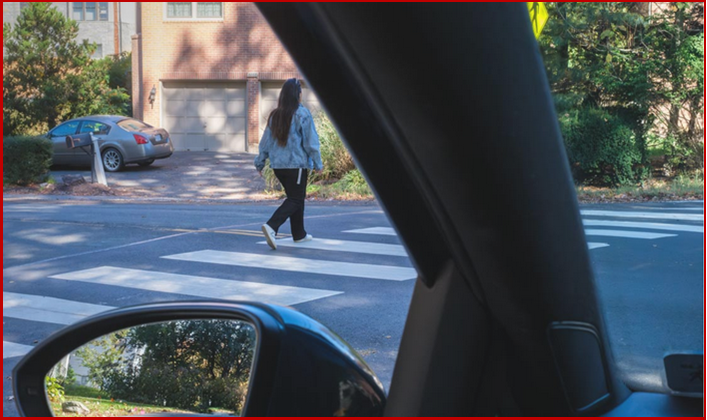
• A front field of view of 85 degrees or less was associated with a 51% increase in left-turn crash risk versus a front field of view wider than 90 degrees. A narrower field of view moves the A-pillars and side mirrors forward relative to the driver’s line of sight, so they block more of the area in the vehicle’s path.
• A nearest ground-level visible point more than 30 feet from the driver was associated with a 37% increase in left-turn crash risk. When the nearest visible point is farther away, more of the blind zone is directly ahead of the driver.
“When a driver’s view is partially blocked, it’s easy for a person in the crosswalk to disappear from sight,” said Wen Hu, senior research transportation engineer at IIHS and lead author of the study. “That’s exactly the kind of situation that leads to turning crashes.”