
The economy remains stuck in park.
Income levels and poverty rates are stuck in park in most states during the 2012 to 2013 years, according to the U.S. Census Bureau’s American Community Survey, which is billed as the nation’s most comprehensive data source on American households.
The latest report makes for depressing reading as the Great Recession continues to hurt the middle class. Income levels remain well below 2007 levels when the Bush Administration’s ideologically induced economic collapse began because of unregulated financial ratings agencies, Wall Street speculators, investment bankers, hedge funds and the hopelessly inept policies of the U.S. Securities and Exchange Commission and the Federal Reserve.
- According to the report Household Income: 2013, which compares American Community Survey statistics from 2012 to 2013:
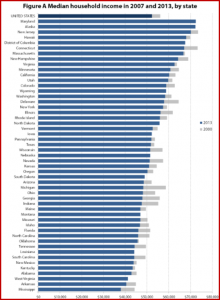
- During 2013, median household incomes were lower than the U.S. median ($52,250) in 28 states and higher in 19 states and the District of Columbia. Iowa ($52,229), Pennsylvania ($52,007) and Vermont ($52,578) median household incomes did not have a statistically significant difference from the U.S. as a whole.
- In 2013, the states with the highest median household incomes were Maryland ($72,483, probably because of government spending) and Alaska ($72,237 – natural resource exploitation), which were not statistically different from each other. Mississippi had the lowest ($37,963).
- There were no statistically significant decreases in median household incomes among states.
- Median household income among the 25 most populous metro areas was highest in the Washington, D.C. ($90,149, government and political lobbying), San Francisco ($79,624) and Boston ($72,907) metro areas.
Only six states had significant changes in their poverty rates: Colorado (-0.7 percentage points), New Hampshire (-1.3 percentage points), New Jersey (+0.6 percentage points), New Mexico (+1.1 percentage points), Texas (-0.4 percentage points), and Wyoming (-1.7 percentage points). All other states had no significant change from their 2012 poverty rates, according to an analysis of the dismal data from EPI – the Economic Policy Institute in Washington DC.
“The increases in poverty in New Jersey and New Mexico are the most troubling, although the lack of any significant decrease in most other states is also deeply frustrating,” said David Copper of EPI. “North Dakota is the only state where the poverty rate has fallen back down to pre-recession levels. In every other state nationwide, poverty rates remain significantly above their 2007 levels.”
“The failure to see any significant reduction in poverty over the last several years is a direct consequence of the continued weakness in the labor market. (It’s not surprising that poverty has fallen in North Dakota given that the state’s unemployment rate has averaged 3.3% from the start of the recession to today.) At the same time, however, policymakers have directly stymied poverty reduction by cutting back on unemployment insurance. If we want to start bringing poverty rates down, we need to restore the labor market back to full health, lift wages, and start sharing economic growth more broadly,” said Cooper.