
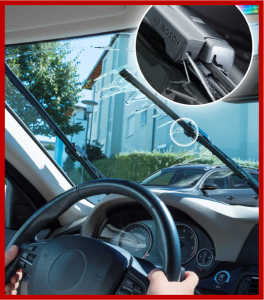
The benefits of the system are that drivers’ vision is not impaired by spray mist, and washer fluid use is cut by as much as 50%.
While the increasing use of electronics is both boon and bane in the auto industry, a jet wiper system on the new Volvo XC90 is clearly, so to speak, good. Electronics, combined with spray nozzles integrated in the wiper arm are the reasons.
This also ensures a clear field of vision for a video sensor used for driver assistance systems, which is normally positioned at the same height as the rear-view mirror. Volvo is promising an Autonomous Driving XC90 in 2017.
As part of a design with an intelligent wiper drive and ‘Aerotwin’ wiper blades from Bosch, the innovative wiper arm will be standard equipment in the new Volvo XC90. Jet wiper has a claim to be superior to conventional windshield wipers.
The nozzles spray the washer fluid evenly, thus ensuring that the windshield is cleaned over the entire length of the wiper blade. The benefits claimed are that drivers’ vision is not impaired by spray mist, and consumption of washer fluid is reduced by as much as 50%.
The wiper drive alternates the rotation of the motor between the wiper arms’ two final positions – parked position and A-pillar. Its integrated electronics means that it can detect the windshield wipers’ position at all times. To achieve the best cleaning effect, spraying is done only when the wiper arm is moving upward. In this way, the washer liquid is immediately picked up by the two wiper blades and distributed over the entire windshield.
Cleaning with the new wipers is independent of driving speed. Conventional systems spray the washer fluid from nozzle elements on the engine hood, and these elements are designed for a certain speed. As speed increases, the airflow diverts the spray, which means less washer fluid is sprayed on the area to be cleaned, resulting in a poor cleaning.
Bosch claims there is practically no effect from the airflow since the nozzle elements are mounted directly along the wiper arm. In addition, the spray nozzles are fitted with tiny valves that open when drivers activate windshield washing and close as soon as spraying has finished. This means there are no subsequent drips, and the wiper blades only have to wipe once. In winter, the nozzles are heated, as you would expect from Volvo making them ready for use in frigid weather.