Click to Enlarge.
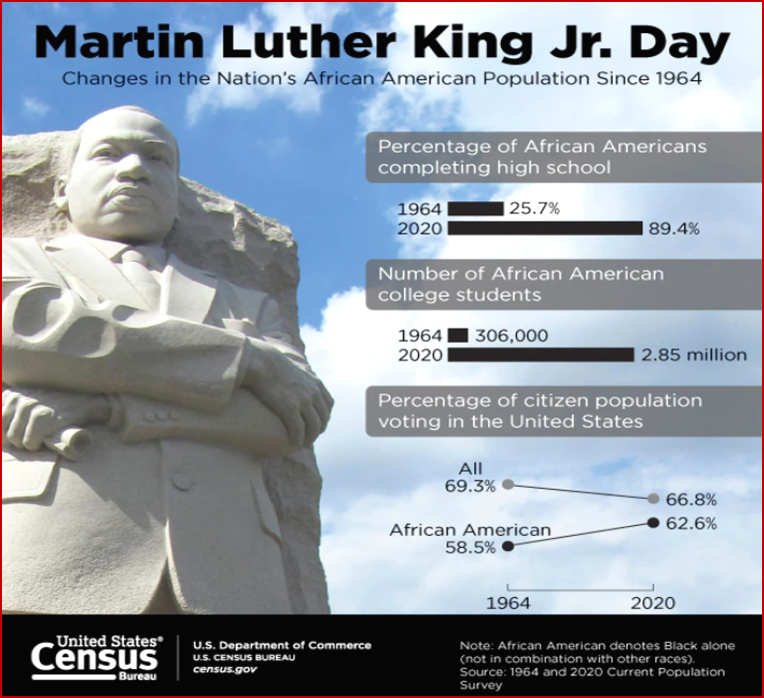
In noting Martin Luther King day, here are data* about African Americans relating to differences between 1964 when Dr. King was awarded the Nobel Peace Prize and 2020 in the percentage of African Americans completing high school, the number of African American college students, and the percentage of citizen population voting in the United States. Martin Luther King Jr. Day has been a U.S. federal holiday since 1986. The violent handling during the Spring of 1965 of protestors he was with over busing segregation by white segregationists and the police in Selma Alabama led to the passage of Voting Rights Act that August. AutoInformed still believes that “Injustice anywhere is a threat to justice everywhere,” as Dr. King said.
Martin Luther King was murdered, possibly, by known-racist and escaped-convict James Earl Ray on 4 April 1968 while standing on the balcony of a motel in Memphis (Ray eventually withdrew his confession). King had traveled to Tennessee to support a sanitation workers’ strike. Subsequent Court decisions – regrettably including not unexpectedly from the Supreme Court, which also brought us the Dred Scott decision saying that he was a mere piece of property**. The courts followed by politicians, especially the Republican party, have since murdered the voting rights act while ignoring the 15th Amendment to the US Constitution.
* as the percentage of African Americans completing high school, the number of African American college students, and the percentage of citizen population voting in the United States. African American denotes black along, not in combination with other races. Courtesy United States Census Bureau.
** It said black people, free or enslaved, could not be American citizens and constitutionally unable to sue for citizenship in the federal courts, which means they cannot vote.

About Ken Zino
Ken Zino, editor and publisher of AutoInformed, is a versatile auto industry participant with global experience spanning decades in print and broadcast journalism, as well as social media. He has automobile testing, marketing, public relations and communications experience. He is past president of The International Motor Press Assn, the Detroit Press Club, founding member and first President of the Automotive Press Assn. He is a member of APA, IMPA and the Midwest Automotive Press Assn.
He also brings an historical perspective while citing their contemporary relevance of the work of legendary auto writers such as Ken Purdy, Jim Dunne or Jerry Flint, or writers such as Red Smith, Mark Twain, Thomas Jefferson – all to bring perspective to a chaotic automotive universe.
Above all, decades after he first drove a car, Zino still revels in the sound of the exhaust as the throttle is blipped during a downshift and the driver’s rush that occurs when the entry, apex and exit points of a turn are smoothly and swiftly crossed. It’s the beginning of a perfect lap.
AutoInformed has an editorial philosophy that loves transportation machines of all kinds while promoting critical thinking about the future use of cars and trucks.
Zino builds AutoInformed from his background in automotive journalism starting at Hearst Publishing in New York City on Motor and MotorTech Magazines and car testing where he reviewed hundreds of vehicles in his decade-long stint as the Detroit Bureau Chief of Road & Track magazine. Zino has also worked in Europe, and Asia – now the largest automotive market in the world with China at its center.







MLK – Changes in African American People Since 1964
Click to Enlarge.
In noting Martin Luther King day, here are data* about African Americans relating to differences between 1964 when Dr. King was awarded the Nobel Peace Prize and 2020 in the percentage of African Americans completing high school, the number of African American college students, and the percentage of citizen population voting in the United States. Martin Luther King Jr. Day has been a U.S. federal holiday since 1986. The violent handling during the Spring of 1965 of protestors he was with over busing segregation by white segregationists and the police in Selma Alabama led to the passage of Voting Rights Act that August. AutoInformed still believes that “Injustice anywhere is a threat to justice everywhere,” as Dr. King said.
Martin Luther King was murdered, possibly, by known-racist and escaped-convict James Earl Ray on 4 April 1968 while standing on the balcony of a motel in Memphis (Ray eventually withdrew his confession). King had traveled to Tennessee to support a sanitation workers’ strike. Subsequent Court decisions – regrettably including not unexpectedly from the Supreme Court, which also brought us the Dred Scott decision saying that he was a mere piece of property**. The courts followed by politicians, especially the Republican party, have since murdered the voting rights act while ignoring the 15th Amendment to the US Constitution.
* as the percentage of African Americans completing high school, the number of African American college students, and the percentage of citizen population voting in the United States. African American denotes black along, not in combination with other races. Courtesy United States Census Bureau.
** It said black people, free or enslaved, could not be American citizens and constitutionally unable to sue for citizenship in the federal courts, which means they cannot vote.
About Ken Zino
Ken Zino, editor and publisher of AutoInformed, is a versatile auto industry participant with global experience spanning decades in print and broadcast journalism, as well as social media. He has automobile testing, marketing, public relations and communications experience. He is past president of The International Motor Press Assn, the Detroit Press Club, founding member and first President of the Automotive Press Assn. He is a member of APA, IMPA and the Midwest Automotive Press Assn. He also brings an historical perspective while citing their contemporary relevance of the work of legendary auto writers such as Ken Purdy, Jim Dunne or Jerry Flint, or writers such as Red Smith, Mark Twain, Thomas Jefferson – all to bring perspective to a chaotic automotive universe. Above all, decades after he first drove a car, Zino still revels in the sound of the exhaust as the throttle is blipped during a downshift and the driver’s rush that occurs when the entry, apex and exit points of a turn are smoothly and swiftly crossed. It’s the beginning of a perfect lap. AutoInformed has an editorial philosophy that loves transportation machines of all kinds while promoting critical thinking about the future use of cars and trucks. Zino builds AutoInformed from his background in automotive journalism starting at Hearst Publishing in New York City on Motor and MotorTech Magazines and car testing where he reviewed hundreds of vehicles in his decade-long stint as the Detroit Bureau Chief of Road & Track magazine. Zino has also worked in Europe, and Asia – now the largest automotive market in the world with China at its center.