
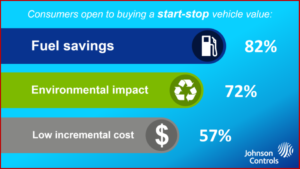
 By 2020, Johnson Controls predicts 50% of all new vehicles sold in the U.S. will have start-stop technology. GM plans to make it standard across its fleet by 2020. Ford will integrate start-stop across all EcoBoost equipped vehicles. Start-stop technology, of course, shuts the engine off during stops, namely red lights, accidents or traffic jams and such. Lights, air conditioning, sound system, the web enabled car remain active. When the driver lifts off the brake, the engine restarts and is ready to accelerate the vehicle. Roughly a 5% fuel economy improvement is possible with the system.
Start-stop is good now for Johnson, a global force in the battery business. Start-stop vehicles only require 1 battery, the so-called Absorbent Glass Mat battery or AGM. Johnson is investing $780 million over the next 5 years to increase AGM capacity. It becomes even a better business when the industry goes to an Advanced Start-stop system. Here you need two batteries – a 12-volt lead-acid and a 12-volt lithium-ion. Those have not yet come to the market, but are imminent.
American consumers are “strongly influenced by both the price of gas and fuel efficiency when purchasing a vehicle, according to a new survey conducted by the Opinion Research Corporation. Of the 1,006 people surveyed, fuel efficiency (57%) is top of mind for consumers when they go to buy any size automobile, followed closely by cost (55%) and safety (54%). AutoInformed caveat here – surveys are one thing, but market behavior is another, think of the record numbers of pickup trucks and SUVs currently being sold – well leased in the U.S. as car sales decline.
“Whether someone wants to drive a truck, SUV, or car – increased fuel efficiency remains the number one purchase criterion for American car buyers,” said Joe Walicki, president of Johnson Controls Power Solutions, the world’s largest automotive battery manufacturer. “What we’re seeing in the market place due to low and stable gas prices is a migration to larger vehicles, but the expectation now is that those vehicles come with increased fuel efficiency,” added Walicki.
Johnson Controls start-stop battery technology is now integrated into 35 million vehicles globally, saving an estimated 660 million gallons of fuel and cutting greenhouse gas emissions by 5.9 million metric tons per year.
Johnson Controls Power Solutions is the world’s largest manufacturer of automotive batteries, supplying ~146 million every year to automakers and aftermarket retailers. It has a full range of lead-acid and lithium-ion battery technology that powers nearly every type of vehicle – including traditional, start-stop, micro-hybrid, hybrid and electric. Johnson Controls’ recycling system has helped make automotive batteries the most recycled consumer product in the world.