
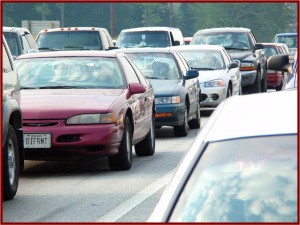
 The California Air Resources Board, aka CARB, has a new guide designed to provide public health, air quality and urban planning policy-makers with options for reducing exposure to traffic pollution for people who live or work near busy roads. Strategies to Reduce Air Pollution Exposure Near High-Volume Roadways is a technical advisory about the potential health implications of living and working in existing or planned developments near hectic roads. Options are discussed that planners and others can put into place to protect public health in developments close to freeways and as so-called “infill” development, which is the opposite of urban sprawl, continues.
This is especially important in urban areas where the freeway network is dense, which means there are few places that are not near a freeway. Strategies are in three categories:
- they reduce traffic emissions,
- reduce the concentration of air pollution from vehicles,
- or remove pollution from our air.
CARB says the strategies were chosen based on peer-reviewed scientific literature and CARB-sponsored research projects. Examples include the use of traffic roundabouts instead of stoplights to reduce stop and go driving, sound walls and vegetation that help dispel pollution, and air filters in buildings that remove pollutants from indoor air.
The new technical advisory is a companion document to a forthcoming updated General Plan Guidelines from the Governor’s Office of Planning and Research.
Infill development, of course, promotes biking and walking, and shortens distances that people must travel for daily activities. Dense developments also support mass transit operations.
“These are scientifically based strategies that can be used at the local level to reduce exposure to air pollution soon while we work toward full implementation of California’s progressive regulations that are cleaning the air but are being phased in over time,” said Chief of CARB’s Research Division Bart Croes.
“As California grows, we have the collective opportunity to shape the future of the built environment to be both protective of public health and supportive of environmental goals,” said Croes. “We hope that this new guide will help decision makers promote healthy, safe, equitable and sustainable communities.”