
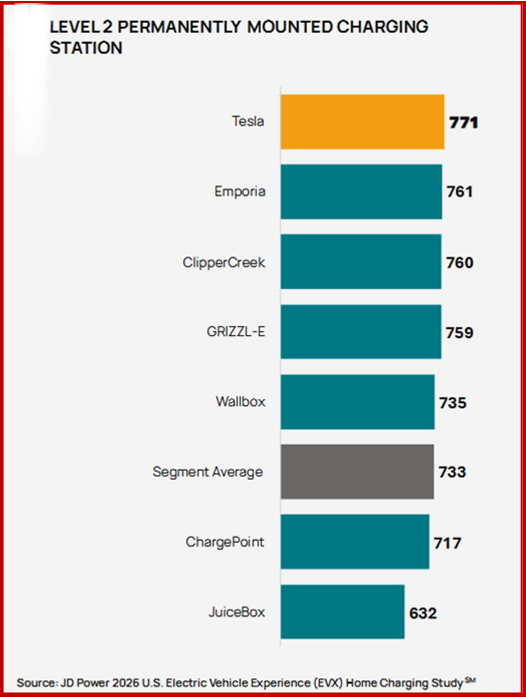
Click to Enlarge.
The 2026 EVX Index at a Glance
• Charging costs climb higher as satisfaction with cost of charging dips lower: The average amount of money that owners say they spent on EV home charging in the past 30 days has increased to $63, up $5 from a year ago. As a result, satisfaction with the cost of charging falls to 687, down 11 points from the 2025 study. Owners in New England are subject to the highest average EV charging spend over the past 30 days ($99), resulting in the lowest satisfaction score with the cost of charging (552) among all regions. By contrast, owners in the Mountain region pay the least ($36) and are much more satisfied with the cost of charging (771).
• Scheduled charging boosts satisfaction and helps lower costs: More than one-third (38%) of EV owners say they always schedule charging at home. Satisfaction among these owners averages 734, compared with 706 among those who sometimes schedule charging (16%) and 700 among those who never do so (46%). Scheduled charging can also help reduce costs. For example, among owners who try to charge during off-peak hours, those who always schedule charging spent an average of $65 on charging in the previous 30 days, compared with $71 among those who say they never schedule charging. This suggests that strategically scheduling charging can help EV owners offset some of the cost by taking advantage of variable electricity rates.
• Few EV owners participate in smart charging programs: Smart charging programs are offered by utilities to incentivize EV owners to charge their vehicles during off-peak hours using Wi-Fi-connected chargers and vehicle telematics to optimize the charging experience. While 69% of EV owners are aware of these smart charging options, just 12% say they are enrolled in such programs. Moreover, only half (50%) of EV owners who charge at home say their utility offers variable electricity rates and incentives for charging at different times of day. Smart charging is an important solution for helping EV owners manage charging costs, while providing flexibility for utility providers to balance demand.
• Level 2 permanently mounted chargers experience more problems, but higher satisfaction: While Level 2 permanently mounted home chargers once again have the highest satisfaction scores, they remain the most problematic with 44.2 problems per 100 chargers (PP100), an increase of 5.2 PP100 year over year. The higher problem count can be attributed to the fact that Level 2 permanently mounted chargers are equipped with more advanced features—such as Wi-Fi connectivity, mobile apps and smart charging capabilities that are usually not present in the other charging segments.