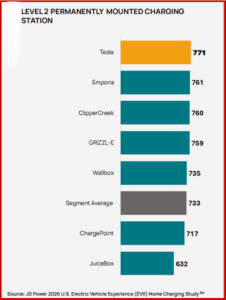
Click to Enlarge.
The J.D. Power 2026 U.S. Electric Vehicle Experience (EVX) Home Charging StudySM released this week indicates that overall satisfaction among owners of Level 1 portable chargers is 569 (on a 1000-point scale), down 12 points from a year ago.* The overall satisfaction score for use of Level 2 portable chargers is 710, 4 points lower than a year ago.* Owner satisfaction with Level 2 permanently mounted home chargers holds steady at 733. [Footnotes 1 and 2 below]
“Charging costs for EV owners are climbing, and there are several options out there for managing those costs through utility incentive programs and optimization of charging schedules during off-peak hours, yet only about 20% [3] of owners say they received any kind of education or advice on home charging from their purchasing dealer,” said Brent Gruber, executive director of the EV practice at JD Power.
The 2026 EVX Index at a Glance
- Charging costs climb higher as satisfaction with cost of charging dips lower: The average amount of money that owners say they spent on EV home charging in the past 30 days has increased to $63, up $5 from a year ago. As a result, satisfaction with the cost of charging falls to 687, down 11 points from the 2025 study. Owners in New England are subject to the highest average EV charging spend over the past 30 days ($99), resulting in the lowest satisfaction score with the cost of charging (552) among all regions. By contrast, owners in the Mountain region pay the least ($36) and are much more satisfied with the cost of charging (771).
- Scheduled charging boosts satisfaction and helps lower costs: More than one-third (38%) of EV owners say they always schedule charging at home. Satisfaction among these owners averages 734, compared with 706 among those who sometimes schedule charging (16%) and 700 among those who never do so (46%). Scheduled charging can also help reduce costs. For example, among owners who try to charge during off-peak hours, those who always schedule charging spent an average of $65 on charging in the previous 30 days, compared with $71 among those who say they never schedule charging. This suggests that strategically scheduling charging can help EV owners offset some of the cost by taking advantage of variable electricity rates.
- Few EV owners participate in smart charging programs: Smart charging programs are offered by utilities to incentivize EV owners to charge their vehicles during off-peak hours using Wi-Fi-connected chargers and vehicle telematics to optimize the charging experience. While 69% of EV owners are aware of these smart charging options, just 12% say they are enrolled in such programs. Moreover, only half (50%) of EV owners who charge at home say their utility offers variable electricity rates and incentives for charging at different times of day. Smart charging is an important solution for helping EV owners manage charging costs, while providing flexibility for utility providers to balance demand.
- Level 2 permanently mounted chargers experience more problems, but higher satisfaction: While Level 2 permanently mounted home chargers once again have the highest satisfaction scores, they remain the most problematic with 44.2 problems per 100 chargers (PP100), an increase of 5.2 PP100 year over year. The higher problem count can be attributed to the fact that Level 2 permanently mounted chargers are equipped with more advanced features—such as Wi-Fi connectivity, mobile apps and smart charging capabilities that are usually not present in the other charging segments.
“While users of more advanced features on Level 2 systems do encounter more problems due to things like Wi-Fi and mobile app connectivity issues, their overall satisfaction levels are so much higher because they are scheduling charge times, monitoring results and engaging more actively in getting the most out of the home charging experience,” said Gruber.
*AutoInformed on
Inevitable Electric Vehicle Footnotes
- Electric vehicles (EV) include battery electric vehicles (BEV) and plug-in hybrid electric vehicles (PHEV).
- JD Power defines charger segments as Level 1 portable; Level 2 portable; or Level 2 permanently mounted (permanent). Level 1 portable charging stations offer simple electric vehicle charging capabilities at home through a standard 120-volt electrical outlet. Level 2 portable charging stations offer faster charging capabilities at home through an upgraded 240-volt electrical outlet. Level 2 permanently mounted charging stations use an upgraded 240-volt electrical outlet via a permanently wall-mounted format.
- Source: JD Power 2026 U.S. Electric Vehicle Experience Ownership StudySM

About Ken Zino
Ken Zino, editor and publisher of AutoInformed, is a versatile auto industry participant with global experience spanning decades in print and broadcast journalism, as well as social media. He has automobile testing, marketing, public relations and communications experience. He is past president of The International Motor Press Assn, the Detroit Press Club, founding member and first President of the Automotive Press Assn. He is a member of APA, IMPA and the Midwest Automotive Press Assn.
He also brings an historical perspective while citing their contemporary relevance of the work of legendary auto writers such as Ken Purdy, Jim Dunne or Jerry Flint, or writers such as Red Smith, Mark Twain, Thomas Jefferson – all to bring perspective to a chaotic automotive universe.
Above all, decades after he first drove a car, Zino still revels in the sound of the exhaust as the throttle is blipped during a downshift and the driver’s rush that occurs when the entry, apex and exit points of a turn are smoothly and swiftly crossed. It’s the beginning of a perfect lap.
AutoInformed has an editorial philosophy that loves transportation machines of all kinds while promoting critical thinking about the future use of cars and trucks.
Zino builds AutoInformed from his background in automotive journalism starting at Hearst Publishing in New York City on Motor and MotorTech Magazines and car testing where he reviewed hundreds of vehicles in his decade-long stint as the Detroit Bureau Chief of Road & Track magazine. Zino has also worked in Europe, and Asia – now the largest automotive market in the world with China at its center.







Electric Vehicle Experience Home Charging Study Released
Click to Enlarge.
The J.D. Power 2026 U.S. Electric Vehicle Experience (EVX) Home Charging StudySM released this week indicates that overall satisfaction among owners of Level 1 portable chargers is 569 (on a 1000-point scale), down 12 points from a year ago.* The overall satisfaction score for use of Level 2 portable chargers is 710, 4 points lower than a year ago.* Owner satisfaction with Level 2 permanently mounted home chargers holds steady at 733. [Footnotes 1 and 2 below]
“Charging costs for EV owners are climbing, and there are several options out there for managing those costs through utility incentive programs and optimization of charging schedules during off-peak hours, yet only about 20% [3] of owners say they received any kind of education or advice on home charging from their purchasing dealer,” said Brent Gruber, executive director of the EV practice at JD Power.
The 2026 EVX Index at a Glance
“While users of more advanced features on Level 2 systems do encounter more problems due to things like Wi-Fi and mobile app connectivity issues, their overall satisfaction levels are so much higher because they are scheduling charge times, monitoring results and engaging more actively in getting the most out of the home charging experience,” said Gruber.
*AutoInformed on
Inevitable Electric Vehicle Footnotes
About Ken Zino
Ken Zino, editor and publisher of AutoInformed, is a versatile auto industry participant with global experience spanning decades in print and broadcast journalism, as well as social media. He has automobile testing, marketing, public relations and communications experience. He is past president of The International Motor Press Assn, the Detroit Press Club, founding member and first President of the Automotive Press Assn. He is a member of APA, IMPA and the Midwest Automotive Press Assn. He also brings an historical perspective while citing their contemporary relevance of the work of legendary auto writers such as Ken Purdy, Jim Dunne or Jerry Flint, or writers such as Red Smith, Mark Twain, Thomas Jefferson – all to bring perspective to a chaotic automotive universe. Above all, decades after he first drove a car, Zino still revels in the sound of the exhaust as the throttle is blipped during a downshift and the driver’s rush that occurs when the entry, apex and exit points of a turn are smoothly and swiftly crossed. It’s the beginning of a perfect lap. AutoInformed has an editorial philosophy that loves transportation machines of all kinds while promoting critical thinking about the future use of cars and trucks. Zino builds AutoInformed from his background in automotive journalism starting at Hearst Publishing in New York City on Motor and MotorTech Magazines and car testing where he reviewed hundreds of vehicles in his decade-long stint as the Detroit Bureau Chief of Road & Track magazine. Zino has also worked in Europe, and Asia – now the largest automotive market in the world with China at its center.