
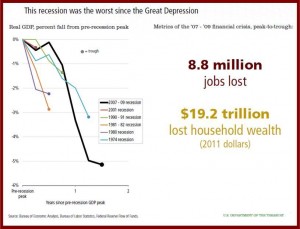
How voters will view this in November comes down to political and ideological viewpoints. The facts say the U.S. economy is stronger today because of the strategy our legislators adopted, and - maybe - the financial reforms now being put in place.
The U.S. Department of the Treasury said yesterday that its latest cost estimates for the controversial Troubled Asset Relief Program (TARP) bailouts would actually create a profit for taxpayers.
TARP, arguably the most contentious of the Federal government’s numerous attempts to stop the U.S. and global economies from sliding into another Great Depression or worse, prevented the collapse of the financial system by bailing out profligate and reckless Wall Street firms and insurance companies. To date, not one person at the firms responsible has been successfully prosecuted for what was rampant financial fraud that caused the housing and stock markets to collapse as the ratings agencies paid by the swindlers continued to claim the complex financial instruments issued were investment grade when they were indeed junk.
All told, actions by Treasury, the Federal Reserve, and the Federal Deposit Insurance Corporation (FDIC) reluctantly started under Republican President Bush and expanded and successfully implemented under Democratic President Obama turned the ailing economy around with costly bailouts, albeit slowly and still with great harm to honest individuals, U.S. wealth creation and tax revenues.
The overall positive financial return claimed for taxpayers is only in terms of direct fiscal cost of the bailouts. The estimates are based on gains already realized and projected cost and returns for the remaining investments outstanding, which includes Treasury’s ownership of 32% of General Motors stock. The bailouts of the General Motors and Chrysler, as well as almost $6 billion in financial assistance to Ford Motor Company to retool plants, without question saved the U.S. auto industry.
However, these election year estimates do not include the full impact of the crisis on the seriously damaged U.S. fiscal position. Moreover, they do not include the cost of the tax cuts and emergency spending programs passed by Congress in the Recovery Act.
How voters will view this in November comes down to political and ideological viewpoints. The facts say the U.S. economy is stronger today because of the strategy our legislators adopted, and – maybe – the financial reforms now being put in place. This, in turn, has allowed our financial system to return as a player in economic growth and job creation although at an agonizingly slow pace.
To supporters these are the crucial measures of the impact of the financial strategy adopted by the United States. Critics, including the likely Republican nominees for president say the government should have stood back and let the failed and frozen markets sort themselves out, a distinctly dubious proposition bordering on fantasy – or outright lying in many peoples’ view – given that the private capital markets were frozen with fear of lending to over-leveraged firms.
In another politically related development, Treasury also announced that it will delay publication of the semi-annual Report to Congress on International Economic and Exchange Rate Policies of our major trading partners. Critics contend that China continues to severely undervalue the RMB, thereby hurting what remains of the U.S. manufacturing sector at a time of record rates of long-term unemployment.