
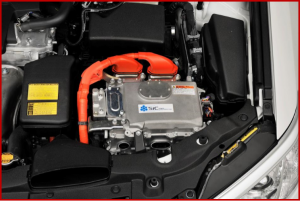
Power semiconductors currently in use account for ~20% of a vehicle’s total electrical losses.
Toyota Motor said today that it would evaluate the performance of silicon carbide (SiC) power semiconductors – transistors and diodes, which could lead to significant efficiency gains in hybrids and other vehicles with electric powertrains.
Power semiconductors are in power control units (PCUs), which are used to control motor drive power in hybrids and other vehicles with electric powertrains. PCUs have a significant role in the use of electricity, supplying battery power to the motors during operation and recharging the battery using energy recovered during deceleration.
Power semiconductors currently in use account for approximately 20% of a vehicle’s total electrical losses, so raising the efficiency of the power semiconductors is a way to increase powertrain efficiency. The auto industry has been studying this problem for decades.
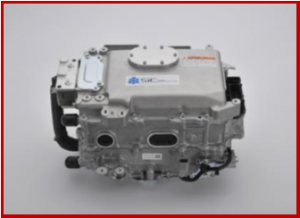
The potential efficiency gains are large.
By comparison with existing silicon power semiconductors, the newly developed high quality silicon carbide (SiC) power semiconductors create less resistance when electricity flows through them. Toyota, Denso Corporation, and Toyota Central R&D Labs., Inc. developed the technologies behind these SiC power semiconductors jointly as part of a broader government R&D project in Japan.
In a Camry hybrid prototype, Toyota is installing SiC power semiconductors in the PCU’s internal voltage step-up converter and the inverter that controls the motor. Data gathered will include PCU voltage and current as well as driving speeds, driving patterns, and conditions such as outside temperature. By comparing this information with data from silicon semiconductors currently in use, Toyota will assess the improvement to efficiency achieved by the new SiC power semiconductors. Road testing of the Camry prototype will begin primarily in Toyota City in early February 2015, and will continue for about one year.
At the begging of January, Toyota began collecting operating data from a fuel cell bus currently in regular commercial operation in Toyota City. The bus features SiC diodes in the fuel cell voltage step-up converter, which is used to control the voltage of electricity from the fuel cell stack.
Data from testing will be reflected in development, with the goal of putting the new SiC power semiconductors into practical use as soon as possible.