
Toyota, the world’s largest automaker, keeps expanding. The Japanese company is particularly strong in Asia, except China where WW2 memories linger. The opposite applies in the U.S. where Toyota is chasing Ford Motor for the Number 2 sales crown.
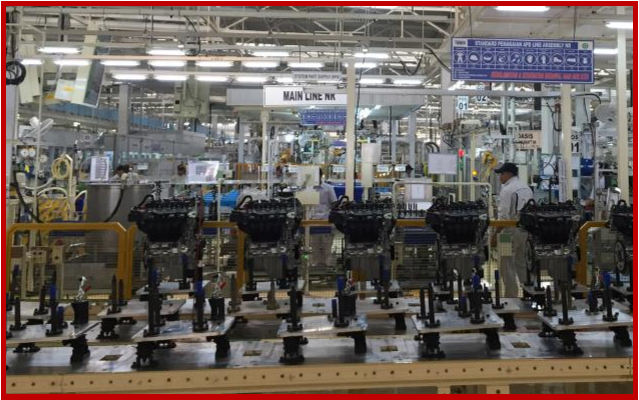
Toyota Motor Manufacturing Indonesia has opened a new engine plant in North Jakarta with the capacity to produce 216,000 engines per year. Built with an investment of approximately 2.3 trillion rupiahs, the Karawang Engine Plant added 400 new employees. The plant will produce 1.3 and 1.5 liter NR engines, some of which will be for export. The latest move might make Indonesia instead of Thailand, the center for auto production in Southeast Asia.
Toyota claims that the Karawang Engine Plant is a milestone because of its “new heights of efficiency.” Introduced at this plant are the following key production technologies:
On-site smelting, first at a Toyota plant outside of Japan.
A large amount of molten alloy is required during the process of casting major components. Previously, the alloy was melted in a large smelting furnace away from the casting machine. The molten metal would then be brought to the casting machine.
Modifications to the heat source and other changes have allowed for the furnace size to be reduced, enabling a shift to an on-site alloy smelting method in which the furnace is now directly connected to the casting machine. This system has previously been adopted in the casting process for small components but this is the first time it has been used in the casting of large components such as engines at a Toyota plant outside of Japan.
The result is a marked improvement in terms of safety, as the dangers associated with transporting molten metal have been eliminated. In addition, the space required for smelting and casting is significantly reduced by taking the transportation process out of the equation. Initial investment has also been reduced along with the reduction in the size of the smelting furnace. Furthermore, fluctuations in demand can be dealt with more responsively, as the amount of molten metal can now be more readily adjusted to meet demand.
Inorganic sand cores
Cores are devices placed in casting molds to create internal cavities in the final cast component. Once molten metal is poured in and has hardened, the cores are broken. Cores with organic additives are traditionally used during casting, due to the need for a combination of ease of disintegration, strength, heat resistance, and molding properties.
However, using cores with organic additives causes tar particles and strong odors to be emitted during the combustion process. This, in turn, requires the use of large dust collectors and deodorizers to remove such by-products. However, a technique has now been developed that improves the shaping properties of cores through the use of inorganic matter additives instead of organic matter.
The resulting reduction in the volume of tar particles emitted means that the size of dust collectors can also be reduced. In addition to saving space, this also results in a significant reduction of fire risks as well as necessary cleaning maintenance, thus improving overall safety standards.
Furthermore, the reduction in odor generated also eliminates the need for deodorizers, which further reduces the space designated for casting and thus reduces the initial investment.







