
The new technology provides significantly more mass reduction and parts consolidation opportunities that – it’s said – cannot be achieved through traditional design optimization methods.
General Motors is using advanced software design for the next generation of vehicle light-weighting. The technology is claimed to be key to developing efficient and lighter alternative propulsion and zero emission vehicles. GM is the first automaker in North America to use tools from Bay Area-based software company Autodesk.
It uses cloud computing and AI-based algorithms to explore multiple permutations of a part design, generating hundreds of high-performance, often organic-looking geometric design options based on goals and parameters set by the user, such as weight, strength, material choice, fabrication method, and more. The user then determines the best part design option.
“When we pair the design technology with manufacturing advancements such as 3D printing, our approach to vehicle development is completely transformed and is fundamentally different to co-create with the computer in ways we simply couldn’t have imagined before,” said GM Vice President Ken Kelzer, Global Vehicle Components and Subsystems.
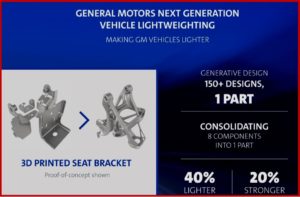
GM and Autodesk engineers have applied this new technology to produce a proof-of-concept seat bracket that is 40% lighter and 20% stronger than the original part. It also consolidates eight different components into one 3D-printed part.
As part of a multi-year alliance focused on innovation, GM and Autodesk will collaborate on projects involving generative design, additive manufacturing, and materials science. Executives and engineers from the two companies will participate in a series of onsite engagements to exchange ideas, learnings, and expertise. GM also has on-demand access to Autodesk’s software and technical specialists.
“Generative technologies fundamentally change how engineering work is done because the manufacturing process is built into design options from the start,’ said Scott Reese, Autodesk Senior Vice President for Manufacturing and Construction Products. “GM engineers will be able to explore hundreds of ready-to-be-manufactured, high-performance design options faster than they were able to validate a single design the old way.”
For more than three decades, GM has used 3D printing to create three-dimensional parts directly from digital data through successive addition of layers of material. GM possessed the first and has some of the auto industry’s most comprehensive 3D printing capabilities in the world with more than 50 rapid prototype machines that have produced more than 250,000 prototype parts during the last decade.
Since 2016, GM has launched 14 new vehicle models with a total mass reduction of more than 5,000 lbs., or more than 350 pounds per vehicle. Most of the weight reduction are a result of material and technology advancements. Of those models, more than half of the vehicles shed 300-pounds or more including the all-new 2019 Chevrolet Silverado, which reduced mass by up to 450-pounds.
Eliminating mass in parts where material is not required for performance combined with parts consolidation benefits vehicle owners with the potential for more interior space and vehicle content, increased range, and enhanced vehicle performance. It also provides vehicle designers a way to explore designs and shapes not seen today.