Click to Enlarge.
Nissan Motor Company in Japan today announced it has jointly developed a technology with Tohoku University’s Faculty of Pharmaceutical Sciences that inactivates viruses using catalyst active species for aerobic oxidation.
This appears to be a medical science breakthrough since the technology has potential applications for inactivating viruses by oxidizing, denaturing and degrading proteins and other substances on the virus surface. With oxygen in the air acting as an oxidant, the catalyst species produces this effect even under dark conditions at room temperature without requiring light irradiation, as is usually the case with oxidation.
Nissan said this technology was created by using Nissan’s technologies and expertise in automotive development, and the Tohoku University faculty’s technologies related to drug development, drug evaluation and other pharmaceutical sciences, catalyst preparation and catalyst performance evaluation.
Moreover, in addition to inactivating viruses – including the novel coronavirus – this technology can also inactivate pathogens such as fungi and bacteria. It has the potential for wide-ranging applications, including use as antibacterial and antiviral base materials in filters for air conditioning equipment and air purifiers, as well as in masks and medical textile products.
The technology uses organic nitroxyl radical oxidation catalysts* (radical catalysts). They oxidize organic compounds in the presence of appropriate co-catalysts using molecular oxygen in ambient air acting as a terminal oxidant.
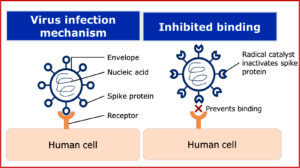
“Studies of this technology’s effects have found that the oxoammonium salts produced from radical catalysts through aerobic oxidation oxidize and inactivate viruses’ surface proteins, thereby reducing their ability to bind to target cells.
“Furthermore, processing the receptor-binding domain of the spike protein of SARS-CoV2 (omicron strain) significantly reduces the binding of the spike protein to the receptor (see figure below). Using feline coronavirus – an alternative SARS-CoV2 virus – its infectious activity on feline renal cells was assessed and a notable inhibition of infection-related morphological changes in the cells was observed,” Nissan said.
*Radical catalysts are used as additives in the polymer base materials of automotive paints, as well as in the fiber and organic polymer materials used in vehicle interiors and exteriors. They inhibit photo-degradation reactions (e.g., cracking, embrittlement, fading) over long periods of time. Nissan has been researching and developing the use of radical catalysts to inactivate viruses in an effort to make the most of their catalytic activity and “further contribute to society.”

About Ken Zino
Ken Zino, editor and publisher of AutoInformed, is a versatile auto industry participant with global experience spanning decades in print and broadcast journalism, as well as social media. He has automobile testing, marketing, public relations and communications experience. He is past president of The International Motor Press Assn, the Detroit Press Club, founding member and first President of the Automotive Press Assn. He is a member of APA, IMPA and the Midwest Automotive Press Assn.
He also brings an historical perspective while citing their contemporary relevance of the work of legendary auto writers such as Ken Purdy, Jim Dunne or Jerry Flint, or writers such as Red Smith, Mark Twain, Thomas Jefferson – all to bring perspective to a chaotic automotive universe.
Above all, decades after he first drove a car, Zino still revels in the sound of the exhaust as the throttle is blipped during a downshift and the driver’s rush that occurs when the entry, apex and exit points of a turn are smoothly and swiftly crossed. It’s the beginning of a perfect lap.
AutoInformed has an editorial philosophy that loves transportation machines of all kinds while promoting critical thinking about the future use of cars and trucks.
Zino builds AutoInformed from his background in automotive journalism starting at Hearst Publishing in New York City on Motor and MotorTech Magazines and car testing where he reviewed hundreds of vehicles in his decade-long stint as the Detroit Bureau Chief of Road & Track magazine. Zino has also worked in Europe, and Asia – now the largest automotive market in the world with China at its center.








Nissan Develops Breakthrough Technology to Disarm Viruses
Click to Enlarge.
Nissan Motor Company in Japan today announced it has jointly developed a technology with Tohoku University’s Faculty of Pharmaceutical Sciences that inactivates viruses using catalyst active species for aerobic oxidation.
This appears to be a medical science breakthrough since the technology has potential applications for inactivating viruses by oxidizing, denaturing and degrading proteins and other substances on the virus surface. With oxygen in the air acting as an oxidant, the catalyst species produces this effect even under dark conditions at room temperature without requiring light irradiation, as is usually the case with oxidation.
Nissan said this technology was created by using Nissan’s technologies and expertise in automotive development, and the Tohoku University faculty’s technologies related to drug development, drug evaluation and other pharmaceutical sciences, catalyst preparation and catalyst performance evaluation.
Moreover, in addition to inactivating viruses – including the novel coronavirus – this technology can also inactivate pathogens such as fungi and bacteria. It has the potential for wide-ranging applications, including use as antibacterial and antiviral base materials in filters for air conditioning equipment and air purifiers, as well as in masks and medical textile products.
The technology uses organic nitroxyl radical oxidation catalysts* (radical catalysts). They oxidize organic compounds in the presence of appropriate co-catalysts using molecular oxygen in ambient air acting as a terminal oxidant.
“Studies of this technology’s effects have found that the oxoammonium salts produced from radical catalysts through aerobic oxidation oxidize and inactivate viruses’ surface proteins, thereby reducing their ability to bind to target cells.
“Furthermore, processing the receptor-binding domain of the spike protein of SARS-CoV2 (omicron strain) significantly reduces the binding of the spike protein to the receptor (see figure below). Using feline coronavirus – an alternative SARS-CoV2 virus – its infectious activity on feline renal cells was assessed and a notable inhibition of infection-related morphological changes in the cells was observed,” Nissan said.
*Radical catalysts are used as additives in the polymer base materials of automotive paints, as well as in the fiber and organic polymer materials used in vehicle interiors and exteriors. They inhibit photo-degradation reactions (e.g., cracking, embrittlement, fading) over long periods of time. Nissan has been researching and developing the use of radical catalysts to inactivate viruses in an effort to make the most of their catalytic activity and “further contribute to society.”
About Ken Zino
Ken Zino, editor and publisher of AutoInformed, is a versatile auto industry participant with global experience spanning decades in print and broadcast journalism, as well as social media. He has automobile testing, marketing, public relations and communications experience. He is past president of The International Motor Press Assn, the Detroit Press Club, founding member and first President of the Automotive Press Assn. He is a member of APA, IMPA and the Midwest Automotive Press Assn. He also brings an historical perspective while citing their contemporary relevance of the work of legendary auto writers such as Ken Purdy, Jim Dunne or Jerry Flint, or writers such as Red Smith, Mark Twain, Thomas Jefferson – all to bring perspective to a chaotic automotive universe. Above all, decades after he first drove a car, Zino still revels in the sound of the exhaust as the throttle is blipped during a downshift and the driver’s rush that occurs when the entry, apex and exit points of a turn are smoothly and swiftly crossed. It’s the beginning of a perfect lap. AutoInformed has an editorial philosophy that loves transportation machines of all kinds while promoting critical thinking about the future use of cars and trucks. Zino builds AutoInformed from his background in automotive journalism starting at Hearst Publishing in New York City on Motor and MotorTech Magazines and car testing where he reviewed hundreds of vehicles in his decade-long stint as the Detroit Bureau Chief of Road & Track magazine. Zino has also worked in Europe, and Asia – now the largest automotive market in the world with China at its center.