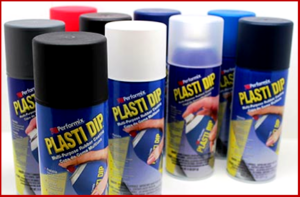
 The California Air Resources Board today announced a settlement of $170,000 with Plasti Dip International for violating California’s Consumer Products Regulations, specifically related to aerosol coatings. Plasti Dip, located in Blaine, MN is the manufacturer of a rubber coating sold nationwide, including in auto and hardware stores throughout California.
Plasti Dip violated the Aerosol Coating Products Regulation by selling, for use in California, Plasti Dip Metalizer, Plasti Dip Classic Muscle, and Plasti Dip Glossifier, all of which exceeded the allowed reactivity limit.
“CARB is continuously working to ensure that products sold to consumers in California meet the standards for smog-causing chemicals,” CARB Executive Officer Richard Corey said. “These violations impact air quality and public health.”
Plasti Dip International has been developing and manufacturing specialty coatings and adhesives since 1972. It started with its most popular product, Plasti Dip. The air-dry rubber coating began as a “grip solution” for tool handles and has become a DIY commodity for crafters, handymen and automotive enthusiasts.
Aerosol coatings such as Plasti Dip products dispense product ingredients by means of a propellant. They are packaged in a disposable aerosol container for hand-held application, or for use in specialized equipment such as ground traffic and other marking applications.
CARB adopted its Aerosol Coating Products Regulation to reduce reactive organic compounds (ROC) from aerosol coating products by limiting product reactivity. Reactivity refers to ROC’s potential to undergo a chemical reaction to form ground-level ozone. ROCs are an important precursor, or component in the formation of ground level ozone, a major part of California’s smog problem.
Any person or company selling or manufacturing aerosol coating products for use in California must comply with the standards in the Aerosol Coating Products Regulation, including the reactivity limits, as well as labeling, reporting, dating, and other administrative requirements.
To meet the terms of its settlement agreement, Plasti Dip modified its products to meet CARB’s regulatory requirements. They will also pay a settlement amount of $170,000 to the Air Pollution Control Fund.

About Ken Zino
Ken Zino, editor and publisher of AutoInformed, is a versatile auto industry participant with global experience spanning decades in print and broadcast journalism, as well as social media. He has automobile testing, marketing, public relations and communications experience. He is past president of The International Motor Press Assn, the Detroit Press Club, founding member and first President of the Automotive Press Assn. He is a member of APA, IMPA and the Midwest Automotive Press Assn.
He also brings an historical perspective while citing their contemporary relevance of the work of legendary auto writers such as Ken Purdy, Jim Dunne or Jerry Flint, or writers such as Red Smith, Mark Twain, Thomas Jefferson – all to bring perspective to a chaotic automotive universe.
Above all, decades after he first drove a car, Zino still revels in the sound of the exhaust as the throttle is blipped during a downshift and the driver’s rush that occurs when the entry, apex and exit points of a turn are smoothly and swiftly crossed. It’s the beginning of a perfect lap.
AutoInformed has an editorial philosophy that loves transportation machines of all kinds while promoting critical thinking about the future use of cars and trucks.
Zino builds AutoInformed from his background in automotive journalism starting at Hearst Publishing in New York City on Motor and MotorTech Magazines and car testing where he reviewed hundreds of vehicles in his decade-long stint as the Detroit Bureau Chief of Road & Track magazine. Zino has also worked in Europe, and Asia – now the largest automotive market in the world with China at its center.







CARB Fines Plasti Dip International for Air Quality Violations
Plasti Dip violated the Aerosol Coating Products Regulation by selling, for use in California, Plasti Dip Metalizer, Plasti Dip Classic Muscle, and Plasti Dip Glossifier, all of which exceeded the allowed reactivity limit.
“CARB is continuously working to ensure that products sold to consumers in California meet the standards for smog-causing chemicals,” CARB Executive Officer Richard Corey said. “These violations impact air quality and public health.”
Plasti Dip International has been developing and manufacturing specialty coatings and adhesives since 1972. It started with its most popular product, Plasti Dip. The air-dry rubber coating began as a “grip solution” for tool handles and has become a DIY commodity for crafters, handymen and automotive enthusiasts.
Aerosol coatings such as Plasti Dip products dispense product ingredients by means of a propellant. They are packaged in a disposable aerosol container for hand-held application, or for use in specialized equipment such as ground traffic and other marking applications.
CARB adopted its Aerosol Coating Products Regulation to reduce reactive organic compounds (ROC) from aerosol coating products by limiting product reactivity. Reactivity refers to ROC’s potential to undergo a chemical reaction to form ground-level ozone. ROCs are an important precursor, or component in the formation of ground level ozone, a major part of California’s smog problem.
Any person or company selling or manufacturing aerosol coating products for use in California must comply with the standards in the Aerosol Coating Products Regulation, including the reactivity limits, as well as labeling, reporting, dating, and other administrative requirements.
To meet the terms of its settlement agreement, Plasti Dip modified its products to meet CARB’s regulatory requirements. They will also pay a settlement amount of $170,000 to the Air Pollution Control Fund.
About Ken Zino
Ken Zino, editor and publisher of AutoInformed, is a versatile auto industry participant with global experience spanning decades in print and broadcast journalism, as well as social media. He has automobile testing, marketing, public relations and communications experience. He is past president of The International Motor Press Assn, the Detroit Press Club, founding member and first President of the Automotive Press Assn. He is a member of APA, IMPA and the Midwest Automotive Press Assn. He also brings an historical perspective while citing their contemporary relevance of the work of legendary auto writers such as Ken Purdy, Jim Dunne or Jerry Flint, or writers such as Red Smith, Mark Twain, Thomas Jefferson – all to bring perspective to a chaotic automotive universe. Above all, decades after he first drove a car, Zino still revels in the sound of the exhaust as the throttle is blipped during a downshift and the driver’s rush that occurs when the entry, apex and exit points of a turn are smoothly and swiftly crossed. It’s the beginning of a perfect lap. AutoInformed has an editorial philosophy that loves transportation machines of all kinds while promoting critical thinking about the future use of cars and trucks. Zino builds AutoInformed from his background in automotive journalism starting at Hearst Publishing in New York City on Motor and MotorTech Magazines and car testing where he reviewed hundreds of vehicles in his decade-long stint as the Detroit Bureau Chief of Road & Track magazine. Zino has also worked in Europe, and Asia – now the largest automotive market in the world with China at its center.