Click for more.
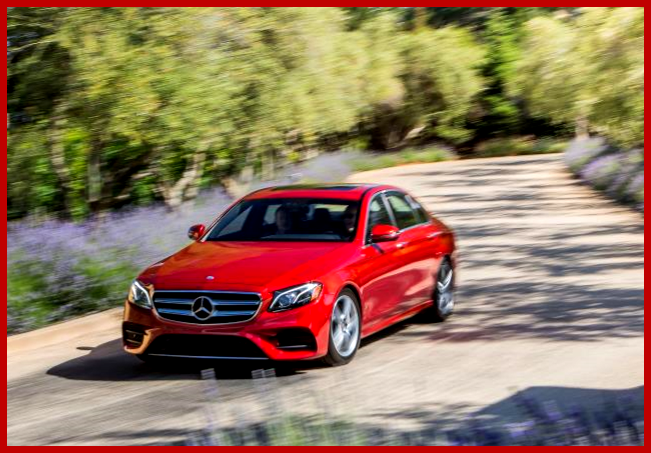
The new E-Class is arguably only one generation away from evolving into a self-driving car. It comes standard with Active Brake Assist, which can decrease the severity of rear-end collisions or prevent them entirely. The radar-based system constantly monitors the area of traffic in front of the vehicle and calculates the distance and speed of the vehicles ahead. If, in the speed range between 4 and 155 mph, the system detects an acute risk of collision because of slower or stopped vehicles or, in the speed range between 4 and 50 mph, because of stationary vehicles or crossing pedestrians, the system gives the driver an additional audible warning.
Further, the Active Brake Assist system computes the brake pressure required to prevent a collision if possible. If, having been warned, the driver then steps on the brake pedal, the system is capable of boosting braking pressure in line with the needs of the situation, making the best possible use of the remaining stopping distance in order to leave the vehicles behind room to brake.
There is also Attention Assist, with adjustable sensitivity,which warns the driver of inattentiveness and drowsiness. Crosswind Assist helps drivers by enabling them to clearly counteract disturbances such as strong gusts of wind by means of one-sided braking.
The E-Class offers additional optional assistance systems, including semi-autonomous driving on motorways, country roads and even in the city, as well as assistance when changing lanes on multi-lane roads. Furthermore, it is capable in more and more situations of autonomously braking the vehicle if required, and providing active assistance during evasive maneuvers.
Drive Pilot automatically maintains the correct distance to vehicles in front by adjusting the car’s desired speed to that of a slower-moving vehicle ahead. With the Steering Pilot sub-function, the E-Class will stay within a lane up to speeds of 130 mph. This helps the driver, who no longer needs to operate the brake or accelerator pedal during normal driving and also receives plenty of steering assistance – even on turns.
Luddites?
The critics [Luddites? – AutoCrat] said the FTC “should take enforcement action against companies that falsely, misleadingly, or unfairly claim that their cars drive autonomously when they actually require the steady control of a human driver.”
The letter acknowledges that on-screen fine print reads: “Vehicle cannot drive itself, but has automated driving features. System will remind the driver frequently to keep hands on the steering wheel. Always observe safe driving practices and obey all state and federal laws…”
The fine print here does not let Mercedes-Benz off the hook, say the naysayers. According to FTC guidance, ‘advertisers can’t use fine print to contradict other statements in an ad or clear up false impressions the ad might leave’ and ‘it’s against the law for businesses to bury important details about a product or service in the fine print. The fine print in this ad certainly contains important details, and likely is intended to clear up false impressions that the images and voice-over may convey.”