
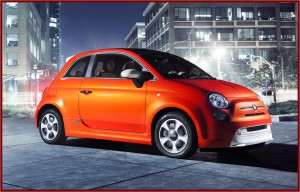
The Fiat 500 EV will lose money because of small sales. Gasoline versions are doing well, though.
U.S. electric vehicle or EV sales are approaching a quarter million, and 20 plug-in models are now available in some parts of the country. This represents an increase, arguably big, from the introductions of the Chevy Volt and Nissan Leaf plug-in EVs in model year 2011. New battery electric models, aka BEVs, introduced since 2011, are the Honda Fit, Chevy Spark, Ford Focus EV, Toyota RAV4 EV, Tesla Model S, the Smart ED, Chevy Spark EV, and the BMW i3.
While the average energy efficiency of EVs is improving, making gasoline and diesel vehicles more efficient also reduces fuel consumption and lowers emissions, too. This means that consumers still show a strong preference for far less costly conventional vehicles. For example, the Volt and the Cadillac ELR account for 14,000 sales year-to-date, while GM has sold almost 2 million vehicles in the U.S. during the same period.
The European Union wants to ban automobiles from all cities by 2050, which has automakers scrambling to develop cleaner modes of transportation. Consultancy Frost & Sullivan claims that the European EV industry is expected to reach shipments of around 62,000 units by 2017, increasing from 245 units in 2011, predominantly in developing urban areas as well as due to anticipated optimization of the supply chain and, therefore, substantial EV cost reductions.
Frost & Sullivan says the lack of government support – especially ‘soft incentives,’ such as the ability to use bus lanes and free parking – in the short-term is expected to restrain Euro EV industry growth. Financial subsidies are not expected to have a strong direct impact on sales, yet appear to be necessary in order to catalyze its development at the initial stage the consultancy says.
World petroleum and other liquid fuels use will increase by 38% between 2010 and 2040, all in the non-OECD countries, according to the U.S. Energy Information Administration. Developing Asia – including China and India – and the Middle East make for 85% of the growth. This requires 33 MMbbl/d of additional liquid fuels to reach 119 MMb/d by 2040. (OPEC crude and lease condensate increases by 14 MMbbl/d. Non-OPEC crude and lease condensate increases by 10 MMbbl/d.) Some of the liquid fuels will go to power generation, of course, but the conventional four-cycle fossil fuel engine while be around for a long, long time.
Consider that the Nissan Leaf was improved for the 2013 model year – more aggressive regenerative braking, better aerodynamics, and a better electric motor. This resulted in an improved efficiency rating from 0.34 kWh per mile traveled to the current rating of 0.30 kWh/mile. Current ratings are an estimated driving range on a fully-charged battery of 84 miles and U.S. MPGe ratings of 126 city, 101 highway and 114 combined. The price of a Leaf starts at about $23,000 after a possible $7,500 federal tax credit
However, Leaf sales year to date are only 19,000 in a U.S. market that could see 17 million light vehicles sold or leased 1in 2014. Globally, Leaf sales are 135,000 since launch.
The Fiat 500e and the BMW i3 are more efficient than the Leaf with the i3 now the most efficient vehicle on the road – achieving an EPA rating of .27kWh/mile. Tesla Model S models are rated at 0.35 kWh/mile and 0.38 kWh/mile. The RAV 4 EV is rated at 0.44 kWh.
To put this in some sort of layman’s perspective, the EV promoting Union of Concerned Scientists calculates that the amount of electricity you use running a toaster oven for 20 minutes can move a 3,000-pound electric car more than a mile. Consumers are saying so what.