Click to Enlarge.
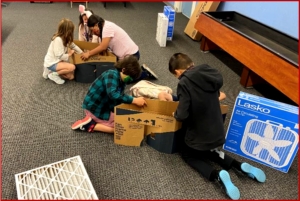
Ford claims that its COVID-19 air filtration kit co-developed with Lasko is effective in fighting the spread of the deadly virus. It cites a scientific journal as proof. The kit is based on Ford research as well as scientific studies by academic and government agencies. It can be assembled at home or in school.
An article, titled “Airborne Transmission of COVID-19 and Mitigation Using Box Fan Air Cleaners in a Poorly Ventilated Classroom,” was published this week in the journal “Physics of Fluids.” Led by Ford with the University of Minnesota, the article cites an investigation using supercomputer air flow analysis to determine if a low-cost box fan air cleaner can mitigate the risk of airborne transmission of COVID-19 in a classroom equipped with a single horizontal unit ventilator.
The study found that box fan air cleaners like this can serve as an effective low-cost alternative for mitigating airborne transmission risks in poorly ventilated spaces. In addition to the peer-reviewed article, research conducted by Well Living Lab, founded as a collaboration between Delos and Mayo Clinic, found similar air purifiers were effective at improving air quality in poorly ventilated areas.
Ford and Lasko are donating 20,000 of these easy-to-make kits to under-served communities. Featuring an open-source design, the kit can be used by others interested in making their own to help reduce COVID-19 in rooms and other enclosed spaces. In conjunction with the Ford Fund, the company’s philanthropic arm, Ford has shipped most of the 20,000 planned units to organizations in under-served communities, including school districts in Los Angeles, New York City and throughout Southeast Michigan.
Scrappy Filtration, as it’s called by Ford’s COVID-19 Project Apollo team, is an air filtration kit made from an easy-to-assemble die-cut cardboard base, a 20-inch Lasko box fan, and a 20x20x4-inch air filter with a standard minimum efficiency reporting value of 13. The air filter is placed inside the folded cardboard base, with the fan placed on top. The fan operates on high for maximum filtration – discharging clean air downward as it pulls unfiltered air from above.
The air filtration kit is intended to supplement a room’s existing filtration system to further help reduce the risk of COVID-19 virus particle concentration. The kit is based on Ford research as well as scientific studies by academic and government agencies.
“We wanted to help under-served communities reduce the risk of airborne COVID-19 in poorly ventilated areas, and it’s great to not only develop something that can meet that goal, but has the data to back it up,” said Dr. Cynthia Flanigan, director, vehicle research and technology, Ford research and advanced engineering. “We engaged with technical leads from University of Minnesota, as well as other scientists doing research in this space, such as Well Living Lab to make sure our research was rock-solid,” Flanigan said.

About Ken Zino
Ken Zino, editor and publisher of AutoInformed, is a versatile auto industry participant with global experience spanning decades in print and broadcast journalism, as well as social media. He has automobile testing, marketing, public relations and communications experience. He is past president of The International Motor Press Assn, the Detroit Press Club, founding member and first President of the Automotive Press Assn. He is a member of APA, IMPA and the Midwest Automotive Press Assn.
He also brings an historical perspective while citing their contemporary relevance of the work of legendary auto writers such as Ken Purdy, Jim Dunne or Jerry Flint, or writers such as Red Smith, Mark Twain, Thomas Jefferson – all to bring perspective to a chaotic automotive universe.
Above all, decades after he first drove a car, Zino still revels in the sound of the exhaust as the throttle is blipped during a downshift and the driver’s rush that occurs when the entry, apex and exit points of a turn are smoothly and swiftly crossed. It’s the beginning of a perfect lap.
AutoInformed has an editorial philosophy that loves transportation machines of all kinds while promoting critical thinking about the future use of cars and trucks.
Zino builds AutoInformed from his background in automotive journalism starting at Hearst Publishing in New York City on Motor and MotorTech Magazines and car testing where he reviewed hundreds of vehicles in his decade-long stint as the Detroit Bureau Chief of Road & Track magazine. Zino has also worked in Europe, and Asia – now the largest automotive market in the world with China at its center.







Ford DIY COVID-19 Air Filtration Kit?
Click to Enlarge.
Ford claims that its COVID-19 air filtration kit co-developed with Lasko is effective in fighting the spread of the deadly virus. It cites a scientific journal as proof. The kit is based on Ford research as well as scientific studies by academic and government agencies. It can be assembled at home or in school.
An article, titled “Airborne Transmission of COVID-19 and Mitigation Using Box Fan Air Cleaners in a Poorly Ventilated Classroom,” was published this week in the journal “Physics of Fluids.” Led by Ford with the University of Minnesota, the article cites an investigation using supercomputer air flow analysis to determine if a low-cost box fan air cleaner can mitigate the risk of airborne transmission of COVID-19 in a classroom equipped with a single horizontal unit ventilator.
The study found that box fan air cleaners like this can serve as an effective low-cost alternative for mitigating airborne transmission risks in poorly ventilated spaces. In addition to the peer-reviewed article, research conducted by Well Living Lab, founded as a collaboration between Delos and Mayo Clinic, found similar air purifiers were effective at improving air quality in poorly ventilated areas.
Ford and Lasko are donating 20,000 of these easy-to-make kits to under-served communities. Featuring an open-source design, the kit can be used by others interested in making their own to help reduce COVID-19 in rooms and other enclosed spaces. In conjunction with the Ford Fund, the company’s philanthropic arm, Ford has shipped most of the 20,000 planned units to organizations in under-served communities, including school districts in Los Angeles, New York City and throughout Southeast Michigan.
Scrappy Filtration, as it’s called by Ford’s COVID-19 Project Apollo team, is an air filtration kit made from an easy-to-assemble die-cut cardboard base, a 20-inch Lasko box fan, and a 20x20x4-inch air filter with a standard minimum efficiency reporting value of 13. The air filter is placed inside the folded cardboard base, with the fan placed on top. The fan operates on high for maximum filtration – discharging clean air downward as it pulls unfiltered air from above.
The air filtration kit is intended to supplement a room’s existing filtration system to further help reduce the risk of COVID-19 virus particle concentration. The kit is based on Ford research as well as scientific studies by academic and government agencies.
“We wanted to help under-served communities reduce the risk of airborne COVID-19 in poorly ventilated areas, and it’s great to not only develop something that can meet that goal, but has the data to back it up,” said Dr. Cynthia Flanigan, director, vehicle research and technology, Ford research and advanced engineering. “We engaged with technical leads from University of Minnesota, as well as other scientists doing research in this space, such as Well Living Lab to make sure our research was rock-solid,” Flanigan said.
About Ken Zino
Ken Zino, editor and publisher of AutoInformed, is a versatile auto industry participant with global experience spanning decades in print and broadcast journalism, as well as social media. He has automobile testing, marketing, public relations and communications experience. He is past president of The International Motor Press Assn, the Detroit Press Club, founding member and first President of the Automotive Press Assn. He is a member of APA, IMPA and the Midwest Automotive Press Assn. He also brings an historical perspective while citing their contemporary relevance of the work of legendary auto writers such as Ken Purdy, Jim Dunne or Jerry Flint, or writers such as Red Smith, Mark Twain, Thomas Jefferson – all to bring perspective to a chaotic automotive universe. Above all, decades after he first drove a car, Zino still revels in the sound of the exhaust as the throttle is blipped during a downshift and the driver’s rush that occurs when the entry, apex and exit points of a turn are smoothly and swiftly crossed. It’s the beginning of a perfect lap. AutoInformed has an editorial philosophy that loves transportation machines of all kinds while promoting critical thinking about the future use of cars and trucks. Zino builds AutoInformed from his background in automotive journalism starting at Hearst Publishing in New York City on Motor and MotorTech Magazines and car testing where he reviewed hundreds of vehicles in his decade-long stint as the Detroit Bureau Chief of Road & Track magazine. Zino has also worked in Europe, and Asia – now the largest automotive market in the world with China at its center.