
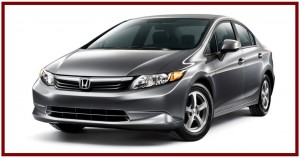
As it stands compressed natural gas – CNG – vehicles that are the current clean air darlings under debatable assumptions about how clean natural gas really is and how it is produced are all conversions of mostly Detroit Three pickup trucks and vans with one Honda factory-made exception.
There is an interesting technical argument about CNG and LPG powertrains that are apparently cheaper and arguably more eco-friendly in cars than diesel or gasoline engines. It starts with combustion that is cleaner, thereby reducing emissions of particulates and nitrogen oxides. Both demonstrably bad stuff.
The real deal, however, is money.
Both fuels are less expensive than gasoline or diesel. There are marketplace anomalies here of course due to low production costs and pernicious tax incentives that add to a compressed natural gas (CNG) sum of -50% less than gasoline. However, these gas-powered vehicles are a little more expensive to buy than petrol-powered ones, because they are generally equipped with two fuel systems – gasoline and CNG/LPG.
Nonetheless, more automakers are offering CNG vehicles, with the difference in price comparable to that between diesel and gasoline variants, generally several thousand dollars more. In Germany, because of government tinkering, CNG powertrains in passenger cars return their investment as soon as annual mileage exceeds 7,000 kilometers.
Compared with a conventional gasoline engine, a gas-powered vehicle at equivalent output power would emit 25% less CO2. This is due to the chemical properties of the fuel. The CO2 savings offered by liquefied petroleum gas (LPG) are lower, but it is less expensive to convert a vehicle to LPG than it is to buy a CNG system.
Since natural gas systems already have the potential to reduce CO2 emissions at little extra cost, they are attractive to politicians who want to spend your money while appearing to do something. To make CNG-powered vehicles more popular on the road, the infrastructure needs to be significantly expanded. Lots of pork potential here.
In Germany – and AutoInformed is by no means offering the moribund, bureaucratic-ridden EU as an economic or political model – both fuels enjoy tax incentives, which will last until 2018. CNG, a gas, is priced in kilograms, while LPG, a liquid, is priced in liters. If all you look at is the prices advertised at non-service stations, then the comparison is invidious.
Heiko Kaiser, a gas systems expert at Bosch, the German mega-supplier says that one kilogram of CNG contains the same energy as around two liters of LPG. Put another way, it is around a third cheaper to obtain one kilowatt-hour of energy from CNG than it is from LPG.







