
While cost is important, more than 70% of passenger satisfaction is determined by other parts of the overall experience.
Low-cost airlines continue to improve their passenger satisfaction, but traditional carriers still largely fail to meet travelers’ expectations. A new study finds that after two years of slight industry improvements, overall passenger satisfaction has declined to 681 index points on a 1,000-point scale–down from 683 in 2011.
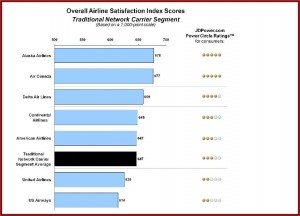
Although satisfaction with low-cost carriers improved for a third consecutive year, increasing three index points from 2011 to an average of 754, satisfaction with traditional carriers declined 4 points to 647.
The study measures overall customer satisfaction based on performance in seven factors (in order of importance): cost and fees; in-flight services; boarding/deplaning/baggage; flight crew; aircraft; check-in; and reservations.
“The airline industry is caught between trying to satisfy customers who demand low prices, high-quality service and comfort, and contending with the economic challenges of profitably operating an airline,” said Stuart Greif, vice president and general manager of the global travel and hospitality practice at J.D. Power and Associates, the source of the data.
Cost and fees continue to affect results. Checked baggage fees are a large customer sore point and have a notable impact, with satisfaction averaging 85 points lower among passengers who pay to check bags. The two carriers with the highest satisfaction scores in the study, JetBlue Airways and SouthwestAirlines, do not charge passengers to check the first bag. Air Canada, which also does not charge for the first bag, performs particularly well among the traditional network carriers in the cost and fees area.
While cost is important, more than 70% of passenger satisfaction is determined by other parts of the overall experience. The study finds that the attributes pertaining to a carrier’s process and people, rather than price, are more highly correlated with passengers’ intentions to fly with an airline again in the future.







