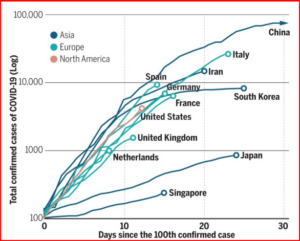
The virus is now spreading more rapidly in the US than Europe or Asia because of the slow response from many American political leaders. They have blood on their partisan hands. Click to Enlarge.
A new study from the University of Chicago find that only 34% of U.S. jobs could be performed at home. Using average hourly wages by occupation and assuming that all occupations involve the same hours of work, Jonathan Dingel and Brent Neiman determine that these jobs account for 44% all wages. It’s an important supplement to the growing body of COVID-19 research and the total unpreparedness – still only partially resolved – of the Federal and State Governments to provide for the health and security of our people.
“Our estimate is an upper bound on what might be feasible and greatly exceeds the share of jobs that in fact have been performed entirely at home in recent years,” they say. Jonathan Dingel and Brent Neiman conclude that identifying which jobs cannot be performed from home could help to target social insurance payments to those who need them the most.
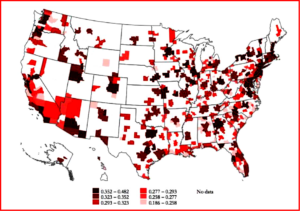
US Jobs that Can be Done at Home.Click to Enlarge.
They observe substantial variation across cities. For example, more than 40% of jobs in San Francisco, San Jose, Austin, and Washington, D.C., can be performed at home, compared with fewer than 30% in Fort Myers, Grand Rapids, and Las Vegas.
They also find differences across industries. While most jobs in finance, corporate management, and professional and scientific services can be performed at home, very few in agriculture, hotels, retail, or restaurants can be done remotely.
“Our work also relates to Mas and Pallais (2020), who offer a detailed and helpful overview of the prevalence, features, and demand for alternative working arrangements, including the ability to work from home. Citing the Quality of Worklife Survey and the Understanding American Study, they report that less than 13 percent of full- and part-time jobs have a formal “work-from- home” arrangement, even though twice that amount work often from home. According to Mas and Pallais, the “median worker reports that only 6 percent of their job could be feasibly done from home,” but plenty of jobs, including those in “computer and mathematical” and “business and financial operations” can do a majority of their work from home. We note that, in the context of the response to COVID-19, there is an important distinction between being able to do most and all of one’s work at home.
“Finally, a recently released paper by the United Kingdom Office for National Statistics (2020) reports that while 27 percent of the U.K. workforce said they’ve previously worked from home, only about 5 percent said they mainly work from home. Whether people have actually worked from home differs conceptually from the focal question of this note, which is whether these people could feasibly work from home.”
References
- Blinder, Alan. 2009. “How Many US Jobs Might be Offshorable?” World Economics, 10(2): 4178.
- Blinder, Alan S., and Alan B. Krueger. 2013. “Alternative Measures of Offshorability: A Survey Approach.” Journal of Labor Economics, 31(S1): 97-128.
- Mas, Alexandre, and Amanda Pallais. 2020. “Alternative Work Arrangements.” Annual Review of Economics.
- United Kingdom Office for National Statistics. 2020. “Coronavirus and homeworking in the UK labour market: 2019.” Working Paper

About Ken Zino
Ken Zino, editor and publisher of AutoInformed, is a versatile auto industry participant with global experience spanning decades in print and broadcast journalism, as well as social media. He has automobile testing, marketing, public relations and communications experience. He is past president of The International Motor Press Assn, the Detroit Press Club, founding member and first President of the Automotive Press Assn. He is a member of APA, IMPA and the Midwest Automotive Press Assn.
He also brings an historical perspective while citing their contemporary relevance of the work of legendary auto writers such as Ken Purdy, Jim Dunne or Jerry Flint, or writers such as Red Smith, Mark Twain, Thomas Jefferson – all to bring perspective to a chaotic automotive universe.
Above all, decades after he first drove a car, Zino still revels in the sound of the exhaust as the throttle is blipped during a downshift and the driver’s rush that occurs when the entry, apex and exit points of a turn are smoothly and swiftly crossed. It’s the beginning of a perfect lap.
AutoInformed has an editorial philosophy that loves transportation machines of all kinds while promoting critical thinking about the future use of cars and trucks.
Zino builds AutoInformed from his background in automotive journalism starting at Hearst Publishing in New York City on Motor and MotorTech Magazines and car testing where he reviewed hundreds of vehicles in his decade-long stint as the Detroit Bureau Chief of Road & Track magazine. Zino has also worked in Europe, and Asia – now the largest automotive market in the world with China at its center.








Only 34% of Jobs in US Can Be Done Remotely
The virus is now spreading more rapidly in the US than Europe or Asia because of the slow response from many American political leaders. They have blood on their partisan hands. Click to Enlarge.
A new study from the University of Chicago find that only 34% of U.S. jobs could be performed at home. Using average hourly wages by occupation and assuming that all occupations involve the same hours of work, Jonathan Dingel and Brent Neiman determine that these jobs account for 44% all wages. It’s an important supplement to the growing body of COVID-19 research and the total unpreparedness – still only partially resolved – of the Federal and State Governments to provide for the health and security of our people.
“Our estimate is an upper bound on what might be feasible and greatly exceeds the share of jobs that in fact have been performed entirely at home in recent years,” they say. Jonathan Dingel and Brent Neiman conclude that identifying which jobs cannot be performed from home could help to target social insurance payments to those who need them the most.
US Jobs that Can be Done at Home.Click to Enlarge.
They observe substantial variation across cities. For example, more than 40% of jobs in San Francisco, San Jose, Austin, and Washington, D.C., can be performed at home, compared with fewer than 30% in Fort Myers, Grand Rapids, and Las Vegas.
They also find differences across industries. While most jobs in finance, corporate management, and professional and scientific services can be performed at home, very few in agriculture, hotels, retail, or restaurants can be done remotely.
“Our work also relates to Mas and Pallais (2020), who offer a detailed and helpful overview of the prevalence, features, and demand for alternative working arrangements, including the ability to work from home. Citing the Quality of Worklife Survey and the Understanding American Study, they report that less than 13 percent of full- and part-time jobs have a formal “work-from- home” arrangement, even though twice that amount work often from home. According to Mas and Pallais, the “median worker reports that only 6 percent of their job could be feasibly done from home,” but plenty of jobs, including those in “computer and mathematical” and “business and financial operations” can do a majority of their work from home. We note that, in the context of the response to COVID-19, there is an important distinction between being able to do most and all of one’s work at home.
“Finally, a recently released paper by the United Kingdom Office for National Statistics (2020) reports that while 27 percent of the U.K. workforce said they’ve previously worked from home, only about 5 percent said they mainly work from home. Whether people have actually worked from home differs conceptually from the focal question of this note, which is whether these people could feasibly work from home.”
References
About Ken Zino
Ken Zino, editor and publisher of AutoInformed, is a versatile auto industry participant with global experience spanning decades in print and broadcast journalism, as well as social media. He has automobile testing, marketing, public relations and communications experience. He is past president of The International Motor Press Assn, the Detroit Press Club, founding member and first President of the Automotive Press Assn. He is a member of APA, IMPA and the Midwest Automotive Press Assn. He also brings an historical perspective while citing their contemporary relevance of the work of legendary auto writers such as Ken Purdy, Jim Dunne or Jerry Flint, or writers such as Red Smith, Mark Twain, Thomas Jefferson – all to bring perspective to a chaotic automotive universe. Above all, decades after he first drove a car, Zino still revels in the sound of the exhaust as the throttle is blipped during a downshift and the driver’s rush that occurs when the entry, apex and exit points of a turn are smoothly and swiftly crossed. It’s the beginning of a perfect lap. AutoInformed has an editorial philosophy that loves transportation machines of all kinds while promoting critical thinking about the future use of cars and trucks. Zino builds AutoInformed from his background in automotive journalism starting at Hearst Publishing in New York City on Motor and MotorTech Magazines and car testing where he reviewed hundreds of vehicles in his decade-long stint as the Detroit Bureau Chief of Road & Track magazine. Zino has also worked in Europe, and Asia – now the largest automotive market in the world with China at its center.