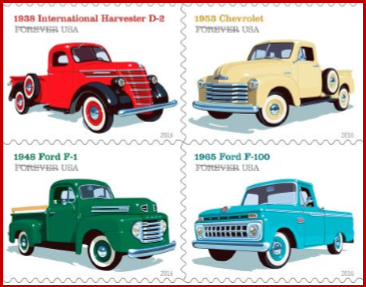
 The U.S. Postal Service celebrated work vehicles that Americans have driven for nearly a century today with the dedication of the Pickup Trucks Forever stamps that highlight four noteworthy models: the 1938 International Harvester D-2; the 1948 Ford F-1; the 1953 Chevrolet; and the 1965 Ford F-100.
“The pickup truck embodies America’s strong work ethic — the work it takes to transport the country’s building blocks, to operate our nation’s agricultural centers and to grow our businesses and communities,” said U.S. Postal Service Chief Human Resources Officer and Executive Vice President Jeff Williamson.
Pickup Profiles
The origin of pickup trucks can be traced back to the early 20th century, when automobiles first became popular in the United States. The trucks made personally hauling cargo, once the job of horse-drawn wagons, easier. By the early 1900s, several manufacturers began producing light-duty trucks in limited numbers.
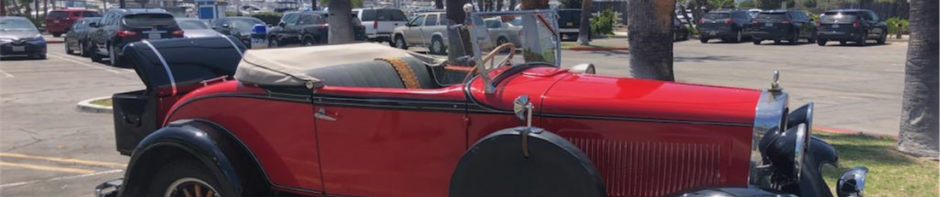
 The first fully factory assembled pickup truck didn’t arrive until the middle of the next decade, when the 1925 Ford Model T Runabout with Pick-Up Body appeared. A fortified version of Ford’s Model T, it had a base price of $281, a steel bed, and was powered by ahem, a 20-horsepower engine. Ford sold nearly 34,000 Model T pickups, starting a trend that continues to this day.
Automaker Studebaker used the word “pickup” in an advertisement in 1913, but the exact root of the term “pickup” is unclear. By the Great Depression, it had become part of the American lexicon. U.S. Federal Regulations currently classify the pickup truck as “a non-passenger automobile which has a passenger compartment and an open cargo area (bed).” Yeah right.
1938 International Harvester D-2
Known for its production of agricultural equipment, International Harvester also made acclaimed light-duty trucks. In the 1930s, the company introduced its D line of pickups. With its six-cylinder engine and half-ton payload capacity, the 1938 International Harvester D-2 was a strong, sturdy pickup. The model was also visually striking. It had a distinct barrel-shaped grille. Its styling deliberately mirrored the look of luxury automobiles of the era – a trend, at least in interior accouterments and sophisticated powertrains and safety equipment – that continues to this day when it is possible to spend $75,000 on a fully optioned pickup.
In the 1960s and 1970s, International Harvester’s line of light trucks flourished. In addition to the pickup version of the popular Scout, the company offered the C-Series, including the C-110. Most International Harvester pickups of the era were available in a number of different wheelbases, a variety of engines, and with a larger, “Bonus-Load” bed. These models also offered a crew cab option, a popular concept introduced by International Harvester in 1957.
1948 Ford F-1
Ford’s F-Series also viagra online au differed greatly from relatively sparse models previously available by incorporating a car interior. Also known as the “Bonus Built” line, F-Series trucks were, in the words of Ford’s famous advertising campaign, “built stronger to last longer.” Ford launched the new line with the 1948 Ford F-1. It included the roomy “Million Dollar Cab,” a sharp horizontal five-bar grille, and a six- or eight-cylinder engine. Ford sold more than 300,000 trucks in the first model year of the F-Series.
1953 Chevrolet
In 1947, Chevrolet rolled out the Advance-Design Series, the first all-new post-World War II pickup truck line. The new Chevys were roomier and more powerful than ever. Advance-Design pickups, such as the 1953 Chevrolet, featured large windshields that provided drivers with excellent visibility, a distinctive curvy grille that bulged in the middle, and a six-cylinder engine. Advance-Design trucks were America’s top-selling pickups for nearly a decade.
1965 Ford F-100
For the 1965 model year, the F-Series pickup got a facelift. The 1965 Ford F-100 had a new grille that featured 18 small rectangular openings. It also had what Ford dubbed “Twin-I-Beam” independent front suspension, which was said to improve the quality of the ride, and a powerful six- or eight-cylinder engine. The F-Series is still in production today of course long been the country’s top-selling truck line. As of 2015, there have been 13 generations of F-Series pickups.
Artist Chris Lyons of Rochester, NY, used Adobe Illustrator to create stylized renderings of the pickup trucks. Art director Antonio Alcalá of Alexandria, VA, designed the stamps. Visit this link for dates and locations on upcoming stamp events.
Ordering First-Day-of-Issue Postmarks
Customers have 60 days to obtain the first-day-of-issue postmark by mail. They may purchase new stamps at their local Post Office, at The Postal Store website at usps.com?shop, or by calling 800-782-6724. They should affix the stamps to envelopes of their choice, address the envelopes (to themselves or others), and place them in a larger envelope addressed to:
Pickup Trucks Stamps
Postmaster
5640 East Taft Road
Syracuse, NY 13220-9810
After applying the first-day-of-issue postmark, the Postal Service will return the envelopes through the mail. There is no charge for the postmark up to a quantity of 50. There is a 5-cent charge for each additional postmark over 50. All orders must be postmarked by Sept. 15, 2016.
Ordering First-Day Covers
The Postal Service also offers first-day covers for new stamp issues and Postal Service stationery items postmarked with the official first-day-of-issue cancellation. Each item has an individual catalog number and is offered in the quarterly USA Philatelic catalog, online at usps.com?shop, or by calling 800-782-6724. Customers may request a free catalog by calling 800-782-6724 or writing to:
U.S. Postal Service
Catalog Request
PO Box 219014
Kansas City, MO 64121-9014