
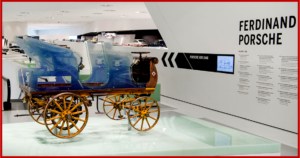
Not a robot in sight.
Porsche Consulting says that one in four employees in Germany would prefer that their jobs not be affected by digitization. That figure rises to 31% for those aged 55 to 65. These are results* of a survey of 1,004 employees from all branches of industry and commerce, as well as the public sector, commissioned by the Porsche Consulting and carried out by the Forsa market research company.
Younger people are more open to change resulting from new technologies. Eighteen percent of the 25-39 age group view digitization as a major advance at their work. This figure is only 8% in the 55+ age group. Per the survey, men are generally more open to digitization at their workplace than women (19% versus 9%).
Half of respondents report upcoming changes in their work environments due to digitization. This figure rises to 71% among those at large companies or corporations with workforces of more than 5,000 people. Of respondents at small companies with fewer than 50 employees, 32% report new developments. Only 13% of respondents have yet to see any effects of the digital transformation on the job, according to this survey.
Where digitization has already arrived at work stations, the responses are largely positive. Sixty-four percent of respondents say that digital technologies have made “many things go faster.” Sixty-one percent report that their work is now easier. And half say that they “can now work in more flexible ways, and are less bound to set times and places.”
Rapid further development of technologies is leading to new formations at work stations. At many companies, humans, high-performance computers, and robots have come together in teams that work in interactive ways. The spread of new forms of work is accelerating at German companies. Forty-two percent of employees say that computers and robots have taken over tasks previously done by people in their immediate work environments over recent years.
This transformation poses a special challenge to business managers and leadership personnel. “Each employee should receive individual guidance on their road to a digital work environment,” says Eberhard Weiblen, President of the Executive Board of Porsche Consulting. This guidance should cover not only the process of change itself, it should devote just as much attention to promoting active employee participation in developing practical solutions. “The teams that actually do the work in question often make the best suggestions. You just have to ask them,” is Weiblen’s observation from consultancy projects.
It is claimed there is great willingness within the workforce to help shape the digital transformation on an active basis. Three out of four employees (73%) would like to contribute more to their companies when it comes to developing new products and services, or new forms of working together. Forty-four percent already participate actively (women 38%; men 50%). Another 29% “would like to” at least, but have not yet done so for lack of opportunity at their companies.
On the other hand, 24% of employees show no interest in participating in new developments. According to Weiblen, “For digitization to be successful, every employee has to be motivated. No manager can afford long-term to have a quarter of the personnel not committed to further developing the business.” He claims every digital agenda must emphasize the importance of “comprehensive further training, internal communications, and employee motivation.”
This should not consist of rigid classroom learning (Germans rigid?). When introducing or increasing digitization, foresighted managers “create experiences that make new approaches more tangible. Hands-on experience makes employees more willing to assimilate new ways of doing things and to further develop their own skills. At our own company, in the automotive industry, we see how much capital there is in highly motivated employees – all the more so during periods of major change.”
Many companies have apparently already set their course when it comes to employee participation in the digital transformation. Sixty-six percent of respondents say that their companies promote their participation in new developments. This approach is currently stronger at industrial companies (70%) and in the service sector (69%) than in the public sector (60%).
Headquartered in Bietigheim-Bissingen, Porsche Consulting GmbH is a subsidiary of the Stuttgart-based auto manufacturer Dr. Ing. h.c. F. Porsche AG. Founded in 1994 with a staff of four, it currently employs more than 380 people. An internationally active company with four subsidiaries of its own in Milan, São Paulo, Atlanta, and Shanghai, it is one of Germany’s leading management consultancies.
*This was a representative survey of 1,004 employees aged 25-65 – chosen by systematic random selection – throughout Germany. The interviews were carried out by the Forsa market research institute from October 18 to 28, 2016.