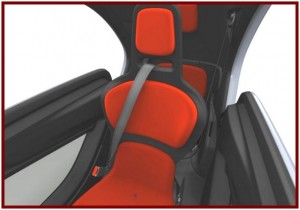
The driver slips an arm under the new vertical shoulder seat belt and then buckles up the regular 3-point seat belt - not shown - as usual.
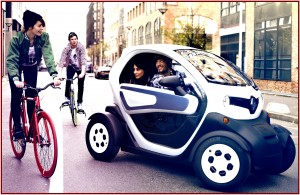
Renaults’ diminutive new electric car, the Twizy, will use a double shoulder seat belt for driver protection. The French company is adding a 2-point-shoulder belt to the well-known 3-point seat belt in universal use.
Geeks can debate whether this is a 4-point seat belt or 5-point solution. Simply put, there are two seat belt systems in play. This latest seat belt restraint design requires a first step – the driver slipping an arm under a fixed 2-pointseat belt, then grabbing a seat belt the opposite side where the traditional “buckle up” action is needed from the driver. Tandem passenger of the two-seat car-like object has only a traditional 3-point seat belt. Since Twizy is really an open air electric motor scooter on four wheels, whether this adds or detracts from the saleability of thus far market challenged EVs remains to be seen.
Other 4-point seat belt solutions exist, but these belts, including 4-point harness belts that automakers have been reluctant to introduce, require both hands for buckling up.
Existing 3-point seat belt systems are effective in most crashes, of course, and for most occupants. They typically reduce the risk for serious head injuries in head-on frontal crashes by 45-75% , according to Autoliv, the supplier of the new restraints, but are less effective for other crash types, such as side impact or roll-over accidents.
By adding a 2-point shoulder belt, the crash load on the driver can be distributed over a wider area, – if it is used – reducing the load on ribs by half. Autoliv says this is especially important for elderly people since the chest of a 60-year old human can only withstand half as much load as the chest of a 20-year-old individual. (Anyone know a 60-year old who will consider driving a Twizy?)
With the added 2-point seat belt, the driver will also be protected in all directions. Having dual seat belts also – in theory – reduces the risk of the driver’s head hitting the inside of the roof in rollover accidents.
The new seat belt system also offers enhanced safety in side-impact collisions, since not only one shoulder of the driver but both shoulders are restrained. This prevents an driver from being thrown or sliding out of the “open side” of a 3-point seat belt when the vehicle is hit on the side where the occupant is not sitting.
In these so-called far-side collisions, the driver is thrust in the direction of the attacking vehicle due to the inertia, and could hit hard objects, including the head of another passenger, which doesn’t apply to the Twizy. In such far-side collisions, tests indicate that Autoliv’s new vertical seat belt over the driver’s inner shoulder will reduce the risk for severe injuries and fatalities by approximately 30%.
Autoliv says that while other 4-point belt solutions exist, these other seat belts, including 4-point harness belts that automakers have been reluctant to introduce, require both hands for buckling up. Studies have shown that the inconvenience of such designs reduces seat belt usage and, as a result, the potential benefits of the 4-point belt system are lost. In contrast, Autoliv’s new belt is said to be easy to use. The driver slips an arm under the new vertical shoulder and then buckles up the regular 3-point seat belt as usual.
See also General Motors to Debut World’s First Center Airbag in 2013







