Click for more.
“November results demonstrate the ongoing tension between vehicle affordability and sales volumes as the industry navigates elevated interest rates and fuel prices,” said Thomas King, president of OEM Solutions at JD Power.
Power U.S. Sales Summary
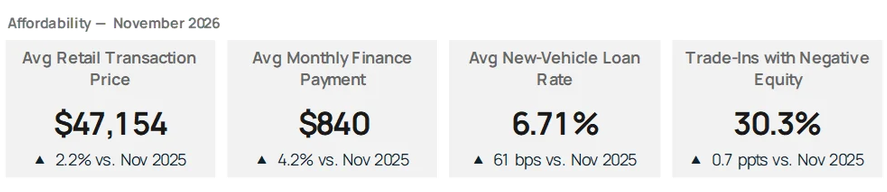
• Average transaction prices expected to rise 2.2% to a November record of $47,154.
• Average monthly payments expected to rise 4.2% to a November record of $840.
• November new-vehicle total sales on track for a 1.2% increase on a selling-day-adjusted basis.
• Retail sales are on pace to rise 1.6% on a selling-day-adjusted basis.
• Hybrid share of retail sales expected to reach 18.3%, up 3.0 percentage points, while EV share is tracking up 1.6 percentage points to 6.7%
Different Maker Incentive Strategies
• “To mitigate the affordability challenges, manufacturers are leaning into discounts to keep buyers in the market. Average incentive spending per vehicle is trending towards $3589, a 5.6% increase from a year ago and $235 more than in October. Incentives as a percentage of manufacturer’s suggested retail price (MSRP) are expected to increase to 6.7%, up 0.2 percentage points from November 2025,” said King.
• “Compared with a year ago, the average interest rate on new vehicle loans is 6.71%, up 61 basis points and the highest November level since 2023.
• “More buyers are carrying negative equity on their trade-ins. In November, 30.3% of trade-ins are projected to have negative equity, up 0.7 percentage points from a year ago.
• “To manage monthly payments in the face of higher rates and negative equity, consumers are using longer loan terms. A total of 12.8% of new-vehicle loans are forecasted to have terms of 84 months or longer, up 1.1 percentage points year-over -year, helping to partially bridge the affordability gap.
• “To mitigate the affordability challenges, manufacturers are leaning into discounts to keep buyers in the market. Average incentive spending per vehicle is trending towards $3,589, a 5.6% increase from a year ago and $235 more than in October. Incentives as a percentage of manufacturer’s suggested retail price (MSRP) are expected to increase to 6.7%, up 0.2 percentage points from November 2025.
• “The divergence in manufacturer incentive strategies by powertrain continues to be evident in November:
• “Incentive spending on traditional internal combustion engine and hybrid vehicles is expected to increase $278 per unit year-over-year, up 8.7% to $3,472 in November 2026.
• “Meanwhile, EV incentives moved in the opposite direction, with a forecasted decline of $5287 per unit or 42.8% to $7055, from an elevated base last November.
• “Buyers continue to shift toward hybrids, with hybrid share of retail sales expected to reach 18.3%, up 3.0 percentage points from last year, due to elevated fuel prices and increased availability of hybrid vehicles. EV share is expected to be 6.7%, up 1.6 percentage points year over year, a return to growth following October’s decline, as the comparison now laps the lower base that followed the expiration of the federal EV tax credit,” said King.