
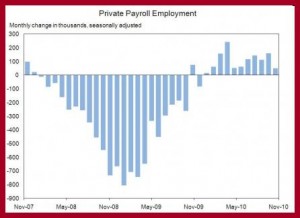
People who want to work remain idle, a human tragedy and an ongoing economic crisis.
As the lame duck U.S. Congress bickers along partisan lines, unemployment rose to 9.8% in November.
While temporary help services and health care continued to add jobs during the month, employment actually fell in retail trade as the holiday shopping season got underway.
Employment in most other major industries – or what’s left of them, according to critics of our lack of an industrial policy that creates jobs — changed little in November, according to the Bureau of Labor Statistics. Unemployment was 9.6% in each of the prior 3 months.
Critics also contend, correctly, that the official data drastically understate how many people are unemployed or under-employed in the United States.
Austan Goolsbee, Chairman of the Council of Economic Advisers, said, “Overall payroll employment rose by 39,000 last month. Among the sectors with the largest payroll employment growth were education and health services (+30,000) and temporary help services (+39,500). Retail trade (-28,100), manufacturing (-13,000), state and local government jobs (-13,000), and construction (-5,000) were among the sectors that subtracted from the total.
Goolsbee also added, insensitively, that … “it is important not to read too much into any one monthly report.”
In spite of attempts by the Administration to spin patently bad news, the latest data continue to show just how deeply ingrained the Great Recession is in the economy, with employers reluctant to add jobs, even though Gross Domestic Product is growing again, albeit slowly.
The latest data is grim for the country and for auto executives, who are looking at years of only gradually improving sales, which at the retail level are running at only 10 million units annually, down from 15 to 17 million vehicles during much of the last decade.
Among the major groups, the unemployment rates for adult men (10%), adult women (8.4%), whites (8.9%), and Hispanics (13.2%) edged up in November. The jobless rate for blacks (16.0%) showed little change over the month, while the rate for teenagers “declined” to 24.6%. The jobless rate for Asians was 7.6%.
Among the unemployed, the number of job losers and persons who completed temporary jobs rose by 390,000 to 9.5 million in November. The number of long-term unemployed (those jobless for 27 weeks or more) was little changed at 6.3 million and accounted for 41.9% of the unemployed.
About 2.5 million persons were marginally attached to the labor force in November, up from 2.3 million a year earlier, according to BLS. These forgotten Americans were not in the labor force, wanted and were available for work, and had looked for a job sometime in the prior 12 months. They were not counted as unemployed because they had not searched for work in the 4 weeks preceding the survey.
Among the “marginally attached” in the cold language of BLS, there were 1.3 million discouraged workers in November, an increase of 421,000 from a year earlier.
Discouraged workers are former taxpayers or productive citizens not currently looking for work because they believe no jobs are available for them. The remaining 1.2 million persons marginally attached to the labor force had not searched for work in the 4 weeks preceding the survey for reasons such as school attendance or family responsibilities.








Pingback: Revised Korean Free Trade Agreement gets UAW and Ford Support - AutoInformed