
Click for more.
Oil Market Hormuz Undercurrents and Minefields
At the close of Wednesday’s formal trading session, WTI rose $3.08 to $73.52 a barrel. The EIA reports that crude oil inventories increased by 3 million barrels from the previous week. At 411.4 million barrels, U.S. crude oil inventories are ~6% below the five-year average for this time of year.
Energy Information Administration Best Guess Given Trump Whims?
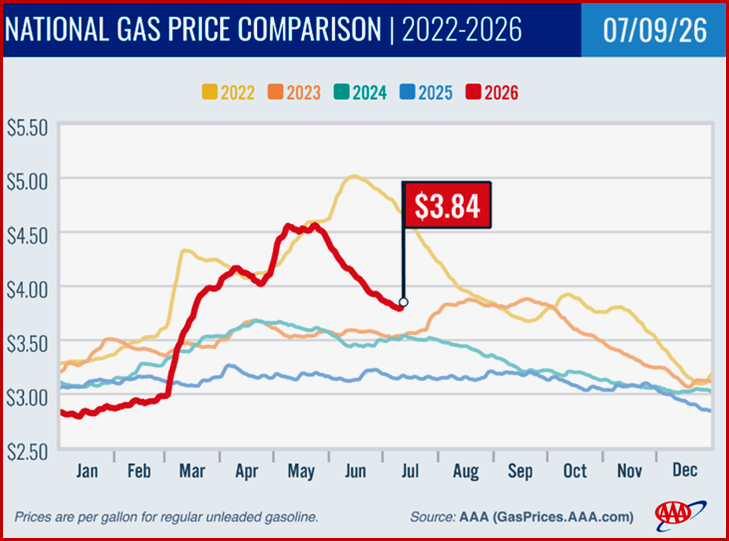
The latest data from the Energy Information Administration (EIA) show gasoline demand decreased last week from 9.13 million b/d to 8.84 million. Total domestic gasoline supply decreased from 214 million barrels to 212.1 million. Gasoline production decreased last week, averaging 9.7 million barrels per day. However, two days ago EIA said “Shipping traffic through the Strait of Hormuz has increased following the June 18 memorandum of understanding (MOU) between the United States and Iran to end a months-long conflict and reopen the strait. EIA now expects worldwide crude oil production and trade flows to rebound to near pre-conflict levels by year’s end, with most previously shut in production returning online by the first quarter of 2027. EIA forecasts that more oil production globally will lower crude oil and gasoline prices, with the U.S. average retail gasoline prices averaging about $3.60 per gallon (gal) in the second half of this year, down from $4.48/gal in May….
“Lower crude oil prices will contribute to a drop in U.S. retail gasoline prices, with EIA’s forecast showing 3Q26 averages declining to $3.80/gal from $4.21/gal in 2Q26. Although tight gasoline inventories keep refiners’ margins elevated in the near term, we expect rebuilding stocks and the end of the summer demand season to narrow those margins and push prices even lower to about $3.40/gal in 4Q26, with the annual average falling below $3.10/gal in 2027,” EIA said.