Raising taxes during an election year? Bet on the proverbial snowball.
A new survey from HNTB Corporation finds two-thirds of Americans “who intend to vote” during this year’s presidential election claim that a candidate’s standing on American transportation infrastructure will influence their decision. More than one in five (22%) claim this will be “extremely influential” on whom they vote for. Nearly nine in ten (89%) Americans feel it is important for the federal government to fund the maintenance and improvements of interstate highways.
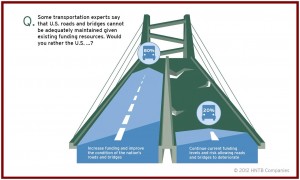
Therein lays the potholes, crumbling concrete and rusting bridges in evidence all around us. Who pays? Overall, 4 in 5 (80%) of those surveyed claim they would rather increase funding and improve roads and bridges than continue current funding levels. You would never know this by observing the behavior of our ruling elites, though.
Washington is paralyzed yet again over funding for the Highway Trust fund – an effective, well-proven federal government program. Congress recently approved the ninth extension of transportation legislation behind the fund that originally expired in 2009. The Highway Trust Fund – due to inflation, rising construction costs and increasingly fuel efficient vehicles – no longer collects enough money to support the U.S. surface transportation system. It has remained solvent, remaining solvent only through a series of stopgap and slight of hand measures, including transfers from federal general revenue funds, which mans almost 50 cents on a dollar are borrowed from future taxpayers.
“The absence of a long-term bill is hurting our economic competitiveness,” said Pete Rahn, HNTB leader national transportation practice. HNTB provides planning, design, program delivery and construction management, so it is not disinterested here. “Recent efforts by the House and Senate to move discussions into a conference committee and hammer out potential details of a bill are a step in the right direction, but what’s really needed is a stable, long-term authorization that can adequately pay for our transportation system.”
This is nothing more than business as usual in an increasingly out of touch Washington. The looming crisis could have been avoided if politicians had the will to solve the core problem: The Highway Trust Fund is bankrupt because the minimal fuel tax (18.4 cents per gallon of gasoline, 24.4 cents per gallon of diesel – and dropping in real dollars because of inflation) paid into to it by users is insufficient to keep up with the spending needed to keep commerce moving on the nation’s highways.
As it stands now, our country needs to invest about $2.2 trillion through 2014 just to maintain our national infrastructure in a state of repair, according to an American Society of Civil Engineers Report issued when President Obama assumed power, and then ignored the thorny problem that the Bush Administration also ignored.
The existing Highway Trust Fund would need about $231 billion in additional revenue over a six-year period to fully pay for the proposed programs, according to Obama’s 2012 budget – and that’s if you believe his rosy economic projections, which are already being scaled back as the U.S. slides back into a recession, if it ever left the Great Recession at all. .
So where does the revenue come from:
- Increasing fuel taxes,
- Putting tolls on the Interstate Highway,
- Putting tolls on other road systems?
None of these look politically possible in Washington right now, even though it’s claimed that more than 3 in 5 (61%) of Americans would prefer to allocate funds for these projects through tolls, according to HNTB.
HNTB’s America THINKS national highway survey polled a random nationwide sample of 1,024 Americans April 2-10, 2012. It was conducted by Kelton Research, which used an e-mail invitation and online survey. Quotas were set to ensure reliable and accurate representation of the total U.S. population ages 18 and over. The margin of error is +/- 3.1 percent.