Subaru said the brake lines could perforate after exposure to seven or more winter seasons.
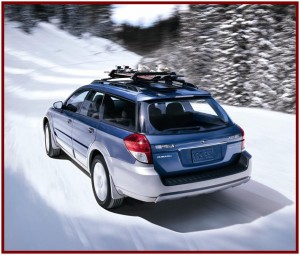
Subaru is recalling more than 200,000 Legacy sedan and Outback wagon models because the brake lines can corrode and leak fluid. In a required NHTSA filing just made public, Subaru said that the brake lines were corroding after several winter seasons. The recall covers only Outback and Legacy models that are or have been registered in 20 salt belt States (CT, DE, IA, IL, IN, MA, MD, ME, MI, MN, MO, NH, NJ, NY, OH, PA, RI, VT, WI, and WV) plus Washington D.C.
Such regional recalls have long been criticized by safety advocates as leaving many potentially unsafe vehicles on the road. Automakers claim it only affects customers who will need to return to a dealership. NHTSA continues to allow the practice, which of course saves automakers money.
Brake lines collected from12 model year 2005-2009 Legacy and Outback vehicles sold in the North American market showed corrosion. Subaru said the brake lines could perforate after exposure to seven or more winter seasons. The perforation could occur at the brake line four-way joint connector, where the center and rear lines are joined and where there is no resin cover installed.
Brake fluid may leak from the perforated lines. Since the center and rear brake lines work independently, braking will still be possible if either but not both systems fail. The driver would be alerted to a fault in the brake system via illumination of the brake warning lamp because the fluid level will drop in the system. Failure of either the center or the rear brake lines might cause the driver to misjudge the amount of brake pedal travel required to achieve the desired stopping distance.
The proposed Subaru fix will have dealers look for brake fluid seepage around the brake line four-way joint connector. If no brake fluid seepage is observed, the affected area will be rust proofed with anti-corrosion wax. If brake fluid seepage is observed, the original center and rear brake lines will be replaced with new ones followed by rust proofing with anti-corrosion wax.