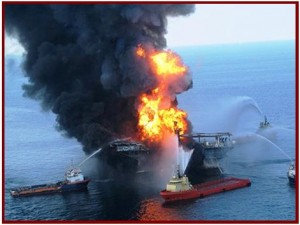
The Gulf oil spill pumped at least 5 billion gallons of crude oil into the Gulf of Mexico because of the negligence and criminal acts of BP, Transocean and Halliburton among others.
Halliburton Energy Services will plead guilty to destroying evidence in connection with the Deepwater Horizon disaster in the Gulf of Mexico, the Department of Justice said late today. Halliburton was charged with one count of destruction of evidence, according to a so-called information filing in the U.S. District Court for the Eastern District of Louisiana. This is the third corporate guilty plea coming from the Deepwater Horizon Task Force.
On 20 April 2010, while stationed at the Macondo well in the Gulf of Mexico, the Deepwater Horizon drilling rig had an uncontrolled blowout and related explosions and fire, which resulted in the deaths of 11 rig workers and the largest oil spill by far in U.S. history.
Halliburton has signed a “cooperation and guilty plea agreement” with the government whereby it will plead guilty and admit its criminal conduct. As part of the plea agreement, Halliburton has further agreed, subject to the court’s certain approval, to pay the maximum-available statutory fine, which will be a pittance compared to the damages incurred, to be subject to three years of probation and to continue its cooperation in the government’s ongoing criminal investigation.
Separately, Halliburton made a voluntary contribution of $55 million to the National Fish and Wildlife Foundation that was not conditioned on the court’s acceptance of its plea agreement.
Following the blowout, Halliburton conducted its own review of the well’s design and construction. On or about 3 May 2010, Halliburton established an internal working group to examine the Macondo well blowout, including whether the number of centralizers used on the final production casing could have contributed to the blowout.
(A production casing is a long, heavy metal pipe set across the area of the oil and natural gas reservoir. Centralizers are protruding metal collars affixed at various intervals on the outside of the casing. Use of centralizers can help keep the casing centered in the wellbore away from the surrounding walls as it is lowered and placed in the well. Centralization can be significant to the quality of subsequent cementing around the bottom of the casing, according to the DOJ.)
Prior to the blowout, Halliburton had recommended to BP the use of 21 centralizers in the Macondo well. BP used six centralizers instead. Halliburton, through its Cementing Technology Director, directed a Senior Program Manager for the Cement Product Line to run two computer simulations of the Macondo well final cementing job using Halliburton’s Displace 3D simulation program to compare the impact of using six versus 21 centralizers. (Displace 3D is simulation program that was being developed to model fluid interfaces and their movement through the wellbore and annulus of a well.) These simulations indicated that there was little difference between using six and 21 centralizers. The Program Manager was directed to, and did, destroy these results.
During June 2010, similar evidence was also destroyed in a later incident. Halliburton’s Cementing Technology Director asked another, more experienced, employee (“Employee 1”) to run simulations again comparing six versus 21 centralizers. Employee 1 reached the same conclusion and, like the Program Manager before him, was then directed to “get rid of” the simulations.
Efforts to recover the original destroyed Displace 3D computer simulations during ensuing civil litigation and federal criminal investigation by the Deepwater Horizon Task Force were unsuccessful.
In agreeing to plead guilty, Halliburton has accepted criminal responsibility for destroying the evidence. The guilty plea agreement and criminal charge announced today are part of the ongoing criminal investigation by the Deepwater Horizon Task Force into matters related to the April 2010 Gulf oil spill.
Read AutoInformed on:
- President Obama Calls for $2 Billion Energy Security Trust Using Fossil Fuel Development Taxes to Wean U.S. from Oil and Gas
- Transocean Pleads Guilty of Environmental Crimes in Gulf Oil Spill. $400 Million in Penalties for its Role in Deepwater Horizon Disaster
- BP Sentenced to Pay $4 Billion for Deepwater Horizon Oil Spill Crimes
- Transocean Pleads Guilty in Deepwater Horizon Oil Spill. Criminal and Civil Fines Set at a Record $1.4 Billion by Department of Justice
- Top Ten Auto Stories of 2012
- EPA Releases Annual Enforcement Results
- BP Barred from Federal Contracts as Oil Spill Costs Mount
- BP in Plea Deal Pays $4 Billion for Deepwater Horizon Gulf Oil Spill. Highest Execs Free from Criminal Charges as Stockholders Pay Fines
- BP Fined Again, this time for Oil Spill Violations in Maryland
- Fraud Charges Filed in Gulf Oil Cleanup Employment Scam
- BP, Marathon, Exxon Mobil, Monsanto, BASF, and Other Hazardous Waste Polluters to Pay for Texas City Superfund Cleanup
- BP to Pay $13 Million More in fines for Refinery Worker Deaths
- BP Fined $8 Million for Clean Air Act Violation in Indiana
- Former BP Engineer Arrested for Obstruction of Justice in Ongoing Deepwater Horizon Criminal Investigation
- Ruling against Chevron in $18 Billion Toxic Oil Waste Case
- Gulf after BP Deepwater Horizon Oil Spill Needs Help
- BP to Pay $426,500, Reserve $240 Million for EPA Violations







