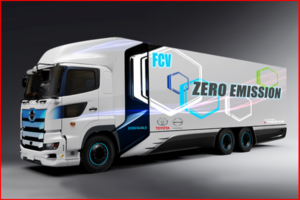
The hydrogen society draws closer each year.
Toyota says that tests to verify the feasibility of using fuel-cell electric trucks to reduce CO2 emissions in logistics will begin in the Spring of 2022. The Japanese automaker appears to have a lead on using fuel-cells in heavy trucks to address the harmful effects of global warming. Toyota and Hino are jointly developing heavy-duty FCETs, and Asahi Group, NLJ, Seino Transportation, Yamato Transport, and Toyota will perform the road trials in their logistics operations.
The goal is to accelerate the early commercial application of heavy-duty FCETs contributing to the development of a sustainable society. The air quality goals may be achieved, at least in part, by reducing CO2 emissions from heavy-duty trucks, which account for approximately 70% of all CO2 emissions from commercial vehicles in Japan.
At issue are Range and load carrying capacity. The heavy-duty FCETs used in highway transportation must have enough range and load capacity, as well as being able to refuel quickly. Fuel cell systems, which are powered by high-energy-density hydrogen, are believed to be effective for the electrification of trucks. Daimler Truck is also exploring the possibilities. The heavy-duty FCETs that will be developed by Toyota and Hino have a target range of ~600 km. The objective is “to meet high standards for both environmental performance and practicality as a commercial vehicle.”
Each of the companies participating in the trials have set global environmental problems as key management issues and are taking various actions including reducing energy consumption in manufacturing processes and reducing environmental impact in logistics operations. Going forward, each company says it will accelerate its efforts for early practical application of heavy-duty FCETs with the aim of contributing to the development of a sustainable society.
Trial Routes
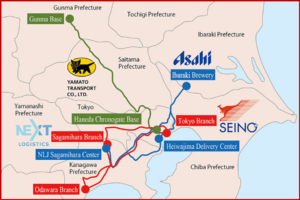
Click to Enlarge.
Toyota: Transportation of parts between Toyota plants in Aichi Prefecture and Toyota Tobishima Logistics Center in Nagoya Port.
Yamato Transport: Transport of collected parcels and other packages between the Haneda Chronogate Base and the Gunma Base . (*A base is a facility that functions as a parcel sorting and highway transportation hub.)
Seino Transportation: Cargo will be transported from the Tokyo Branch to the Sagamihara Branch and the Odawara Branch.
Asahi Group & NLJ: Asahi Group will load the trucks with beer and soft drinks produced at its Ibaraki Brewery and whisky, spirits, wine, and other products from Asahi Breweries Heiwajima Delivery Center. The products will be unloaded at NLJ Sagamihara Center, and cargo from Kansai will be retrieved and returned to the Ibaraki Brewery.
See AutoInformed on:

About Ken Zino
Ken Zino, editor and publisher of AutoInformed, is a versatile auto industry participant with global experience spanning decades in print and broadcast journalism, as well as social media. He has automobile testing, marketing, public relations and communications experience. He is past president of The International Motor Press Assn, the Detroit Press Club, founding member and first President of the Automotive Press Assn. He is a member of APA, IMPA and the Midwest Automotive Press Assn.
He also brings an historical perspective while citing their contemporary relevance of the work of legendary auto writers such as Ken Purdy, Jim Dunne or Jerry Flint, or writers such as Red Smith, Mark Twain, Thomas Jefferson – all to bring perspective to a chaotic automotive universe.
Above all, decades after he first drove a car, Zino still revels in the sound of the exhaust as the throttle is blipped during a downshift and the driver’s rush that occurs when the entry, apex and exit points of a turn are smoothly and swiftly crossed. It’s the beginning of a perfect lap.
AutoInformed has an editorial philosophy that loves transportation machines of all kinds while promoting critical thinking about the future use of cars and trucks.
Zino builds AutoInformed from his background in automotive journalism starting at Hearst Publishing in New York City on Motor and MotorTech Magazines and car testing where he reviewed hundreds of vehicles in his decade-long stint as the Detroit Bureau Chief of Road & Track magazine. Zino has also worked in Europe, and Asia – now the largest automotive market in the world with China at its center.







Toyota and Hino Heavy-Duty Fuel-Cell Electric Truck Verification Tests Start in the Spring of 2022
The hydrogen society draws closer each year.
Toyota says that tests to verify the feasibility of using fuel-cell electric trucks to reduce CO2 emissions in logistics will begin in the Spring of 2022. The Japanese automaker appears to have a lead on using fuel-cells in heavy trucks to address the harmful effects of global warming. Toyota and Hino are jointly developing heavy-duty FCETs, and Asahi Group, NLJ, Seino Transportation, Yamato Transport, and Toyota will perform the road trials in their logistics operations.
The goal is to accelerate the early commercial application of heavy-duty FCETs contributing to the development of a sustainable society. The air quality goals may be achieved, at least in part, by reducing CO2 emissions from heavy-duty trucks, which account for approximately 70% of all CO2 emissions from commercial vehicles in Japan.
At issue are Range and load carrying capacity. The heavy-duty FCETs used in highway transportation must have enough range and load capacity, as well as being able to refuel quickly. Fuel cell systems, which are powered by high-energy-density hydrogen, are believed to be effective for the electrification of trucks. Daimler Truck is also exploring the possibilities. The heavy-duty FCETs that will be developed by Toyota and Hino have a target range of ~600 km. The objective is “to meet high standards for both environmental performance and practicality as a commercial vehicle.”
Each of the companies participating in the trials have set global environmental problems as key management issues and are taking various actions including reducing energy consumption in manufacturing processes and reducing environmental impact in logistics operations. Going forward, each company says it will accelerate its efforts for early practical application of heavy-duty FCETs with the aim of contributing to the development of a sustainable society.
Trial Routes
Click to Enlarge.
Toyota: Transportation of parts between Toyota plants in Aichi Prefecture and Toyota Tobishima Logistics Center in Nagoya Port.
Yamato Transport: Transport of collected parcels and other packages between the Haneda Chronogate Base and the Gunma Base . (*A base is a facility that functions as a parcel sorting and highway transportation hub.)
Seino Transportation: Cargo will be transported from the Tokyo Branch to the Sagamihara Branch and the Odawara Branch.
Asahi Group & NLJ: Asahi Group will load the trucks with beer and soft drinks produced at its Ibaraki Brewery and whisky, spirits, wine, and other products from Asahi Breweries Heiwajima Delivery Center. The products will be unloaded at NLJ Sagamihara Center, and cargo from Kansai will be retrieved and returned to the Ibaraki Brewery.
See AutoInformed on:
About Ken Zino
Ken Zino, editor and publisher of AutoInformed, is a versatile auto industry participant with global experience spanning decades in print and broadcast journalism, as well as social media. He has automobile testing, marketing, public relations and communications experience. He is past president of The International Motor Press Assn, the Detroit Press Club, founding member and first President of the Automotive Press Assn. He is a member of APA, IMPA and the Midwest Automotive Press Assn. He also brings an historical perspective while citing their contemporary relevance of the work of legendary auto writers such as Ken Purdy, Jim Dunne or Jerry Flint, or writers such as Red Smith, Mark Twain, Thomas Jefferson – all to bring perspective to a chaotic automotive universe. Above all, decades after he first drove a car, Zino still revels in the sound of the exhaust as the throttle is blipped during a downshift and the driver’s rush that occurs when the entry, apex and exit points of a turn are smoothly and swiftly crossed. It’s the beginning of a perfect lap. AutoInformed has an editorial philosophy that loves transportation machines of all kinds while promoting critical thinking about the future use of cars and trucks. Zino builds AutoInformed from his background in automotive journalism starting at Hearst Publishing in New York City on Motor and MotorTech Magazines and car testing where he reviewed hundreds of vehicles in his decade-long stint as the Detroit Bureau Chief of Road & Track magazine. Zino has also worked in Europe, and Asia – now the largest automotive market in the world with China at its center.