
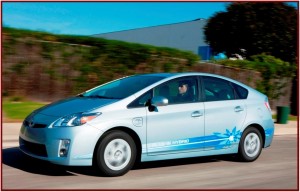
Prius Plug-in will begin arriving at Toyota dealers in 15 launch states in spring 2012.
Toyota Motor Corporation said today production would fall by 31% during the fiscal year ending 31 March 2012 as a result of the Japan earthquake in March of 2011. Toyota forecasts a drop in earnings of ¥350 billion to ¥280 billion (~$3.5 billion) for the year. Global vehicle sales might drop to 7.24 million from 7.308 million last year.
It is a serious reversal from the ¥408 billion earnings posted a year earlier when Japan’s largest automaker was slowly recovering from the global financial crisis and recalls of millions of Toyota and Lexus vehicles for stuck gas pedals and unintended acceleration safety defects.
Partially offsetting the loss in revenue are significant reductions of sales incentives and ongoing cost cutting. However, Takahiko Ijichi, Senior Managing Director of TMC, said on a phone call that incentives are now returning since production is approaching normal levels faster than anticipated and will be restored before year end.
The longer term issues facing Toyota are recovering lost market share and the unprecedented strength of the Japanese Yen caused by massive inflows of cash as export-oriented Japanese companies attempt to recover from earthquake losses.
Yesterday the Japanese Automobile Manufacturers Association “strongly demanded” that the Japanese government take swift and effective action aimed at reducing the yen’s current strength of ¥80:$1. Japanese automakers last year were struggling to be profitable at ¥96:$1. It was an unusually direct statement from the Japanese who normally are subtle – if not evasive – about trade matters and their relationship with the government.
“Current foreign exchange rate levels represent, for the yen, an appreciation that not only far surpasses all prior projections by Japanese automakers, but also totally fails to reflect Japan’s economic fundamentals,” said Toshiyuki Shiga Chairman, Japan Automobile Manufacturers Association and Koichiro Nishihara President, Confederation of Japan Automobile Workers’ Unions in a joint statement.
Whether the government can manipulate the value of one of the world’s largest currencies is a matter open to debate.
Toyota will likely lose its Number One spot in global sales this calendar year to General Motors because of production already lost, a problem that GM and Volkswagen – also stalking Toyota for the Number Two spot – largely avoided because of the location their suppliers.
Thus a new automotive world order is underway. Toyota, Nissan and Honda – the Japanese Big Three – all saw U.S. sales plummet in May as a combination of their limited inventories because of production disruptions and decreased marketing activities and incentives that followed took a huge bite out of sales.
However, in the U.S market, General Motors and Ford with flat sales in May have not been able to capitalize on the production disruptions of all Japanese automakers – perhaps because of the loyalty of Japanese car buyers and also because of the sagging U.S. economy.
Some of the biggest sales gains in May were posted by Korean automakers Hyundai (up 20.7% versus a year ago) and Kia (up 53.4%), admittedly on smaller sales bases than the Japanese Big Three have. Combined, the two Korean automakers sold more than 100,000 vehicles for the month. Korea is the fifth largest producer and fourth largest exporter of motor vehicles in the world.
(See Japanese U.S. May Sales Plunge as Inventories Evaporate. Toyota, Nissan and Honda Decline in Earthquake Aftershocks and General Motors May Sales Flat in U.S. as Retail Sales Rise 9% and Ford May Sales Flat in U.S. as Retail Sales Rise 5% and Korean Automakers Post Huge U.S. Sales Gains as Disputed Free Trade Agreement Heads for Congressional Approval)