Click for more information.
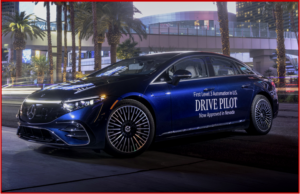
Mercedes‑Benz today claimed it is the world’s first automotive company to bring SAE Level 3* automated driving to the US as Nevada became the first state to confirm the compliance of the system with state regulations, under certain conditions. At SAE Level 3 [1], the driver does not need to monitor the driving circumstances constantly but must take back control when the system requests. (autoinformed.com: SAE Autonomous Driving Levels)
If Mercedes is able to deliver model year 2024 Mercedes‑Benz S-Class and EQS Sedans late in 2023, then its optional DRIVE PILOT system would be the first and perhaps the only SAE Level 3 system in a standard-production vehicle authorized for use on US public freeways. Mercedes‑Benz also aspires to expand to California later this year with the certification documents already filed with state authorities. General Motors, among other automakers, is also actively pursuing autonomous vehicles. Several GM brands are partially there already with its Super Cruise system. (autoinformed.com: GM Expanding Super Cruise Hands-Free Driver Assistance; Mercedes EQS Sedan Valet Parks Itself in Los Angeles)
The requirements of Nevada Chapter 482A for Autonomous Vehicles means DRIVE PILOT will allow the driver to hand over in motion driving to the vehicle only under certain conditions. On suitable freeway sections and where there is high traffic density, DRIVE PILOT can offer to take over the dynamic driving task, up to the speed of 40 mph. The control buttons needed for this are located in the steering wheel rim, on the left and right above the thumb recesses. Once conditions are suitable, the system indicates availability on the control buttons.
If the driver activates DRIVE PILOT, the system controls the speed and distance, and guides the vehicle within its lane. The route profile, events occurring on the route and traffic signs are correspondingly taken into consideration. The system also reacts to unexpected traffic situations and handles them independently by evasive maneuvers within the lane or by braking maneuvers.
“In the modern world, time is one of the most precious commodities, and giving back time to our customers is a core element in our strategy to build the world’s most desirable cars. Our DRIVE PILOT takes a major step forward in achieving that, and places us at the very forefront of innovation in the crucially important field of automated driving. Certification in Nevada marks the start of its international rollout and, with it, the dawning of a new era,” said Markus Schäfer, Member of the Board of Management of Mercedes Benz Group AG, Chief Technology Officer, responsible for Development and Procurement. [2]
Click for more information.
LiDAR Sensor and Redundant Systems
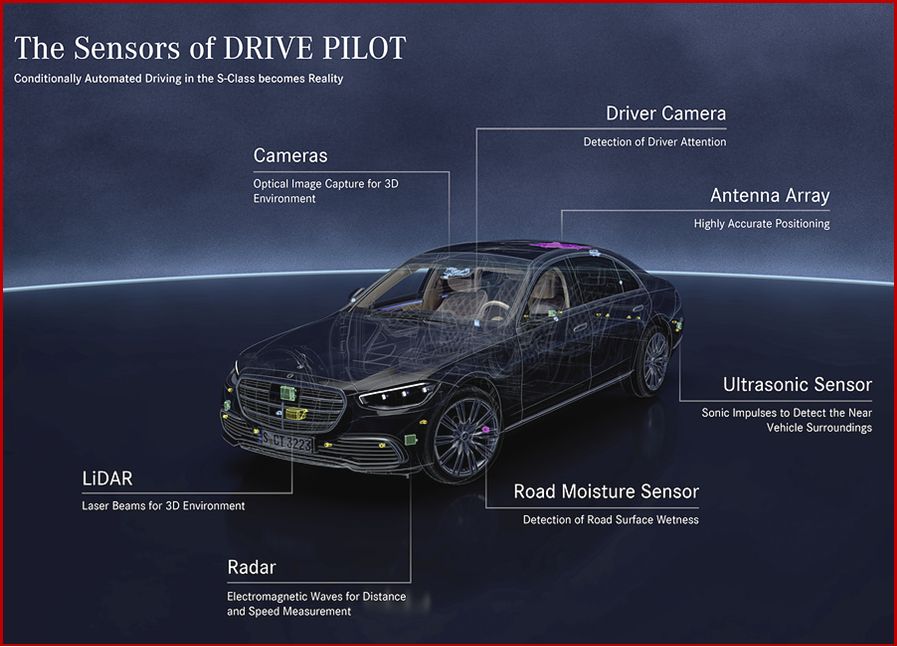
DRIVE PILOT builds on the surround sensors of the Driving Assistance Package with additional sensors. These include LiDAR, as well as a camera in the rear window and microphones for detecting emergency vehicles, as well as a road wetness sensor in the wheel well. A vehicle equipped with the optional DRIVE PILOT system also has redundant steering and braking actuators and a redundant on-board electrical system, so that it remains maneuverable even if one of these systems fails and a safe handover to the driver can be ensured.
If the driver fails to take back control even after increasingly urgent prompting and expiration of the takeover time, the system brakes the vehicle to a standstill in a controlled manner while engaging the hazard warning lights. Once the vehicle has come to a standstill, the Mercedes Benz emergency call system is activated and the doors are unlocked to make the interior accessible for first responders.
Positioning System
The exact location of a Mercedes Benz equipped with DRIVE PILOT is determined using a high-precision positioning system that is more powerful than conventional GPS systems. In addition to what’s claimed to be “anonymized data” amassed by LiDAR, camera, radar and ultrasound sensors, a digital HD map provides a three-dimensional image of the road and the surroundings with information on road geometry, route characteristics, traffic signs and traffic accidents or road construction. This is made available and updated via a back-end connection.
This high-precision map differs from maps for navigation devices by its higher accuracy in the centimeter rather than meter range and its detailed junction and route model. The map data is stored in back-end data centers and updated constantly. Each vehicle also stores an image of this map information on board, constantly compares it with the back-end data and updates the local data-set as required. All of this enables stable and accurate positioning through an illustration of the surroundings that is independent of factors such as shadows or dirty sensors.
A chipset inside the central control unit provides the necessary software functions for conditionally automated driving while algorithms are calculated redundantly within what Mercedes calls “the framework of a modern security architecture.”
During the conditionally automated journey, DRIVE PILOT allows the driver to take their mind off the traffic and focus on certain secondary activities [2]. When DRIVE PILOT is active, applications can be enabled on the vehicle’s integrated central display that are otherwise blocked while driving.
Initially introduced in Germany in May 2022, the highly sophisticated Mercedes Benz DRIVE PILOT system was the first SAE Level 3 system in the world to meet the legal requirements of UN R157. The German Federal Motor Transport Authority (KBA) first granted system approval based on the regulation UN R157, paving the way for offering DRIVE PILOT internationally [3], where legislation allows.
*SAE Automated Driving Levels
[1] SAE Level 3: the automated driving function takes over certain driving tasks. However, a driver is still required. The driver must be ready to take control of the vehicle at all times when prompted to intervene by the vehicle.
[2] Which secondary activities of the driver are legally permissible depends on the respective national road traffic regulations.
[3] ECE contracting states (57) incl. states of the EU, GB, Japan, Korea, Australia.

About Ken Zino
Ken Zino, editor and publisher of AutoInformed, is a versatile auto industry participant with global experience spanning decades in print and broadcast journalism, as well as social media. He has automobile testing, marketing, public relations and communications experience. He is past president of The International Motor Press Assn, the Detroit Press Club, founding member and first President of the Automotive Press Assn. He is a member of APA, IMPA and the Midwest Automotive Press Assn.
He also brings an historical perspective while citing their contemporary relevance of the work of legendary auto writers such as Ken Purdy, Jim Dunne or Jerry Flint, or writers such as Red Smith, Mark Twain, Thomas Jefferson – all to bring perspective to a chaotic automotive universe.
Above all, decades after he first drove a car, Zino still revels in the sound of the exhaust as the throttle is blipped during a downshift and the driver’s rush that occurs when the entry, apex and exit points of a turn are smoothly and swiftly crossed. It’s the beginning of a perfect lap.
AutoInformed has an editorial philosophy that loves transportation machines of all kinds while promoting critical thinking about the future use of cars and trucks.
Zino builds AutoInformed from his background in automotive journalism starting at Hearst Publishing in New York City on Motor and MotorTech Magazines and car testing where he reviewed hundreds of vehicles in his decade-long stint as the Detroit Bureau Chief of Road & Track magazine. Zino has also worked in Europe, and Asia – now the largest automotive market in the world with China at its center.







Almost Autonomous – Mercedes-Benz 2024 S‑Class, EQS?
Click for more information.
Mercedes‑Benz today claimed it is the world’s first automotive company to bring SAE Level 3* automated driving to the US as Nevada became the first state to confirm the compliance of the system with state regulations, under certain conditions. At SAE Level 3 [1], the driver does not need to monitor the driving circumstances constantly but must take back control when the system requests. (autoinformed.com: SAE Autonomous Driving Levels)
If Mercedes is able to deliver model year 2024 Mercedes‑Benz S-Class and EQS Sedans late in 2023, then its optional DRIVE PILOT system would be the first and perhaps the only SAE Level 3 system in a standard-production vehicle authorized for use on US public freeways. Mercedes‑Benz also aspires to expand to California later this year with the certification documents already filed with state authorities. General Motors, among other automakers, is also actively pursuing autonomous vehicles. Several GM brands are partially there already with its Super Cruise system. (autoinformed.com: GM Expanding Super Cruise Hands-Free Driver Assistance; Mercedes EQS Sedan Valet Parks Itself in Los Angeles)
The requirements of Nevada Chapter 482A for Autonomous Vehicles means DRIVE PILOT will allow the driver to hand over in motion driving to the vehicle only under certain conditions. On suitable freeway sections and where there is high traffic density, DRIVE PILOT can offer to take over the dynamic driving task, up to the speed of 40 mph. The control buttons needed for this are located in the steering wheel rim, on the left and right above the thumb recesses. Once conditions are suitable, the system indicates availability on the control buttons.
If the driver activates DRIVE PILOT, the system controls the speed and distance, and guides the vehicle within its lane. The route profile, events occurring on the route and traffic signs are correspondingly taken into consideration. The system also reacts to unexpected traffic situations and handles them independently by evasive maneuvers within the lane or by braking maneuvers.
“In the modern world, time is one of the most precious commodities, and giving back time to our customers is a core element in our strategy to build the world’s most desirable cars. Our DRIVE PILOT takes a major step forward in achieving that, and places us at the very forefront of innovation in the crucially important field of automated driving. Certification in Nevada marks the start of its international rollout and, with it, the dawning of a new era,” said Markus Schäfer, Member of the Board of Management of Mercedes Benz Group AG, Chief Technology Officer, responsible for Development and Procurement. [2]
Click for more information.
LiDAR Sensor and Redundant Systems
DRIVE PILOT builds on the surround sensors of the Driving Assistance Package with additional sensors. These include LiDAR, as well as a camera in the rear window and microphones for detecting emergency vehicles, as well as a road wetness sensor in the wheel well. A vehicle equipped with the optional DRIVE PILOT system also has redundant steering and braking actuators and a redundant on-board electrical system, so that it remains maneuverable even if one of these systems fails and a safe handover to the driver can be ensured.
If the driver fails to take back control even after increasingly urgent prompting and expiration of the takeover time, the system brakes the vehicle to a standstill in a controlled manner while engaging the hazard warning lights. Once the vehicle has come to a standstill, the Mercedes Benz emergency call system is activated and the doors are unlocked to make the interior accessible for first responders.
Positioning System
The exact location of a Mercedes Benz equipped with DRIVE PILOT is determined using a high-precision positioning system that is more powerful than conventional GPS systems. In addition to what’s claimed to be “anonymized data” amassed by LiDAR, camera, radar and ultrasound sensors, a digital HD map provides a three-dimensional image of the road and the surroundings with information on road geometry, route characteristics, traffic signs and traffic accidents or road construction. This is made available and updated via a back-end connection.
This high-precision map differs from maps for navigation devices by its higher accuracy in the centimeter rather than meter range and its detailed junction and route model. The map data is stored in back-end data centers and updated constantly. Each vehicle also stores an image of this map information on board, constantly compares it with the back-end data and updates the local data-set as required. All of this enables stable and accurate positioning through an illustration of the surroundings that is independent of factors such as shadows or dirty sensors.
A chipset inside the central control unit provides the necessary software functions for conditionally automated driving while algorithms are calculated redundantly within what Mercedes calls “the framework of a modern security architecture.”
During the conditionally automated journey, DRIVE PILOT allows the driver to take their mind off the traffic and focus on certain secondary activities [2]. When DRIVE PILOT is active, applications can be enabled on the vehicle’s integrated central display that are otherwise blocked while driving.
Initially introduced in Germany in May 2022, the highly sophisticated Mercedes Benz DRIVE PILOT system was the first SAE Level 3 system in the world to meet the legal requirements of UN R157. The German Federal Motor Transport Authority (KBA) first granted system approval based on the regulation UN R157, paving the way for offering DRIVE PILOT internationally [3], where legislation allows.
*SAE Automated Driving Levels
[1] SAE Level 3: the automated driving function takes over certain driving tasks. However, a driver is still required. The driver must be ready to take control of the vehicle at all times when prompted to intervene by the vehicle.
[2] Which secondary activities of the driver are legally permissible depends on the respective national road traffic regulations.
[3] ECE contracting states (57) incl. states of the EU, GB, Japan, Korea, Australia.
About Ken Zino
Ken Zino, editor and publisher of AutoInformed, is a versatile auto industry participant with global experience spanning decades in print and broadcast journalism, as well as social media. He has automobile testing, marketing, public relations and communications experience. He is past president of The International Motor Press Assn, the Detroit Press Club, founding member and first President of the Automotive Press Assn. He is a member of APA, IMPA and the Midwest Automotive Press Assn. He also brings an historical perspective while citing their contemporary relevance of the work of legendary auto writers such as Ken Purdy, Jim Dunne or Jerry Flint, or writers such as Red Smith, Mark Twain, Thomas Jefferson – all to bring perspective to a chaotic automotive universe. Above all, decades after he first drove a car, Zino still revels in the sound of the exhaust as the throttle is blipped during a downshift and the driver’s rush that occurs when the entry, apex and exit points of a turn are smoothly and swiftly crossed. It’s the beginning of a perfect lap. AutoInformed has an editorial philosophy that loves transportation machines of all kinds while promoting critical thinking about the future use of cars and trucks. Zino builds AutoInformed from his background in automotive journalism starting at Hearst Publishing in New York City on Motor and MotorTech Magazines and car testing where he reviewed hundreds of vehicles in his decade-long stint as the Detroit Bureau Chief of Road & Track magazine. Zino has also worked in Europe, and Asia – now the largest automotive market in the world with China at its center.