BP stockholders pay, senior BP executives walk away from criminal charges after 5 billion gallons of oil were spilled.
BP shareholders will pay more than $4 billion in criminal fines and penalties because of the Deepwater Horizon Oil spill that killed 11 people and caused the largest environmental disaster in U.S. history. The highest BP executive are now clear of future criminal charges as the result of the plea bargain where stockholders will pay fines for causing the monumental oil pollution that is still despoiling the Gulf Coast environment. During the disaster, BP publicly maintained that 5,000 gallons of oil were spewing forth daily into the Gulf, when in fact 60,000 gallons a day were gushing into the water and destroying the ecosystem.
BP lawyers arranged or agreed to a plea deal with the federal government that was filed today admitting to criminal conduct though. BP was charged with 11 counts of felony manslaughter, one count of felony obstruction of Congress, and violations of the Clean Water and Migratory Bird Treaty Acts. As part of its guilty plea, BP has agreed, subject to almost certain court approval, to pay the largest criminal fines in United States history. Nevertheless, the penalty remains a small fraction of the actual damage caused by pumping at least 5 billion gallons of crude oil into the Gulf of Mexico. This means that BP is paying less than $1 a gallon for the criminal spill and destruction of the environment.
However, the United States continues to pursue a civil action to recover penalties under the Clean Water Act, and hold BP and other defendants liable for natural resource damages under the Oil Pollution Act. A trial on these matters is scheduled to begin in February 2013, during which the United States will seek to establish that the spill was caused by BP’s gross negligence. BP shareholders could face billions of dollars of additional fines in the lawsuit. BP will vigorously contest the charges and tie the courts up for years in the hope that public apathy will set in and remaining settlements will be relatively small.
In return for the resolution of criminal charges against BP’s highest executives, Robert M. Kaluza, 62, of Henderson, Nevada, and Donald J. Vidrine, 65, of Lafayette, Louisiana, who were onboard the Deepwater Horizon on 20 April 2010, are alleged to have engaged in negligent and grossly negligent conduct. The Department of Justice filed a 23-count indictment against them charging violations of the federal involuntary manslaughter and seaman’s manslaughter statutes as well as the Clean Water Act. David I. Rainey, 58, of Houston, a former BP employee who was BP’s second highest employee during the spill response – is charged with obstruction of Congress and making false statements to law enforcement officials. A grand jury in the Eastern District of Louisiana returned indictments against Kaluza, Vidrine and Rainey, which were unsealed today.
This is a clear victory for critics who maintain that all too often corporate executives are not held accountable for their criminal actions, as indeed remains the case concerning the global financial markets that collapsed in 2008 the direct result from the fraudulent practices of Wall Street firms, investment banks, ratings agencies, mortgage companies and insurance firms. The cost to taxpayers for subsequent bailouts was large, and the damage to economies was much, much larger and ongoing.
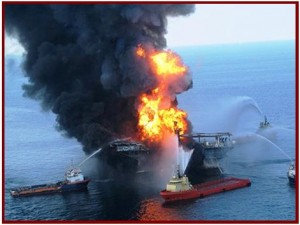
In the BP matter according to court documents, on 20 April 2010 while drilling at the Macondo well site in the Gulf of Mexico, the Deepwater Horizon rig experienced an uncontrolled blowout and related explosions. In agreeing to plead guilty, BP has admitted that the two employees on board the Deepwater Horizon, known as BP’s “Well Site Leaders” or “company men,” (how apt) negligently caused the deaths of 11 men and the resulting oil spill.
On that evening in April, Kaluza and Vidrine observed “clear indications” that the Macondo well was not secure and that oil and gas were flowing into the well. They allegedly did not take the appropriate steps to prevent the ensuing blowout. Because of their conduct, control of the Macondo well was lost, resulting in a devastating oil spill catastrophe.
Kaluza and Vidrine are charged with 11 felony counts of seaman’s manslaughter, 11 felony counts of involuntary manslaughter and one violation of the Clean Water Act. If convicted, Kaluza and Vidrine each face a maximum potential penalty of 10 years in prison on each seaman’s manslaughter count, up to eight years in prison on each involuntary manslaughter count, and up to a year in prison on the Clean Water Act count – that is if the federal prosecution doesn’t cut another plea deal.
Rainey is charged with one count of obstruction of Congress, and one count of making false statements to law enforcement officials. If convicted, Rainey faces a maximum potential penalty of five years in prison on each count.
See
- BP Fined Again, this time for Oil Spill Violations in Maryland
- Former BP Engineer Arrested for Obstruction of Justice in Ongoing Deepwater Horizon Criminal Investigation
- Gulf after BP Deepwater Horizon Oil Spill Needs Help
- Big Oil has Big Day in U.S. Senate as Tax Breaks are Intact