In the production 2017 E-Class, if the driver takes his or her hands off the wheel, audible and visual warnings are activated. If the warnings are ignored, the automatic safety systems disable themselves.
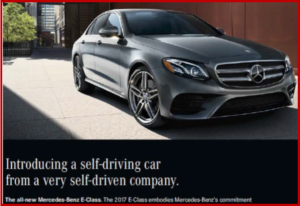
Auto safety advocates want the Federal Trade Commission to investigate – and take action against – Mercedes-Benz for the advertising of its 2017 E-Class vehicles claiming it “is likely to mislead a reasonable consumer by representing the E-Class as self-driving car when it is not.” This allegedly could give consumers “a false sense of security in the ability of the car to operate autonomously.”
Since debuting in March, the ad has aired nationally nearly 500 times, according to advertising measurement firm iSpot.4.
The letter to FTC Chairwoman Edith Ramirez was signed by Consumer Reports, the Center for Auto Safety, Consumer Federation of America, and Joan Claybrook, former administrator of the National Highway Traffic Safety Administration.
In it they claimed a current Mercedes-Benz TV ad called “The Future,” which markets automated features available in the 2017 E-Class, violates advertising standards. A voice-over says: “Is the world truly ready for a vehicle that can drive itself? An autonomous-thinking automobile that protects those inside and outside. Ready or not, the future is here.”
Mercedes-Benz Disagrees
A spokesperson told AutoInformed: “It certainly was not our intent to cause any confusion between driver assistance systems and the promise of an autonomous future, one leads to the other, but they are not the same. While the E- class does everything it is shown doing in the ad, the systems used in the new E-Class are clearly identified as “driver assistance systems” which we have spent the better part of two decades developing in pursuit of an accident-free future.
Here we get into interpretation and the problems facing autonomous or self-driving car makers, legislators, regulators, insurance companies, the courts and ultimately consumers as autonomous vehicles are on the verge of production reality.
Mercedes said, “The Future,” featuring the F015 concept car, is intended to draw the connection between that vision and the innovations that are in today’s Mercedes-Benz models.”
2017 E-Class – Technological Tour de Force
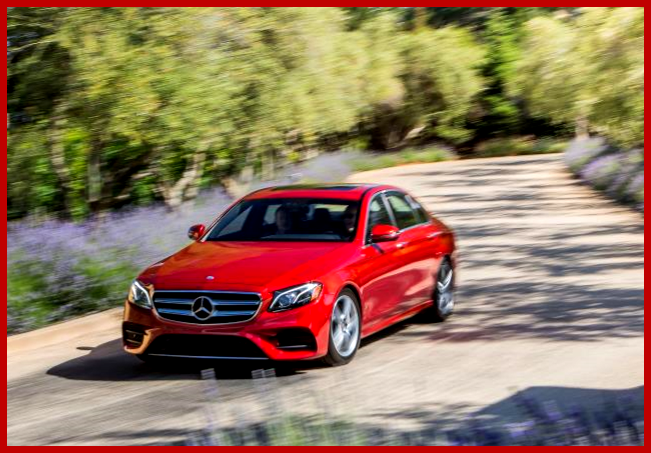 The new E-Class is arguably only one generation away from evolving into a self-driving car. It comes standard with Active Brake Assist, which can decrease the severity of rear-end collisions or prevent them entirely. The radar-based system constantly monitors the area of traffic in front of the vehicle and calculates the distance and speed of the vehicles ahead. If, in the speed range between 4 and 155 mph, the system detects an acute risk of collision because of slower or stopped vehicles or, in the speed range between 4 and 50 mph, because of stationary vehicles or crossing pedestrians, the system gives the driver an additional audible warning.
Further, the Active Brake Assist system computes the brake pressure required to prevent a collision if possible. If, having been warned, the driver then steps on the brake pedal, the system is capable of boosting braking pressure in line with the needs of the situation, making the best possible use of the remaining stopping distance in order to leave the vehicles behind room to brake.
There is also Attention Assist, with adjustable sensitivity,which warns the driver of inattentiveness and drowsiness. Crosswind Assist helps drivers by enabling them to clearly counteract disturbances such as strong gusts of wind by means of one-sided braking.
The E-Class offers additional optional assistance systems, including semi-autonomous driving on motorways, country roads and even in the city, as well as assistance when changing lanes on multi-lane roads. Furthermore, it is capable in more and more situations of autonomously braking the vehicle if required, and providing active assistance during evasive maneuvers.
Drive Pilot automatically maintains the correct distance to vehicles in front by adjusting the car’s desired speed to that of a slower-moving vehicle ahead. With the Steering Pilot sub-function, the E-Class will stay within a lane up to speeds of 130 mph. This helps the driver, who no longer needs to operate the brake or accelerator pedal during normal driving and also receives plenty of steering assistance – even on turns.
Luddites?
The critics (Luddites?) said the FTC “should take enforcement action against companies that falsely, misleadingly, or unfairly claim that their cars drive autonomously when they actually require the steady control of a human driver.”
The letter acknowledges that on-screen fine print reads: “Vehicle cannot drive itself, but has automated driving features. System will remind the driver frequently to keep hands on the steering wheel. Always observe safe driving practices and obey all state and federal laws…”
The fine print here does not let Mercedes-Benz off the hook, say the naysayers. According to FTC guidance, ‘advertisers can’t use fine print to contradict other statements in an ad or clear up false impressions the ad might leave’ and ‘it’s against the law for businesses to bury important details about a product or service in the fine print. The fine print in this ad certainly contains important details, and likely is intended to clear up false impressions that the images and voice-over may convey.”
What E-Class Automatic Safety Systems do
In the actual production 2017 E-Class, if a driver takes his or her hands off the wheel, audible and visual warnings are issued. If the warnings are not heeded, the safety systems listed above will disable themselves.