
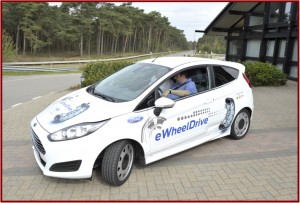
The Fiesta project aims to increase the integration of in-wheel motors in a car and will look at vehicle dynamic controls, braking and stability.
Ford Motor and Schaeffler said today that they would build two Fiesta-based electric vehicles by 2015 as part of a small car research project. The so-called eWheelDrive vehicles will be powered by independent electric motors in both rear wheels in place of a conventional engine.
With in-wheel motors, the components required for drive, deceleration and driver assistance technologies are installed in an integrated wheel hub drive – including the electric motor, braking and cooling systems.
While offering no clear business reasons for the project at loss-making Ford of Europe, the company said there could be space-saving benefits that could support development of smaller cars that are more agile and optimized for urban areas with the ability to move sideways to park. Schaeffler is a German-based automotive component manufacturer. No other details were released.
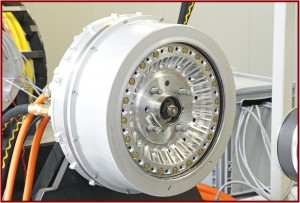
In-wheel electric motors are seen by some as an important future technology for city cars.
“This highly integrated wheel-hub drive makes it possible to rethink the city car without restrictions, and could be a key factor in new vehicle concepts and automobile platforms in the future,” said Peter Gutzmer, chief technical officer, Schaeffler.
While there is a clear emerging global trend of rising demand for small and inexpensive cars, regulations are increasing their costs and decreasing there potential market. Since 2010, supply by automakers has been growing as they offer products in the range of €10,000 (~$13,000). Some vehicles in this price range are micro-cars, such as the Piaggio, NT3, Renault Twizy ZE, Tata Nano, and Opel Rak-e, all unheard of in the United States.
So far, more than 35 micro-cars have appeared at various auto shows. While the prices for many are unknown, other electric micro-car introductions are expensive with high battery or components costs. The new Mahindra Reva e2o launched in India on18 March 2013, priced at €8,000-10,000. The European market version is expected to be €10,000.
According to Frost & Sullivan research, the so-called micro-cars are expected to grow to nearly 280,000 units in Europe alone by 2017, which includes quadricycles or variants of motorcycles, as well as the newly produced sub-A segment vehicles. The European Commission has already begun increasing regulations with even stricter safety and emission levels for micro-cars. The resulting addition in seat belts, airbags, reflectors, cross protection beams, and better bumpers is increasing their cost.
One strategy to compete here has automakers trying to “de-content” their A-segment vehicles, including the VW Up! and Toyota iQ, to have an entry into the micro-car market with their smallest vehicle already in production that meet emission and safety regulations.
Another strategy sees big cars such as the Dacia Duster in the compact SUV category that have been engineered to be priced around the €10,000 to garner sales from micro-car or small car customers who want to migrate to big cars with, well, smaller costs.
Micro-cars retain advantages that the Dacia Duster and its ilk cannot offer, though. Micro-cars are designed for congested mega cities and targeted at Gen-Y consumers (20 to 30 years old, and the fastest growing segment in the workforce) who are interested in alternative mobility, including car sharing. Traditional car sharing companies have added these small micro-cars to their fleets in 2012.