Click for more.
There are clear signs that human-induced climate change reached new heights in 2024, with some of the consequences being irreversible over hundreds if not thousands of years, according to a new report from the World Meteorological Organization (WMO), which also underlined the massive economic and social upheavals from extreme weather.
“Our planet is issuing more distress signals – but this report shows that limiting long-term global temperature rise to 1.5 degrees Celsius is still possible. Leaders must step up to make it happen — seizing the benefits of cheap, clean renewables for their people and economies with new National climate plans due this year, ” said United Nations Secretary-General António Guterres.
WMO’s Top Report Indicated
- Atmospheric concentration of carbon dioxide are at the highest levels in the last 800,000 years.
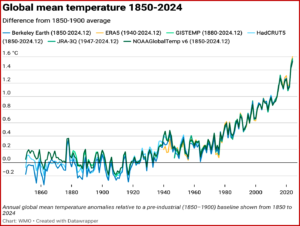
- Globally each of the past ten years were individually the ten warmest years on record.
- Each of the past eight years has set a new record for ocean heat content.
- The 18 lowest Arctic sea-ice extents on record were all in the past 18 years.
- The three lowest Antarctic ice extents were in the past three years.
- The largest three-year loss of glacier mass on record occurred in the past three years.
- The rate of sea level rise has doubled since satellite measurements began.
“While a single year above 1.5 C of warming does not indicate that the long-term temperature goals of the Paris Agreement are out of reach, it is a wake-up call that we are increasing the risks to our lives, economies and to the planet,” said WMO Secretary-General Celeste Saulo.
The report said that long-term global warming is currently estimated to be between 1.34 C and 1.41 C compared to the 1850-1900 baseline based on a range of methods – although it noted the uncertainty ranges in global temperature statistics.
A WMO team of international experts is examining this further in order to ensure consistent, reliable tracking of long-term global temperature changes to be aligned with the Intergovernmental Panel on Climate Change (IPCC).
Regardless of the methodology used, every fraction of a degree of warming matters and increases risks and costs to society. The record global temperatures seen in 2023 and broken in 2024 were mainly due to the ongoing rise in greenhouse gas emissions, coupled with a shift from a cooling La Niña to warming El Niño event. Several other factors may have contributed to the unexpectedly unusual temperature jumps, including changes in the solar cycle, a massive volcanic eruption and a decrease in cooling aerosols, according to the report.
Temperatures are a Small Part of a Much Bigger Problem
“Data for 2024 show that our oceans continued to warm, and sea levels continued to rise. The frozen parts of Earth’s surface, known as the cryosphere, are melting at an alarming rate: glaciers continue to retreat, and Antarctic sea ice reached its second-lowest extent ever recorded. Meanwhile, extreme weather continues to have devastating consequences around the world,” said Saulo.
Tropical cyclones, floods, droughts, and other hazards in 2024 led to the highest number of new displacements recorded for the past 16 years, contributed to worsening food crises, and caused massive economic losses.
“In response, WMO and the global community are intensifying efforts to strengthen early warning systems and climate services to help decision-makers and society at large be more resilient to extreme weather and climate. We are making progress but need to go further and need to go faster. Only half of all countries worldwide have adequate early warning systems. This must change,” said Saulo. Investment in weather, water and climate services is more important than ever to meet the challenges and build safer, more resilient communities, she stressed.
The report is based on scientific contributions from National Meteorological and Hydrological Services, WMO Regional Climate Centers, UN partners and dozens of experts. It includes sidebars on monitoring global temperature for the Paris Agreement and understanding the temperature anomalies in 2023 and 2024. It includes supplements on climate services and on extreme weather.
It is one of a suite of WMO scientific reports which seek to inform decision-making. It was published ahead of World Meteorological Day on 23 March, World Water Day on 22 March and World Glaciers Day on 21 March.

About Ken Zino
Ken Zino, editor and publisher of AutoInformed, is a versatile auto industry participant with global experience spanning decades in print and broadcast journalism, as well as social media. He has automobile testing, marketing, public relations and communications experience. He is past president of The International Motor Press Assn, the Detroit Press Club, founding member and first President of the Automotive Press Assn. He is a member of APA, IMPA and the Midwest Automotive Press Assn.
He also brings an historical perspective while citing their contemporary relevance of the work of legendary auto writers such as Ken Purdy, Jim Dunne or Jerry Flint, or writers such as Red Smith, Mark Twain, Thomas Jefferson – all to bring perspective to a chaotic automotive universe.
Above all, decades after he first drove a car, Zino still revels in the sound of the exhaust as the throttle is blipped during a downshift and the driver’s rush that occurs when the entry, apex and exit points of a turn are smoothly and swiftly crossed. It’s the beginning of a perfect lap.
AutoInformed has an editorial philosophy that loves transportation machines of all kinds while promoting critical thinking about the future use of cars and trucks.
Zino builds AutoInformed from his background in automotive journalism starting at Hearst Publishing in New York City on Motor and MotorTech Magazines and car testing where he reviewed hundreds of vehicles in his decade-long stint as the Detroit Bureau Chief of Road & Track magazine. Zino has also worked in Europe, and Asia – now the largest automotive market in the world with China at its center.








Global Warming – Rising Weather and Climate Impacts!
Click for more.
There are clear signs that human-induced climate change reached new heights in 2024, with some of the consequences being irreversible over hundreds if not thousands of years, according to a new report from the World Meteorological Organization (WMO), which also underlined the massive economic and social upheavals from extreme weather.
“Our planet is issuing more distress signals – but this report shows that limiting long-term global temperature rise to 1.5 degrees Celsius is still possible. Leaders must step up to make it happen — seizing the benefits of cheap, clean renewables for their people and economies with new National climate plans due this year, ” said United Nations Secretary-General António Guterres.
WMO’s Top Report Indicated
“While a single year above 1.5 C of warming does not indicate that the long-term temperature goals of the Paris Agreement are out of reach, it is a wake-up call that we are increasing the risks to our lives, economies and to the planet,” said WMO Secretary-General Celeste Saulo.
The report said that long-term global warming is currently estimated to be between 1.34 C and 1.41 C compared to the 1850-1900 baseline based on a range of methods – although it noted the uncertainty ranges in global temperature statistics.
A WMO team of international experts is examining this further in order to ensure consistent, reliable tracking of long-term global temperature changes to be aligned with the Intergovernmental Panel on Climate Change (IPCC).
Regardless of the methodology used, every fraction of a degree of warming matters and increases risks and costs to society. The record global temperatures seen in 2023 and broken in 2024 were mainly due to the ongoing rise in greenhouse gas emissions, coupled with a shift from a cooling La Niña to warming El Niño event. Several other factors may have contributed to the unexpectedly unusual temperature jumps, including changes in the solar cycle, a massive volcanic eruption and a decrease in cooling aerosols, according to the report.
Temperatures are a Small Part of a Much Bigger Problem
“Data for 2024 show that our oceans continued to warm, and sea levels continued to rise. The frozen parts of Earth’s surface, known as the cryosphere, are melting at an alarming rate: glaciers continue to retreat, and Antarctic sea ice reached its second-lowest extent ever recorded. Meanwhile, extreme weather continues to have devastating consequences around the world,” said Saulo.
Tropical cyclones, floods, droughts, and other hazards in 2024 led to the highest number of new displacements recorded for the past 16 years, contributed to worsening food crises, and caused massive economic losses.
“In response, WMO and the global community are intensifying efforts to strengthen early warning systems and climate services to help decision-makers and society at large be more resilient to extreme weather and climate. We are making progress but need to go further and need to go faster. Only half of all countries worldwide have adequate early warning systems. This must change,” said Saulo. Investment in weather, water and climate services is more important than ever to meet the challenges and build safer, more resilient communities, she stressed.
The report is based on scientific contributions from National Meteorological and Hydrological Services, WMO Regional Climate Centers, UN partners and dozens of experts. It includes sidebars on monitoring global temperature for the Paris Agreement and understanding the temperature anomalies in 2023 and 2024. It includes supplements on climate services and on extreme weather.
It is one of a suite of WMO scientific reports which seek to inform decision-making. It was published ahead of World Meteorological Day on 23 March, World Water Day on 22 March and World Glaciers Day on 21 March.
About Ken Zino
Ken Zino, editor and publisher of AutoInformed, is a versatile auto industry participant with global experience spanning decades in print and broadcast journalism, as well as social media. He has automobile testing, marketing, public relations and communications experience. He is past president of The International Motor Press Assn, the Detroit Press Club, founding member and first President of the Automotive Press Assn. He is a member of APA, IMPA and the Midwest Automotive Press Assn. He also brings an historical perspective while citing their contemporary relevance of the work of legendary auto writers such as Ken Purdy, Jim Dunne or Jerry Flint, or writers such as Red Smith, Mark Twain, Thomas Jefferson – all to bring perspective to a chaotic automotive universe. Above all, decades after he first drove a car, Zino still revels in the sound of the exhaust as the throttle is blipped during a downshift and the driver’s rush that occurs when the entry, apex and exit points of a turn are smoothly and swiftly crossed. It’s the beginning of a perfect lap. AutoInformed has an editorial philosophy that loves transportation machines of all kinds while promoting critical thinking about the future use of cars and trucks. Zino builds AutoInformed from his background in automotive journalism starting at Hearst Publishing in New York City on Motor and MotorTech Magazines and car testing where he reviewed hundreds of vehicles in his decade-long stint as the Detroit Bureau Chief of Road & Track magazine. Zino has also worked in Europe, and Asia – now the largest automotive market in the world with China at its center.