Click for more.
Traffic signals known as pedestrian hybrid beacons (PHBs) allow walkers who need to cross a busy road to evoke a stoplight by pressing a button. However, while the devices are great at getting drivers to yield, many pedestrians don’t bother to activate them before crossing, a new study from the Insurance Institute for Highway Safety shows. Pedestrians are more likely to activate rectangular rapid flashing beacons (RRFBs), even though they’re less effective at getting drivers to stop.
“It’s well-documented that both of these common pedestrian warning signals make drivers more likely to yield and allow walkers to cross the street safely,” said IIHS President David Harkey. “But they can only do that if pedestrians push the button to activate them. This study offers valuable lessons for how we can make that more likely.”
A significant difference between the devices is that an RRFB instructs drivers to yield as soon as a pedestrian presses the button, while a PHB cycles through two yellow warning phases before it signals drivers to stop. Pedestrians appear more willing to activate slower-acting PHBs when the road is wide, traffic is heavy, or the vehicles are zooming past at higher speeds, IIHS researchers found.
RRFBs are yellow LEDs mounted to pedestrian or bicycle crossing signs that flash intermittently when activated by a person attempting to cross. They begin flashing immediately, and the pedestrian can cross as soon as they feel it is safe to do so.
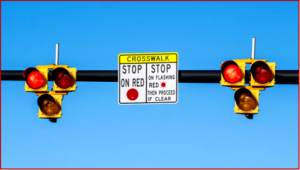
PHBs consist of two red lights arranged horizontally above a single yellow one. When a pedestrian presses the button, the yellow light flashes and then remains lit for a short interval before both red lights come on for the drivers and a walk signal is displayed to the waiting pedestrian. Driving through the signal at that point is equal to running a standard stoplight. After another interval, the red lights begin flashing, signaling to drivers that they can proceed through the crosswalk if there are no pedestrians still in the roadway.
Previous research has shown that both devices reduce pedestrian crashes. However, few studies have examined how real-world pedestrians use them. Instead, most focus on how effective they are at getting drivers to yield when activated.
The new IIHS study investigated yield rates and activation rates for the two types of beacons through video observations of more than 3000 pedestrians crossing at various locations in North Carolina. Researchers also conducted a survey of 343 pedestrians who were observed crossing.
In general, regardless of the type of pedestrian signal used, activation rates increased and yielding rates decreased with higher speed limits and when traffic was heavy.
At locations where PHBs were deployed, drivers were more than twice as likely to yield to pedestrians when the lights were red as when the device was not activated, the researchers found. However, fewer than two-thirds of the people crossing at these locations chose to activate the signal.
At locations with RRFBs, drivers were about 80% more likely to yield when the lights were flashing than when they weren’t activated, but 4 out of 5 pedestrians chose to press the button.
Waiting times were also 52% shorter for pedestrians seeking to cross at activated RRFBs than for those crossing at activated PHBs. Delays were likely longer for the PHBs because they cycle through two yellow warning periods before changing to red and giving the walk signal. RRFBs begin flashing immediately and allow pedestrians to cross as soon as they feel it is safe.
The most common reasons that survey respondents gave for activating either type of signal were that traffic was heavy or fast-moving or that the road was wide. The observational study also showed that activation rates increased substantially under those conditions.
“It makes sense that pedestrians don’t want to wait if they think they can get across the road safely,” said Raul Avelar, IIHS senior research transportation engineer and lead author of the study. “That means pedestrian hybrid beacons, which drivers are more likely to treat like a red light at a regular traffic signal, may be more effective at the hairiest crossings, where pedestrians are more likely to use them. RRFBs should be installed at less challenging crossings, such as two-lane roads, where traffic is relatively light, or where speed limits are lower.”

About Ken Zino
Ken Zino, editor and publisher of AutoInformed, is a versatile auto industry participant with global experience spanning decades in print and broadcast journalism, as well as social media. He has automobile testing, marketing, public relations and communications experience. He is past president of The International Motor Press Assn, the Detroit Press Club, founding member and first President of the Automotive Press Assn. He is a member of APA, IMPA and the Midwest Automotive Press Assn.
He also brings an historical perspective while citing their contemporary relevance of the work of legendary auto writers such as Ken Purdy, Jim Dunne or Jerry Flint, or writers such as Red Smith, Mark Twain, Thomas Jefferson – all to bring perspective to a chaotic automotive universe.
Above all, decades after he first drove a car, Zino still revels in the sound of the exhaust as the throttle is blipped during a downshift and the driver’s rush that occurs when the entry, apex and exit points of a turn are smoothly and swiftly crossed. It’s the beginning of a perfect lap.
AutoInformed has an editorial philosophy that loves transportation machines of all kinds while promoting critical thinking about the future use of cars and trucks.
Zino builds AutoInformed from his background in automotive journalism starting at Hearst Publishing in New York City on Motor and MotorTech Magazines and car testing where he reviewed hundreds of vehicles in his decade-long stint as the Detroit Bureau Chief of Road & Track magazine. Zino has also worked in Europe, and Asia – now the largest automotive market in the world with China at its center.







Hybrid Crossing Beacons Often Ignored by Pedestrians
Click for more.
Traffic signals known as pedestrian hybrid beacons (PHBs) allow walkers who need to cross a busy road to evoke a stoplight by pressing a button. However, while the devices are great at getting drivers to yield, many pedestrians don’t bother to activate them before crossing, a new study from the Insurance Institute for Highway Safety shows. Pedestrians are more likely to activate rectangular rapid flashing beacons (RRFBs), even though they’re less effective at getting drivers to stop.
“It’s well-documented that both of these common pedestrian warning signals make drivers more likely to yield and allow walkers to cross the street safely,” said IIHS President David Harkey. “But they can only do that if pedestrians push the button to activate them. This study offers valuable lessons for how we can make that more likely.”
A significant difference between the devices is that an RRFB instructs drivers to yield as soon as a pedestrian presses the button, while a PHB cycles through two yellow warning phases before it signals drivers to stop. Pedestrians appear more willing to activate slower-acting PHBs when the road is wide, traffic is heavy, or the vehicles are zooming past at higher speeds, IIHS researchers found.
RRFBs are yellow LEDs mounted to pedestrian or bicycle crossing signs that flash intermittently when activated by a person attempting to cross. They begin flashing immediately, and the pedestrian can cross as soon as they feel it is safe to do so.
PHBs consist of two red lights arranged horizontally above a single yellow one. When a pedestrian presses the button, the yellow light flashes and then remains lit for a short interval before both red lights come on for the drivers and a walk signal is displayed to the waiting pedestrian. Driving through the signal at that point is equal to running a standard stoplight. After another interval, the red lights begin flashing, signaling to drivers that they can proceed through the crosswalk if there are no pedestrians still in the roadway.
Previous research has shown that both devices reduce pedestrian crashes. However, few studies have examined how real-world pedestrians use them. Instead, most focus on how effective they are at getting drivers to yield when activated.
The new IIHS study investigated yield rates and activation rates for the two types of beacons through video observations of more than 3000 pedestrians crossing at various locations in North Carolina. Researchers also conducted a survey of 343 pedestrians who were observed crossing.
In general, regardless of the type of pedestrian signal used, activation rates increased and yielding rates decreased with higher speed limits and when traffic was heavy.
At locations where PHBs were deployed, drivers were more than twice as likely to yield to pedestrians when the lights were red as when the device was not activated, the researchers found. However, fewer than two-thirds of the people crossing at these locations chose to activate the signal.
At locations with RRFBs, drivers were about 80% more likely to yield when the lights were flashing than when they weren’t activated, but 4 out of 5 pedestrians chose to press the button.
Waiting times were also 52% shorter for pedestrians seeking to cross at activated RRFBs than for those crossing at activated PHBs. Delays were likely longer for the PHBs because they cycle through two yellow warning periods before changing to red and giving the walk signal. RRFBs begin flashing immediately and allow pedestrians to cross as soon as they feel it is safe.
The most common reasons that survey respondents gave for activating either type of signal were that traffic was heavy or fast-moving or that the road was wide. The observational study also showed that activation rates increased substantially under those conditions.
“It makes sense that pedestrians don’t want to wait if they think they can get across the road safely,” said Raul Avelar, IIHS senior research transportation engineer and lead author of the study. “That means pedestrian hybrid beacons, which drivers are more likely to treat like a red light at a regular traffic signal, may be more effective at the hairiest crossings, where pedestrians are more likely to use them. RRFBs should be installed at less challenging crossings, such as two-lane roads, where traffic is relatively light, or where speed limits are lower.”
About Ken Zino
Ken Zino, editor and publisher of AutoInformed, is a versatile auto industry participant with global experience spanning decades in print and broadcast journalism, as well as social media. He has automobile testing, marketing, public relations and communications experience. He is past president of The International Motor Press Assn, the Detroit Press Club, founding member and first President of the Automotive Press Assn. He is a member of APA, IMPA and the Midwest Automotive Press Assn. He also brings an historical perspective while citing their contemporary relevance of the work of legendary auto writers such as Ken Purdy, Jim Dunne or Jerry Flint, or writers such as Red Smith, Mark Twain, Thomas Jefferson – all to bring perspective to a chaotic automotive universe. Above all, decades after he first drove a car, Zino still revels in the sound of the exhaust as the throttle is blipped during a downshift and the driver’s rush that occurs when the entry, apex and exit points of a turn are smoothly and swiftly crossed. It’s the beginning of a perfect lap. AutoInformed has an editorial philosophy that loves transportation machines of all kinds while promoting critical thinking about the future use of cars and trucks. Zino builds AutoInformed from his background in automotive journalism starting at Hearst Publishing in New York City on Motor and MotorTech Magazines and car testing where he reviewed hundreds of vehicles in his decade-long stint as the Detroit Bureau Chief of Road & Track magazine. Zino has also worked in Europe, and Asia – now the largest automotive market in the world with China at its center.