Click for more information.
The Insurance Institute for Highway Safety said today that it is changing its scoring criteria for its updated moderate overlap front crash test. IIHS claims that this will improve the test by accounting for variations in the position of the rear shoulder belt. (AutoInformed.com on: Automakers Slow to Make Vehicles Safer?)*
“Most of these changes are part of a planned transition that we informed automakers we’d be making before we launched the updated test a year ago,” said Jessica Jermakian, IIHS vice president of vehicle research. “The new scoring eliminates an artificial benefit our initial ratings awarded for a high shoulder-belt position. Pressing ahead with a simpler program while we validated the new metric allowed us to start incentivizing vehicle improvements a year earlier,” Jermakian claimed.
The new so-called “chest index” measurement factors both the position of the shoulder belt on the rear dummy’s chest and chest compression. The safety belt position itself is also evaluated as part of the analysis of how well the restraints control the motion of the dummy during the crash. In addition, the range of shoulder belt positions considered acceptable has been expanded slightly.
Previously published ratings in the updated moderate overlap test that was launched in 2022, have now been adjusted on the Institute’s website. The ratings of five vehicles improve, and eight receive downgrades.
IIHS updated the moderate overlap front test in 2022 after research showed that in newer vehicles the risk of a fatal injury is now higher for belted occupants in the second row than for those in front. “This is not because the second row has become less safe. Rather, the front seat has become safer because of improved airbags and advanced seat belts that are rarely available in the back. Even with these developments, the back seat remains the safest place for children, who can be injured by an inflating front airbag, and the rating does not apply to children secured properly in child safety seats,” IIHS said.
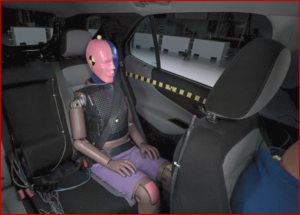
In the updated test, a dummy the size of a small woman or 12-year-old child is positioned in the second row behind the driver dummy. For a vehicle to earn a good rating, there can’t be an excessive risk of injury to the chest, among other body regions, as recorded by the second-row dummy.
The changes were made because for the initial year of testing, IIHS engineers estimated the risk of chest injuries with a device that records the seat belt tension and the dummy’s own chest deflection sensor, which measures how much the rib cage is compressed by the force of the crash.
To avoid delaying the launch of the program, IIHS employees simply used a pressure mat to track the position of the shoulder belt and penalized vehicles when it exceeded a maximum height. Vehicles with shoulder belts higher than the cutoff could receive no better than a marginal rating for chest injury risk, regardless how little chest deflection the dummy’s internal sensor recorded.
The new “chest index” considers both chest deflection and belt position, using a formula that the Institute says it has been validating for the past year to adjust the deflection metric based on distance of the shoulder belt from the internal sensor.
However, the pressure mat is still used to determine the maximum shoulder belt position during the crash. Engineers now evaluate maximum belt position separately as part of their assessment of how well the restraints control the motion of the dummy during the test, which reduces the influence of shoulder belt height on the overall rating. In addition, the cutoff for a belt that is too high has been raised by 10 millimeters in recognition of the need for shoulder belts to accommodate occupants of various sizes. These changes were not part of the original phase-in plan.
“The belt tension metric, which makes it very difficult for a vehicle without technology like pretensioners and belt force limiters to earn a good rating, remains unchanged,” IIHS said.
*AutoInformed on

About Ken Zino
Ken Zino, editor and publisher of AutoInformed, is a versatile auto industry participant with global experience spanning decades in print and broadcast journalism, as well as social media. He has automobile testing, marketing, public relations and communications experience. He is past president of The International Motor Press Assn, the Detroit Press Club, founding member and first President of the Automotive Press Assn. He is a member of APA, IMPA and the Midwest Automotive Press Assn.
He also brings an historical perspective while citing their contemporary relevance of the work of legendary auto writers such as Ken Purdy, Jim Dunne or Jerry Flint, or writers such as Red Smith, Mark Twain, Thomas Jefferson – all to bring perspective to a chaotic automotive universe.
Above all, decades after he first drove a car, Zino still revels in the sound of the exhaust as the throttle is blipped during a downshift and the driver’s rush that occurs when the entry, apex and exit points of a turn are smoothly and swiftly crossed. It’s the beginning of a perfect lap.
AutoInformed has an editorial philosophy that loves transportation machines of all kinds while promoting critical thinking about the future use of cars and trucks.
Zino builds AutoInformed from his background in automotive journalism starting at Hearst Publishing in New York City on Motor and MotorTech Magazines and car testing where he reviewed hundreds of vehicles in his decade-long stint as the Detroit Bureau Chief of Road & Track magazine. Zino has also worked in Europe, and Asia – now the largest automotive market in the world with China at its center.








IIHS Changes Rear Occupant Scoring on Overlap Crashes
Click for more information.
The Insurance Institute for Highway Safety said today that it is changing its scoring criteria for its updated moderate overlap front crash test. IIHS claims that this will improve the test by accounting for variations in the position of the rear shoulder belt. (AutoInformed.com on: Automakers Slow to Make Vehicles Safer?)*
“Most of these changes are part of a planned transition that we informed automakers we’d be making before we launched the updated test a year ago,” said Jessica Jermakian, IIHS vice president of vehicle research. “The new scoring eliminates an artificial benefit our initial ratings awarded for a high shoulder-belt position. Pressing ahead with a simpler program while we validated the new metric allowed us to start incentivizing vehicle improvements a year earlier,” Jermakian claimed.
The new so-called “chest index” measurement factors both the position of the shoulder belt on the rear dummy’s chest and chest compression. The safety belt position itself is also evaluated as part of the analysis of how well the restraints control the motion of the dummy during the crash. In addition, the range of shoulder belt positions considered acceptable has been expanded slightly.
Previously published ratings in the updated moderate overlap test that was launched in 2022, have now been adjusted on the Institute’s website. The ratings of five vehicles improve, and eight receive downgrades.
IIHS updated the moderate overlap front test in 2022 after research showed that in newer vehicles the risk of a fatal injury is now higher for belted occupants in the second row than for those in front. “This is not because the second row has become less safe. Rather, the front seat has become safer because of improved airbags and advanced seat belts that are rarely available in the back. Even with these developments, the back seat remains the safest place for children, who can be injured by an inflating front airbag, and the rating does not apply to children secured properly in child safety seats,” IIHS said.
In the updated test, a dummy the size of a small woman or 12-year-old child is positioned in the second row behind the driver dummy. For a vehicle to earn a good rating, there can’t be an excessive risk of injury to the chest, among other body regions, as recorded by the second-row dummy.
The changes were made because for the initial year of testing, IIHS engineers estimated the risk of chest injuries with a device that records the seat belt tension and the dummy’s own chest deflection sensor, which measures how much the rib cage is compressed by the force of the crash.
To avoid delaying the launch of the program, IIHS employees simply used a pressure mat to track the position of the shoulder belt and penalized vehicles when it exceeded a maximum height. Vehicles with shoulder belts higher than the cutoff could receive no better than a marginal rating for chest injury risk, regardless how little chest deflection the dummy’s internal sensor recorded.
The new “chest index” considers both chest deflection and belt position, using a formula that the Institute says it has been validating for the past year to adjust the deflection metric based on distance of the shoulder belt from the internal sensor.
However, the pressure mat is still used to determine the maximum shoulder belt position during the crash. Engineers now evaluate maximum belt position separately as part of their assessment of how well the restraints control the motion of the dummy during the test, which reduces the influence of shoulder belt height on the overall rating. In addition, the cutoff for a belt that is too high has been raised by 10 millimeters in recognition of the need for shoulder belts to accommodate occupants of various sizes. These changes were not part of the original phase-in plan.
“The belt tension metric, which makes it very difficult for a vehicle without technology like pretensioners and belt force limiters to earn a good rating, remains unchanged,” IIHS said.
*AutoInformed on
About Ken Zino
Ken Zino, editor and publisher of AutoInformed, is a versatile auto industry participant with global experience spanning decades in print and broadcast journalism, as well as social media. He has automobile testing, marketing, public relations and communications experience. He is past president of The International Motor Press Assn, the Detroit Press Club, founding member and first President of the Automotive Press Assn. He is a member of APA, IMPA and the Midwest Automotive Press Assn. He also brings an historical perspective while citing their contemporary relevance of the work of legendary auto writers such as Ken Purdy, Jim Dunne or Jerry Flint, or writers such as Red Smith, Mark Twain, Thomas Jefferson – all to bring perspective to a chaotic automotive universe. Above all, decades after he first drove a car, Zino still revels in the sound of the exhaust as the throttle is blipped during a downshift and the driver’s rush that occurs when the entry, apex and exit points of a turn are smoothly and swiftly crossed. It’s the beginning of a perfect lap. AutoInformed has an editorial philosophy that loves transportation machines of all kinds while promoting critical thinking about the future use of cars and trucks. Zino builds AutoInformed from his background in automotive journalism starting at Hearst Publishing in New York City on Motor and MotorTech Magazines and car testing where he reviewed hundreds of vehicles in his decade-long stint as the Detroit Bureau Chief of Road & Track magazine. Zino has also worked in Europe, and Asia – now the largest automotive market in the world with China at its center.