A Silicon Valley startup is claiming a new electric vehicle battery – LytCell EV lithium-sulfur (Li-S) battery is designed to deliver three times the gravimetric energy density of conventional lithium-ion (Li-ion) batteries (claimed potentially at 900 Wh/kg). Moreover it also claims to outperform solid state batteries.
Whether this is a genuine breakthrough or just another silly-CON (Do you know the ways of San Jose? Privately held until the IPO?) remains to be validated by vehicle use on the road and ultimately adoption by major automakers. Lyten expects full production and market availability for ‘25-‘26 model year vehicles.
Lyten’s Battery Claims:
- Will be safer in vehicles than conventional Li-ion batteries because Li-S does not contain oxygen from metallic oxides, which is what drives thermal runaway events (pr obfuscation for fires) that have afflicted many EVs.
- It is better for the environment with the lowest carbon footprint of any EV battery.
- They can be produced in cylindrical, pouch, and prismatic formats.
- It delivers better temperature performance and faster charging.
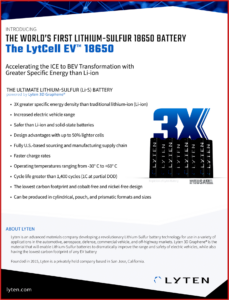
Click to Enlaaaaarge…
Lyten Sulfur Caging is the technology used in LytCell batteries to achieve the performance potential of sulfur by arresting the so-called ‘poly-sulfide shuttle,’ a cycle-life compromising factor that so far prevented practical Li-S use in battery electric vehicles. Under Department of Defense (DoD) test protocols, a LytCell prototype design has demonstrated greater than 1,400 cycles, it’s claimed.
“We’re confident that Lyten’s breakthrough battery platform will accelerate the mass consumer adoption of electric vehicle ownership due to the performance, range, and safety improvements of our LytCell EV batteries,” claimed Dan Cook, CEO and a Co-Founder of Lyten.
Additional Claimed Benefits
The Lyten battery platform will offer other advantages to automakers and their end users it’s claimed:
- Below internal combustion engine (ICE) cost parity
- Safe and effective operation in environments as cold as -30 degrees Celsius to as high as 60 degrees Celsius enabling reduced system-level costs
- Flexible and scalable pack sizing, enabling Lyten to accommodate the unique needs of a wide range of automotive platforms
- Can be produced in cylindrical, pouch, and prismatic formats
- On-shore cell manufacturing facilities proximate to OEM’s
- Extended range and/or increased payloads
- Faster charge times of less than 20 minutes
- Better for the environment with the lowest carbon footprint of any EV battery
- No conflict minerals
About Lyten
Lyten is an advanced materials company developing a revolutionary lithium-sulfur battery technology for use in a variety of applications in automotive, aerospace, defense, and many other markets. Lyten 3D Graphene® is the advanced material that enables lithium-sulfur batteries to improve the range and safety of electric vehicles, while also achieving a lower carbon footprint than other EV batteries. Lyten holds more than 260 issued or pending patents on covering technologies. Founded in 2015, the privately held company is based in San Jose, California.

About Ken Zino
Ken Zino, editor and publisher of AutoInformed, is a versatile auto industry participant with global experience spanning decades in print and broadcast journalism, as well as social media. He has automobile testing, marketing, public relations and communications experience. He is past president of The International Motor Press Assn, the Detroit Press Club, founding member and first President of the Automotive Press Assn. He is a member of APA, IMPA and the Midwest Automotive Press Assn.
He also brings an historical perspective while citing their contemporary relevance of the work of legendary auto writers such as Ken Purdy, Jim Dunne or Jerry Flint, or writers such as Red Smith, Mark Twain, Thomas Jefferson – all to bring perspective to a chaotic automotive universe.
Above all, decades after he first drove a car, Zino still revels in the sound of the exhaust as the throttle is blipped during a downshift and the driver’s rush that occurs when the entry, apex and exit points of a turn are smoothly and swiftly crossed. It’s the beginning of a perfect lap.
AutoInformed has an editorial philosophy that loves transportation machines of all kinds while promoting critical thinking about the future use of cars and trucks.
Zino builds AutoInformed from his background in automotive journalism starting at Hearst Publishing in New York City on Motor and MotorTech Magazines and car testing where he reviewed hundreds of vehicles in his decade-long stint as the Detroit Bureau Chief of Road & Track magazine. Zino has also worked in Europe, and Asia – now the largest automotive market in the world with China at its center.








Lithium-Sulfur – Better than Lithium-Ion Battery?
A Silicon Valley startup is claiming a new electric vehicle battery – LytCell EV lithium-sulfur (Li-S) battery is designed to deliver three times the gravimetric energy density of conventional lithium-ion (Li-ion) batteries (claimed potentially at 900 Wh/kg). Moreover it also claims to outperform solid state batteries.
Whether this is a genuine breakthrough or just another silly-CON (Do you know the ways of San Jose? Privately held until the IPO?) remains to be validated by vehicle use on the road and ultimately adoption by major automakers. Lyten expects full production and market availability for ‘25-‘26 model year vehicles.
Lyten’s Battery Claims:
Click to Enlaaaaarge…
Lyten Sulfur Caging is the technology used in LytCell batteries to achieve the performance potential of sulfur by arresting the so-called ‘poly-sulfide shuttle,’ a cycle-life compromising factor that so far prevented practical Li-S use in battery electric vehicles. Under Department of Defense (DoD) test protocols, a LytCell prototype design has demonstrated greater than 1,400 cycles, it’s claimed.
“We’re confident that Lyten’s breakthrough battery platform will accelerate the mass consumer adoption of electric vehicle ownership due to the performance, range, and safety improvements of our LytCell EV batteries,” claimed Dan Cook, CEO and a Co-Founder of Lyten.
Additional Claimed Benefits
The Lyten battery platform will offer other advantages to automakers and their end users it’s claimed:
About Lyten
Lyten is an advanced materials company developing a revolutionary lithium-sulfur battery technology for use in a variety of applications in automotive, aerospace, defense, and many other markets. Lyten 3D Graphene® is the advanced material that enables lithium-sulfur batteries to improve the range and safety of electric vehicles, while also achieving a lower carbon footprint than other EV batteries. Lyten holds more than 260 issued or pending patents on covering technologies. Founded in 2015, the privately held company is based in San Jose, California.
About Ken Zino
Ken Zino, editor and publisher of AutoInformed, is a versatile auto industry participant with global experience spanning decades in print and broadcast journalism, as well as social media. He has automobile testing, marketing, public relations and communications experience. He is past president of The International Motor Press Assn, the Detroit Press Club, founding member and first President of the Automotive Press Assn. He is a member of APA, IMPA and the Midwest Automotive Press Assn. He also brings an historical perspective while citing their contemporary relevance of the work of legendary auto writers such as Ken Purdy, Jim Dunne or Jerry Flint, or writers such as Red Smith, Mark Twain, Thomas Jefferson – all to bring perspective to a chaotic automotive universe. Above all, decades after he first drove a car, Zino still revels in the sound of the exhaust as the throttle is blipped during a downshift and the driver’s rush that occurs when the entry, apex and exit points of a turn are smoothly and swiftly crossed. It’s the beginning of a perfect lap. AutoInformed has an editorial philosophy that loves transportation machines of all kinds while promoting critical thinking about the future use of cars and trucks. Zino builds AutoInformed from his background in automotive journalism starting at Hearst Publishing in New York City on Motor and MotorTech Magazines and car testing where he reviewed hundreds of vehicles in his decade-long stint as the Detroit Bureau Chief of Road & Track magazine. Zino has also worked in Europe, and Asia – now the largest automotive market in the world with China at its center.